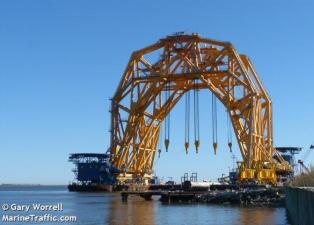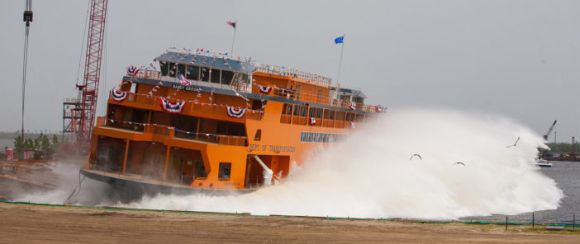
On Friday, June 26, 2020, Eastern Shipbuilding Group launched the Sandy Ground, the second of three new 4,500-passenger ferries for New York City’s Staten Island Ferry system. The Ollis Class ferries will be double-ended, with an overall length of 320 feet, beam of 70 feet, and draft of 13 feet at the design load at the waterline. The launch took place at Eastern’s Allanton facility in Panama City, Fla.
Two groups of fishermen had recent close encounters with humpback whales off the Jersey Shore.
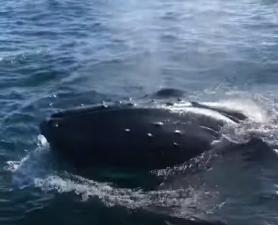
In early June, two men fishing in a 25′ boat not far offshore near Seaside Park, NJ were thrown from their boat when it was capsized by a humpback whale. The juvenile humpback was apparently feeding on the same school of fish that the fishermen were trying to haul in.
“He was six feet in front of me, kind of like if you’ve ever saw ‘Jaws,’” angler Robert Riley told ABC 7 of the harrowing moment a whale sprang from the sea on Monday. “The fish just breached the water and I was like, ‘It’s going to land on us.'”
In May, we posted about the virtual return New York’s South Street Seaport Museum‘s monthly Chantey Sing. It was great fun. The next Seaport Chantey sing is scheduled for this Sunday, July 5th. From the Seaport press release:
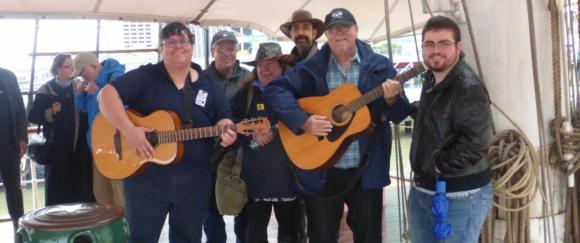
South Street Seaport Museum’s monthly sea-music Sea Chanteys and Maritime Music continues – virtually. From our living rooms and kitchens, and even from the deck of Wavertree, join our round-robin of shared songs, featuring members of the New York Packet and friends. Listen in, lead or request a song, and belt out the choruses for your neighbors to hear during a Virtual Chantey Sing on Sunday, July 5, 2020 from 2-4pm. The event is FREE. Sign up here to receive the Zoom link 24 hours prior: http://events.constantcontact.com/register/event?llr=4pcqx8iab&oeidk=a07eh55kqffdc22ec73.
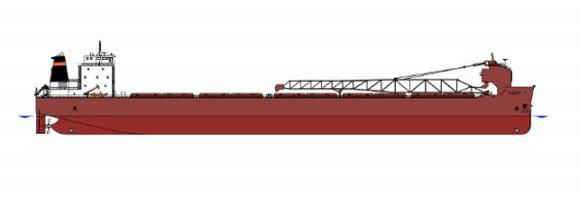
On June 23, the keel was laid for the Interlake Steamship‘s new Great Lakes bulk carrier at Fincantieri Bay Shipbuilding in Sturgeon Bay, WI. The 639 ft-long, 28,000-tonne Lake-Class self-unloading bulker is the first US flag self-propelled bulk carrier to be built in the Great Lakes in 35 years.
The ship’s name was revealed by Interlake chairman James R Barker who named it Mark W Barker, after his son. Barker said: “This ship is more than the steel assembled here by Fincantieri Bay Shipbuilding.
“This ship represents Interlake’s determination to be an active and responsible participant in all aspects of Great Lakes trade.
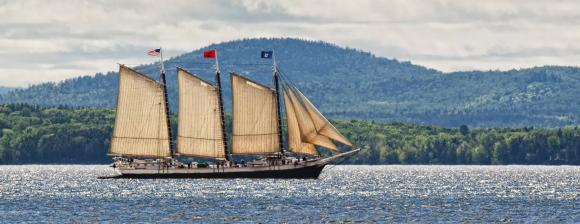
We recently posted about a delay in the start of the Maine windjammer schooner passenger season due to the pandemic and concerns that it may not start at all. The good news is that the State of Maine, working with the Maine Windjammer Association and others, has agreed on a set of rules and guidelines to allow overnight windjammer cruises to start in July.
Cruise Critic reports that Maine has been one of the most cautious states in allowing non-residents to enter for tourism. The regulations surrounding windjammer cruising reflect that. All out-of-state visitors must have a negative COVID-19 test result within 72 hours of travel. While the state exempts fellow New England states Vermont and New Hampshire, the MWA said some captains might require all passengers to prove they tested negative for COVID-19, regardless of the state.
Whale watchers off San Diego were shocked to see what appeared to be a beluga whale in southern Californian waters. Video shot from a drone confirmed the sighting. Belugas typically live in the waters of the Arctic and sub-Arctic. This is believed to be the first beluga sighted so far south in the Pacific.
Experts from Alaska said it appears to them that the whale did not escape from captivity, but instead is what they call an “explorer” who wandered off from a pod in the wild. The good news is that there is a lot of food for it in our water so, if it’s healthy, it definitely has a chance to survive, according to reporting by CBS8.
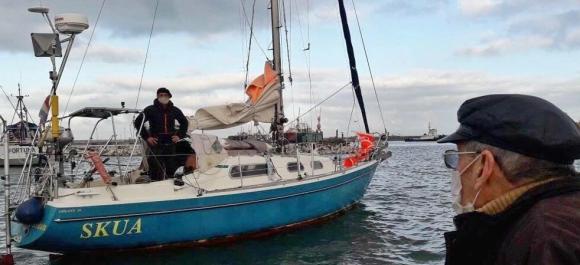
At the end of May, we posted about the unplanned 10,000-mile voyage of the bark Europa, made necessary when the pandemic shut down transportation options for its crew. Argentine sailor, Juan Manuel Ballestero, 47, faced a similar challenge and found a similar solution. Ballestero was on the Portuguese island of Porto Santo and wanted to return to Argentina to be with his 90-year-old father and 82-year old mother. However, in mid-March, Argentina canceled all international passenger flights to shield the country from the new coronavirus. There was no way to fly home.
Rather than being trapped by the lockdown, Ballestero set off on March 24, to sail back to Argentina, singlehanded on his Ohlson 29 sailboat named Skua, It was an eventful voyage that would ultimately take 85 days.
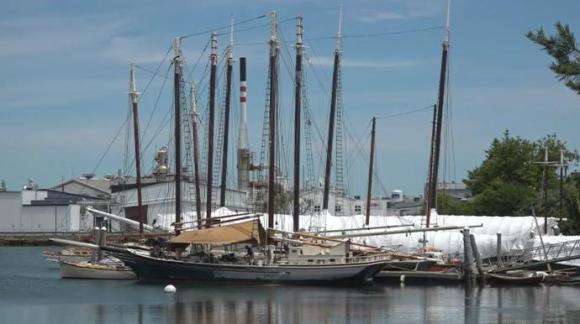
For decades, schooners referred to as “windjammers” have sailed up and down the Maine coast carrying vacationers from May to October. This year, however, the pandemic has delayed the season and there are concerns that it may not start at all.
Already Boothbay’s 58th Annual Windjammer Days, scheduled for this week have been canceled. Likewise, the Maine Windjammer Association has canceled its 44th Annual Great Schooner Race, scheduled for July 2 and the Parade of Sail scheduled for July 10 in Roclkand.
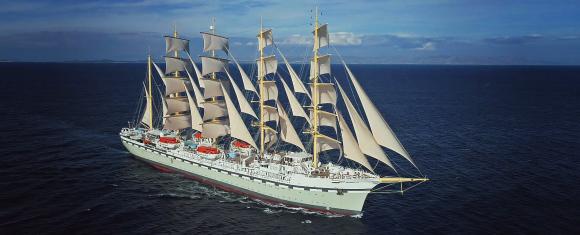
While this may not appear to be the best time to start a new cruise venture, if all goes well, in the Spring of 2021, Tradewind Voyages will offer voyages on the Golden Horizon, a 272 passenger five-masted barque. Setting 68,000 square feet of sail, or over twice the sail area of the clipper ship Cutty Sark, she is the largest square-rigged sailing ship in the world. The design of the ship was inspired by the France II, built in 1913.
Some of this may sound familiar. For the last five years, we have been following the construction of the Flying Clipper for Star Clipper Lines. Last year we posted about a contract dispute between Star Clipper and the Croatian shipyard Brodosplit. Unable to come to terms, the shipyard took over the ship. Reportedly, Brodosplit still owns the square-rigger which is, or will be, chartered to the UK based Tradewind.
The 958-foot long, US flag container ship, Maersk Idaho is anchored off the coast of Virginia after several crew members tested positive for COVID-19. Maersk is working on a plan to evacuate the ship, bring the crew to a quarantine facility, clean the ship and then bring a new crew on board, said Patrick McCaffery, Maersk Line’s general counsel, as reported by the Virginia Pilot.
The ship had transited the Atlantic from Bremerhaven Germany to Newark, NJ. One crew member had become ill with symptoms of pneumonia after the ship arrived in the Port of Newark. He was taken to a hospital where he tested positive for COVID-19. By the time Maersk was notified of the positive case, the Idaho was en route to Norfolk where, according to the Port of Virginia’s vessel schedule, it was scheduled to load and unload cargo at Virginia International Gateway this weekend.
In subsequent testing on Sunday, nine more crew tested positive for the virus. All had been asymptomatic.
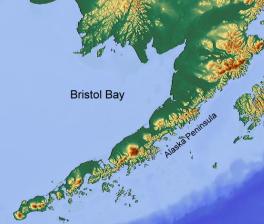
Every year, the Alaskan fishing industry attracts tens of thousands of migrant workers. In remote Bristol Bay, Alaska, between 10,000 and 15,000 fishermen come to work on the salmon boats plying the Bering Sea, while another 6,000 workers or so arrive to process the salmon brought ashore. Salmon fishing brings in $700 million each year to this remote, sparsely populated area. But, as reported by the Counter, with only 15 hospital beds and limited medical resources, local tribal leaders are wondering: Are the risks worth it?
As of June 23rd, Alaska Public Media reports that 12 seafood workers in Dillingham, a Bristol Bay hub town, have tested positive for COVID-19 while under quarantine, sparking anxiety in the small community. The Bristol Bay region didn’t have a single Covid-19 case until May 16. The salmon fishing season starts at the beginning of June.
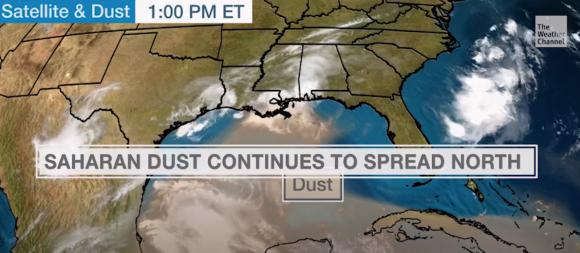
A huge cloud of desert dust has blown off the Sahara and is bound across the Atlantic Ocean heading toward the United States. While dust plumes are not uncommon, this plume is exceptionally large and dense with the highest concentration of dust particles observed in 50 to 60 years.
The plume has already turned blue Caribbean skies a hazy brownish gray and is expected to arrive on the US Gulf Coast later this week after traveling 5,000 miles from Africa.
The plume could have a range of impacts on local weather in the South-East. Sunsets and sunrises may look brighter and more vibrant, with orange and red hues showing up more clearly as the dust scatters the sun’s rays.
The dust should also bring drier air which has the benefit that tropical storms and hurricanes in this already busy hurricane season may be temporarily less active while the plume is around.
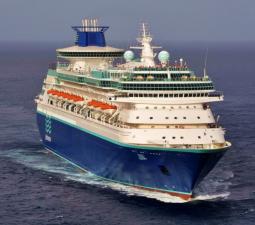
Pullmantur Cruceros, a joint venture between Royal Caribbean and Cruises Investment Holding, has filed for reorganization under Spanish insolvency laws. Cruises Investment Holding owns 51 percent of the three-ship Spanish cruise line, while Royal Caribbean owns the remaining 49 percent.
Pullmantur’s board of directors issued a statement that reads in part, “Despite the great progress the company made to achieve a turnaround in 2019, … the headwinds caused by the pandemic are too strong for Pullmantur to overcome without a reorganization.”
While the bankruptcy filing impacts only a small cruise operation, it does raise the question — what impact will the pandemic headwinds have on the cruise industry as a whole?
In mid-March, the Cruise Lines International Association (CLIA) announced that the major cruise lines were shutting down operations from all US ports for at least 30 days in response to the coronavirus pandemic. A month later, the Center for Disease Control (CDC) extended its “No Sail Order” fro up to 100 days. Nevertheless, by mid-May, the major cruise lines were planning restarting operations in July and August.
Now, reality has set in, once again and the CLIA announced last Friday that the major cruise lines will not attempt starting operations from the US until September 15th.
Whether the latest date is any more likely than the previous targets remains to be seen. Recently, a White House advisor raised concerns about a second wave of the novel coronavirus pandemic this fall, as 29 states and U.S. territories logged an increase in their seven-day average of newly reported cases after many lifted restrictions in recent weeks.
Fifty years ago this November, the residents of Florence, Oregon learned how not to dispose of a dead whale. Now, a half-century later they have named a park after that lesson. The residents have recently chosen to name a local recreational area “Exploding Whale Memorial Park.”
On November 9, 1970, a 45-foot long, 8-ton whale, described variously as a gray or sperm whale, washed ashore at Florence on the central Oregon Coast. At the time, Oregon beaches were under the jurisdiction of the state’s Highway Division, which, after consulting with the United States Navy, decided to remove the whale using dynamite – assuming that the resulting pieces would be small enough for scavenger animals to consume.
It turned out to be a really, really bad idea. Continue reading