
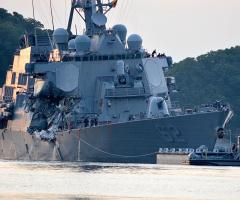
USS Fitzgerald after collision
On June 17, 2017, the Arleigh Burke-class destroyer, USS Fitzgerald, collided with the container ship ACX Crystal near Toyko Bay off the coast of Japan. Seven US sailors died in the collision and at least three more were injured, including the destroyer’s commanding officer.
Now, almost three years to the day after the collision, the USS Fitzgerald has finally returned to service, sailing from Ingalls Shipbuilding bound for her homeport of San Diego. The ship was transported by heavy-lift ship to the Mississippi shipyard almost a year after the collision, where it underwent two years of repairs and upgrading, impacting every aspect of the ship, including hull structure, machinery, electrical, combat systems, comms, intelligence and command, and control systems.
A US Navy investigation of the collision determined that Fitzgerald’s watch teams “disregarded established norms of basic contact management and, more importantly, leadership failed to adhere to well-established protocols in place to prevent collisions,” concluding that the accident was avoidable.
 The bad news is that the annual summer “hypoxic” or “dead zone” in the Gulf of Mexico this year may be
 As protests over the death of George Floyd and against racism and police brutality continue across the nation and parts of the globe, the leadership of U.S. Naval Forces Europe and Africa/U.S. Sixth Fleet has issued a letter titled “
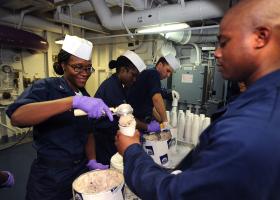 General Order 99
 On June 1, 1813, two hundred and seven years ago today, the British frigate