
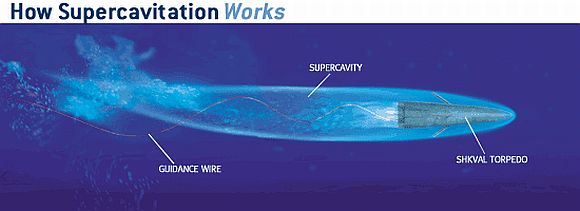
 The headline in the South China Morning Post was, at the very least, eye catching — Shanghai to San Francisco in 100 minutes by Chinese supersonic submarine. The article makes it clear that while the Chinese may be researching such a submarine, they are no where close to actually building one. So how does one, even theoretically, build a “supersonic submarine?” The answer may be by using supercavitation. How close are the Chinese to actually designing and building one — not very.
Cavitation is the creation of water vapor bubbles in areas of low pressure on a hull or propeller underwater. In most cases cavitation is something to avoid, if possible. Cavitation bubbles forming and collapsing on a ship’s propeller can damage the blades. The formation and collapse of the bubbles is also noisy, so submarine designers try to design to avoid cavitation in order that submarines be a stealthy as possible. Cavitation also reduces the lift on hydrofoils.
Supercavitation is very different, however. Continue reading
 Starting today and running through October 3rd, the 1933 lighthouse tender
  A team of US Navy divers recovered five crates of live munitions from the bottom of
  We have been following the 1995 built replica of the topsail schooner HMS Pickle for some time. In 2008,
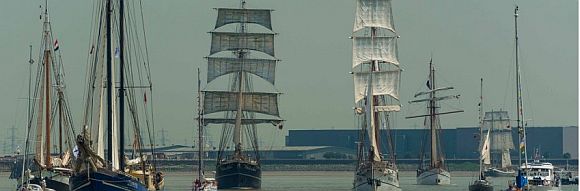 Another great event that I wish I was attending. Starting tomorrow September 5th and lasting through the 9th, the
  Tuvalu
 Yesterday, we posted about
 I recently learned about

 The 22nd annual running of the