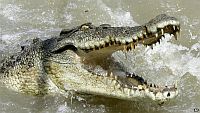
A 57 year old fisherman, wading in the Adelaide River, south of Darwin, was attacked and killed by a 15 foot long (4.5 metre) crocodile. The fisherman was attempting to unsnag his line when attacked. As reported by the BBC: The attack took place in a stretch of the river close to where cruise ships show sightseers crocodiles leaping from the water to snatch chicken carcasses suspended from poles. The killer crocodile is believed to be a rare half-albino who had regularly approached the cruise ships. This is the fourth person to be killed by a crocodile in Australia’s Northern Territory this year. In the recent past, deaths from crocodile attack have averaged about one a year. The crocodile population has increased since being declared a protected species in 1971.
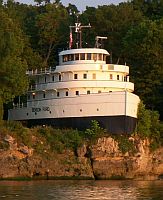
Benson Ford
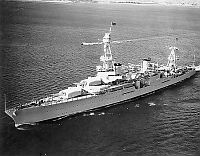
Great Lakes freighters are known for their longevity. Compared to their salt water sisters, lakes boats, as they are called, rust slowly and tend to be around for a long time. Here are two lakes freighters, Benson Ford and John W. Boardman, which may be around even longer than usual. Their hull and engine rooms have been scrapped but their forward deck houses have become lake houses.
Put-In Bay, Ohio is a village on South Bass Island in Lake Erie. It is probably best known for being the site of Oliver Hazard Perry’s War of 1812 victory over British Naval forces, known as the Battle of Lake Erie, and sometimes referred to as the Battle of Put-in-Bay. The bi-centennial of the battle was celebrated last year. Put-in_Bay is also known as the resting place for the forward deck-house of the Great Lakes freighter Benson Ford. The forward deck-house is now a lake house on a cliff high above Lake Erie.
A wonderful suitable video for a summer Sunday. From the video description — “Slow” marine animals show their secret life under high magnification. Corals and sponges are very mobile creatures, but their motion is only detectable at different time scales compared to ours and requires time lapses to be seen. These animals build coral reefs and play crucial roles in the biosphere, yet we know almost nothing about their daily lives.
Slow Life from Daniel Stoupin on Vimeo.

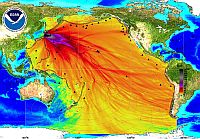
No, this is not radiation from Fukushima
In March of 2011, the Fukushima Daiichi nuclear power plant was hit by a tsunami triggered by the magnitude 9.0 Tōhoku earthquake. Three operating nuclear reactors suffered partial meltdowns and a fourth reactor which was not in service suffered hydrogen explosions which threaten the containment of highly radioactive spent fuel rods. Significant radiation was released into both the air and into the ocean. The Fukushima disaster is the largest nuclear incident since the Chernobyl disaster in April 1986 and the second (after Chernobyl) to measure Level 7 on the International Nuclear Event Scale. One ongoing problem is that Tokyo Electric Power Co (Tepco), the Japanese utility company that operates the plant, has been grossly incompetent, deceptive and guilty of downplaying the extent of the damage. Tepco initially denied that radioactive cooling water had leaked into the ocean and then belated admitted that many hundreds of tons had been leaking and continue to leak into Pacific.
While Tepco has been downplaying the problem, some in the United States have been spreading wild, bizarre wholly dishonest claims about the extent of the radiation from Fukushima. Continue reading
Just about 40 years ago, while a student studying naval architecture, I had a summer job working for a major oil company in New York City. One weekend, two friends and I took a train out to visit Mystic Seaport. Departing Manhattan and arriving in a 19th century seaport village was a revelation. I recall being very impressed by the Charles W. Morgan and the Joseph Conrad. The chandlery, the pharmacy and the rope walk were both interesting. Oddly, the one shop that I recall most distinctly was the cooperage — where the barrels were made. I had known at least something about whaling ships before I arrived yet I simply hadn’t given the work of the cooper any thought. Without the cooper’s staves, hoops and barrels, no whaler would have a profitable voyage. Here is an excellent video about the cooperage at the Mystic Seaport Museum.

Photo: Reuters
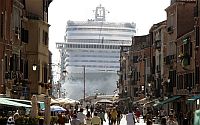
We posted in June 2012 about protests over the docking of large cruise ships in Venice, Italy. The arrival of the MSC Davina at 139,400 GT, almost 1,100 feet long, about 125 feet wide and carries up to 5,329 passengers and crew, kicked off a campaign to limit the size of cruise ships calling on the island city.
Critics of the cruise ships argued that the large ships damaged the ecology of the lagoon and the pollution and vibration might damage the city’s historic buildings. In 2013, Venice proposed banning liners of more than 96,000 tonnes from Saint Mark’s basin and the Giudecca Canal, but the decree was overturned by a regional tribunal. Now the Italian government has reinstated the ban which also limits the number of smaller cruise ships calling on the city. Italian news agency, ANSA, reports that 650 cruise ships currently pass through the city annually. Eight large ships currently calling on Venice will be banned under the new rules.
The the Cruise Lines International Association (CLIA), an industry lobbying group, is calling for the Italian government to dredge a new channel in the Venice lagoon to allow additional cruise traffic. Local groups, however, oppose the new dredging. An environmental report on the potential impact of the new channel is expected be completed within 90 days.
For the last thirty five hundred years, Peruvian fisherman have paddled boats called caballito de totora, the little reed horses, out through the surf to cast their nets offshore. At the end of the day, they ride the waves back to shore almost like modern surfboards. The fishermen build the boats themselves– growing the reeds, harvesting and drying them, and then bundling the reeds together, in the same way that the boats have been built for the last three millennium.
The little reed horses, however, may be on their way out, as the marshes where the reeds grown are drained by developers and the children of the fishermen look for a better life at universities or by working in construction or in the tourist hotels that now line the beaches in resort town like Huanchaco.

Photo: Concordia Company
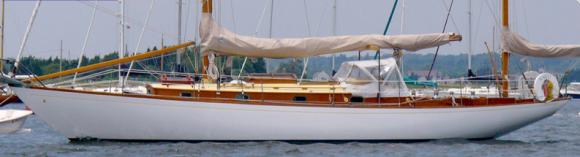
The recent sinking of the Concordia yawl, Winnie of Bourne, brought to mind just how remarkable this class of boats indeed is. Winnie of Bourne was raised from the bottom near the entrance of Nantucket harbor just two days after she sank, so we hope that she will be salvaged and restored.
The Concordia yawl is the most successful and beloved class of wooden offshore sailboats ever built. The first was built to replace Llewellyn Howland’s family’s Colin Archer designed pilot cutter, which was destroyed by the Great Hurricane of 1938. The first yawl, named Java, was (and is) 39ft 10in long with a 10ft 3in beam, 5ft 8in draught, an 18,000 pound displacement, a 7/8ths fractional rig and a coveline with the iconic star on her bow and a crescent moon on her stern.
Over the next 28 years, over 100 Concordia yawls would be built. Continue reading
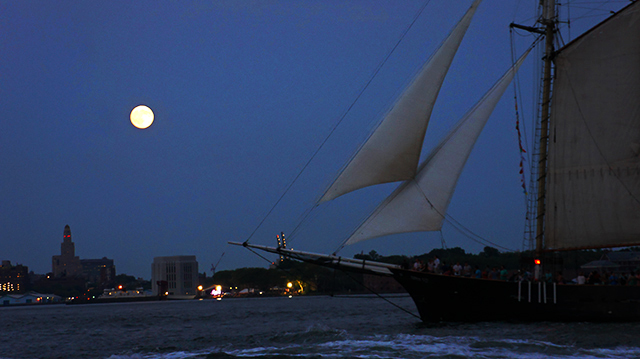
Last night, my wife and I took to a two hour sail on the schooner Pioneer to watch the “super moon” rise over New York harbor. The “super moon,” is in scientific terms referred to as a “perigee moon,” a full moon at perigee, when the moon is closest to the earth. This year we are having a solid streak of “supermoons.” We had one last month on July 12th, one last night August 10th and will will have another on September 28th. On nights with a “supermoon” the moon is roughly 14% larger and 30% brighter than other, non-super full moons. So, supermoons are not really all that impressive, but it was a beautiful night for a sail on the harbor.
On Friday morning, near the entrance to Nantucket harbor at around 10:30 AM, someone made a very bad mistake. The 40′ Concordia yawl, Winnie of Bourne, and the 46′ Swan, Dragon, collided, sending the Concordia yawl to the bottom. The four aboard the 1952 built yawl were rescued from the water by the Coast Guard. The collision remains under investigation. Winnie of Bourne was raised by a crane barge on Sunday. For photographs of the yawl before the collision, click here.
The collision took place just before the start of the nine day Nantucket Race Week, one of the busiest weeks of boat traffic on the island.
A remarkable video of gannetts, sharks, dolphins & divers diving on the sardine run on the Agulhas Bank off South Africa.
Shark Explorers – Sardine Run 2013
From Scuba Diver Life — Gearing Up For South Africa’s Sardine Run
Exactly why and how the sardine run takes place is still a subject of some debate among experts. It is an unpredictable event that depends upon a delicate balance of simultaneous factors; while some years produce shoals of sardines so dense that they can be seen from the air, in other years the sardines do not run at all. Continue reading

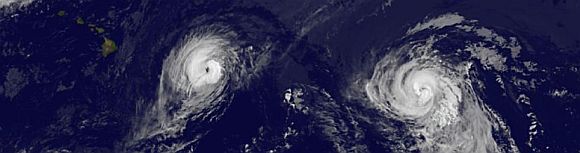
Hurricanes Iselle and Julio threatening Hawaii Photo: AP
Hawaii survived a near miss with two hurricanes. On Friday, Hurricane Iselle, downgraded to a tropical storm, hit the Big Island of Hawaii. Hurricane Julio is expected to pass roughly 200 miles to the north of the islands on Sunday or Monday. Tropical Storm Iselle still brought heavy rains, strong winds, downed trees and power outages to the Big Island, Maui and Oahu.
Despite having a near miss by two hurricanes in a matter of days, overall, hurricanes are relatively rare in Hawaii. Since formal records began to be kept in 1950, the Big Island of Hawaii has not been struck by a hurricane. Tropical Storm Iselle is only the second tropical storm to make landfall on the Big Island. The last hurricane to strike the state of Hawaii was Hurricane Iniki in 1992, which made landfall in Kuaui, killing four and doing $3 billion worth of damage.
Why are hurricanes so rare in Hawaii? Continue reading
A very well-made short documentary by Keven A. Fraser about David Welsford’s life on an Herreshoff 28, Lizzy Belle.
Twenty Eight Feet: life on a little wooden boat from kevinAfraser on Vimeo.
On Tuesday, the New York Media Boat‘s 2pm Adventure Sightseeing Tour was interrupted just off South Street Seaport, when the boat captain, Bjoern Kils, spotted three people in the water near Pier 15. They immediatey went to help. Bjoern describes what happened next in his blog:
When we arrived, two men were in the water trying to keep an unconscious victim afloat. Apparently, he had been handling lines for a large vessel when a line snapped, knocking him into the water.
Captain Francesco Schettino recently gave a two-hour lecture on emergency procedures to criminal science masters candidates at Rome’s Sapienza University. Yes, this is the same Capt. Schettino who ripped open the side of the cruise ship Costa Concordia on a reef, then ignored the ship’s safety management procedures by delaying the order to abandon ship for at least an hour, until the ship was aground on a rocky bottom. The grounding caused the ship to partially capsize. The same Schettino who abandoned the crippled cruise ship early in the evening. The same Capt. Schettino who is now on trial for multiple counts of manslaughter and abandoning his ship. 32 passengers and crew died when the ship sank and rolled over.
Who thought that this would be a good idea? The university dean, Luigi Frati, isn’t wild about the idea, and is seeking disciplinary action against the professor who invited the captain to share his wisdom and experience. The dean is not the only one upset. As reported by ABC News: Italy’s education minister called the news “disconcerting,” while the prosecutor in Tuscany who is arguing for Schettino’s guilt expressed indignation also at reports that Schettino had been awarded a diploma.