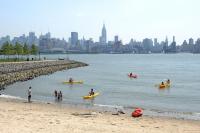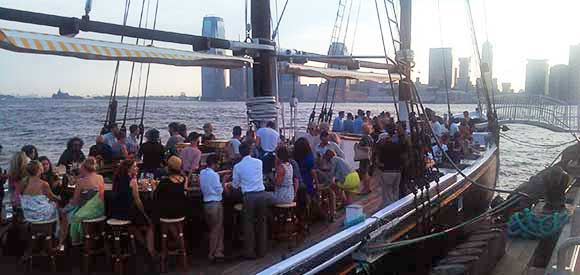
I believe that this is the first straight-out restaurant review that we have done on the Old Salt Blog. Then again the Grand Banks Oyster Bar on the schooner Sherman Zwicker is not your typical restaurant. Sherman Zwicker is a 142′ long wooden auxiliary fishing schooner, originally built in 1942 for dory fishing on the Grand Banks. She is now alongside Hudson River Park’s ‘Pier 25 in Manhattan with an oyster bar named Grand Banks on her deck and a soon-to-open exhibition by New Draft Collective in her hold. The schooner is said to be the largest wooden vessel now afloat in New York.
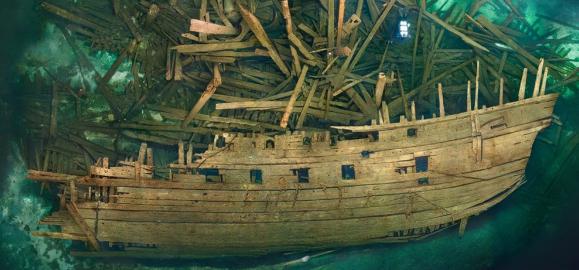
National Geographic has published breathtaking photographs and video of the Swedish warship Mars, which exploded and sank in the first battle of Öland in 1564. Because the ship sank in the dark, cold waters of the Baltic Sea, where the water is brackish and contains relatively little oxygen near the bottom, the ship is amazingly well preserved.
The Mars was believed to be one of the largest ships of her day. When the ship sank she carried a fortune in silver coins, as well as 800 to 900 sailors, all of which ended at the bottom. The wreck of the Mars has long been sought after. There is a legend that a specter rose from the inferno when Mars sank, to guard the ship against ever being discovered. After 450 years, perhaps the legendary specter has retired. At least one silver coin has been recovered. Also numerous bones have been found at the wreck site from the ill-fated sailors and soldiers who went down with the ship. There is video of the shipwreck after the page break.
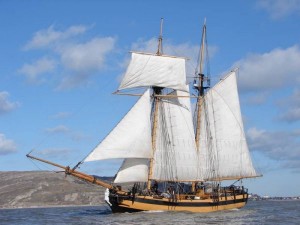
HMS Pickle is for sale on Ebay, with a minimum opening bid of £69,500.00, no reserve and five days left in the auction. The topsail schooner is a replica of the first ship to bring the news of Nelson’s great victory and tragic death at Trafalgar back to England.
We last posted about HMS Pickle when she was for sale back in 2008 when the asking price was £350,000.00. From the Seller’s Notes of Ebay: “Pickle is in need of some work to bring her up to scratch.” Apparently while in good shape below the waterline, the schooner needs a few new deck planks and beams. Click here to learn more.

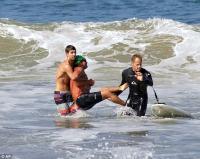
Attack victim being carried through surf
This weekend, Steven Robles, 40, was swimming off Manhattan Beach in Southern California on Saturday morning when he was attacked by a juvenile 7′ long great white shark. He suffered a single bite wound on the right side of his rib cage and was taken to Harbor-UCLA Medical Center and then released to recover at home. If that was the entire story, it would be easy just to write it off as an another example of how dangerous great whites can be. The story ends up being a bit more complicated, however.
An amazing video of Hannah Whiteley kiteboarding in South Africa from Scuttlebutt Sailing News. Enjoy.
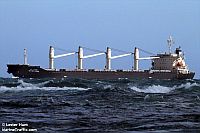
The US Coast Guard in Florida faced an unusual challenge earlier this week. Virtually the entire crew, 19 out of 21, on the 35,362 dwt Korean bulk carrier JS Comet had become seriously ill with symptoms of food poisoning and needed to be rescued. The ship was anchored in the Atlantic three miles off Port Canaveral, Florida while Tropical Storm Arthur raged offshore. The condition of the crew and the 35 knot winds and five to 6-foot seas raised by the tropical storm made evacuation by boat impossible. Despite the deteriorating weather conditions, the Coast Guard successfully evacuate the 19 sick crew members leaving only two crew aboard the ship.
So, what poisoned the crew? The crew told the Coast Guard they believe they got food poisoning from bad sushi. gCaptain reports that an unconfirmed report indicates the crew may have eaten some bad barracuda, which may have been contaminated with ciguatoxin.
In just over a week, salvors expect to start pumping air into sponson tanks welded along the hull of the Costa Concordia to refloat the ship. Prior to the refloating, Italian police have released footage showing the underwater interior of the wrecked cruise ship.
Costa Concordia: New video of the inside of sunken cruise ship
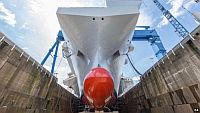
Today, Great Britain’s Queen Elizabeth II christened the Royal Navy’s new aircraft carrier, HMS Queen Elizabeth. As the ceremony was held in Rosyth, Scotland, the queen christened the ship with a bottle of whiskey from the Bowmore Distillery, rather than the more traditional champagne. The new carrier will be the largest warship ever constructed for the UK. With a displacement of 65,000 tonnes, the ship is 280m long, about 70m wide, and carry some 1,600 personnel, including air crew. The new ship is roughly three times the size of HMS Illustrious, the Royal Navy’s remaining carrier.
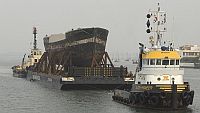
The composite clipper, City of Adelaide, built in 1864, is the world’s oldest surviving clipper ship. Between 1864 and 1887 the ship made 23 voyages from London and Plymouth to Adelaide, South Australia. Approximately a quarter of a million Australians can trace an ancestor that migrated, or was a passenger, on the City of Adelaide. The historic clipper was recently transported to its namesake city, following a lavish send off featuring Prince Philip, the Duke of Edinburgh, on the River Thames at Greenwich near London.
Apparently, the reception that the ship has received in Australia has been somewhat less enthusuastic. South Australia’s Department of Environment, Water and Natural Resources CEO Allan Holmes has called the clipper restoration project an “indulgence” and “eventual taxpayer burden.” He went on to say,”I’m not a supporter, I think it’s the last thing we need. As a government official I know where this is going to end up, they’ll come calling on government to pay the bill, there’s no doubt about that. Government will be under enormous pressure because we have this hulk, this wreck in the port with public expectation that something is going to be done about it.”
In contrast, a few years ago, the City of Adelaide zoo spent close to $30 million building a pavilion for borrowed Chinese pandas. It appears that borrowed pandas have a higher priority to government officials than Australia’s maritime heritage.
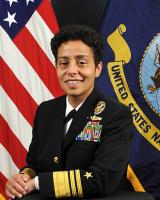
Last December, we congratulated Admiral Michelle Howard on her nomination to serve as Vice Chief for Naval Operations. The nomination was confirmed and yesterday she was promoted to the number two position in the US Navy. She will be the first woman to serve as a four star admiral.
Indeed, Admiral Howard is associated with many firsts. She was the first African-American woman to achieve three star rank in the U.S. Armed Forces as well as being first woman and African-American woman to achieve the rank of admiral in the Navy. She was the first African-American woman to command a U.S. Navy ship, the USS Rushmore. She is the first African-American Vice Chief for Naval Operations. She was also the first admiral selected from the U.S. Naval Academy class of 1982 and the first female graduate of the U.S. Naval Academy selected for flag rank. Admiral Howard was also in command of the anti-terror strike force which rescued Captain Richard Phillips from Somali pirates following the attack on the Maersk Alabama.

Graphic: Fleetmon.com
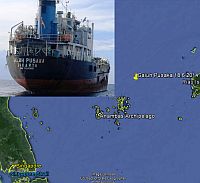
The owners of the product tanker Arsenal lost contact with the ship while she was underway in the South China Sea near the Anambas Archipelago, Indonesia. Fearing that the ship might have been hijacked by pirates, they contacted the Indonesian Navy, which began a search for the missing tanker. (Not long afterwards, the Arsenal re-established contact after apparently suffering a failure in its communication equipment.)
The Indonesia navy did find a tanker, however. At roughly 03 49 15 N, 106 33 20 E, they came upon the Indonesia-flagged product tanker Galuh Pusaka, drifting with engine and navigational lights off, without crew or cargo, but with fresh provisions in the galley. The ship was towed to the Indonesian naval base at Tarempa. The suspicion is that the tanker was used by pirates to siphon and transport stolen oil from hijacked ships. It may have been used by the pirates for some time, as the last AIS signal received from the tanker dates back to Sept 24, 2010. Lt. Col. Agung Jaya Saktika, Tarempa Maritime Authorities, said the tanker had significant damage and a lot of the communication and navigational equipment was missing. The Galuh Pusaka, IMO 7511060, is a product tanker of 2500 DWT, built in 1975, flying the Indonesia flag. The manager of record is Waruna Nusa Sentana, Sumatra.
Modern Mary Celeste – the mystery of tanker Galuh Pusaka, South China sea

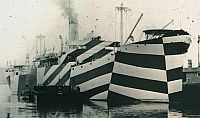
Cargo Ship SS West Mahomet in Dazzle 1918
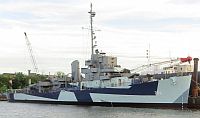
We posted earlier today about the USS Slater’s dazzle camouflage paint. Dazzle, sometimes referred to as razzle dazzle, is a very different approach to camouflage. Where most camouflage attempts to hide an object or person, dazzle camouflage on ships uses complex patterns of geometric shapes in contrasting colors, to make it difficult to identity the ship and to determine which direction it is traveling. If successful, the dazzle camouflage will confuse the targeting of the guns or torpedoes.
Norman Wilkinson is usually credited with developed the widely used disruptive coloration that became known as dazzle painting. Dazzle reached its peak usage in World War I but continued to be used throughout World War II. The color schemes ranged from checker-board or stripped patterns to wildly abstract geometric imagery. Many dazzle schemes were black, white and gray, while some used brighter colors, including red, blues and purples and greens.

USS Slater in dazzle camouflage
In April we posted about the drydocking of USS Slater, the last World War II destroyer escort still afloat in the United States, at Caddell Dry Dock in Staten Island. Yesterday, her repairs completed, newly cleaned, and painted, she returned to her home port, up the Hudson in Albany, NY. Her new paint job is dazzling. Literally. She has been repainted in the “dazzle” camouflage scheme that she wore in service in 1945.

Photo: Weeki Wachee
I have recently discovered that mermaids are indeed real, well, after a fashion, though not in the sense suggested by cheesy fake documentaries shown on the Discovery Channel. There is a small cadre of women who perform as mermaids and models professionally. It is certainly one of the more unusual jobs, though no doubt providing steadier work than scuba-diving Santas, which does tend to be highly seasonal.
Well before the billionaire’s AC72 catamarans were rising up on foils to race in the America’s Cup, nimble Moth dinghies were flying on hydrofoils around the buoys. I will admit to being fascinated by the foiling Moths, although they appear to be rather challenging to sail. Perhaps beyond my capabilities. The Moths are light and relatively simple, while still being a wonder of design, engineering and fabrication. Here is a wonderful video by Onne van der Wal of a recent Moth regatta in Newport on Narragansett Bay, RI.
2014 11th Hour Cup – Moth Racing in Newport, Rhode Island
2014 11th Hour Cup – Moth Racing in Newport, Rhode Island from Onne van der Wal on Vimeo.