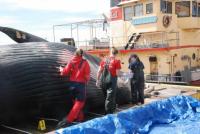
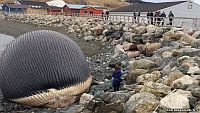
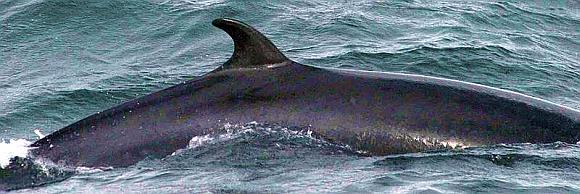
 Fin and sei whale are not usually seen in New York’s upper harbor, yet in a period of less than a month, two have made an appearance. Unfortunately, both were dead, pinned to the bows of ships.
On the April 12th, a 65′ fin whale was found in Port Elizabeth, carried in on the bow of a container ship. Last Sunday, a 45′ sei whale was carried into the harbor by the cruise ship Norwegian Breakaway. The dead whale may have been related to damage to one of the ship’s pod propulsion units. The damage delayed the ship’s docking by three hours, much to the displeasure of at least some of the 4,500 passengers aboard the ship. Evidence of striking the whale was found on the bow of the cruise ship. A necropsy of the female sei whale was not able to determine whether the whale was alive or not when it was hit by the cruise ship. Fin and sei whales are the second and third largest whales in the ocean, respectively. Both species are endangered.
While the focus in much of the media has been on Japanese “research” whaling, ship strikes pose a far greater risk to endangered whales. Continue reading
 The
The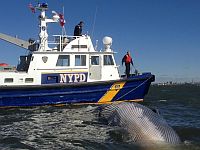 Update: The dead whale is now identified as a
 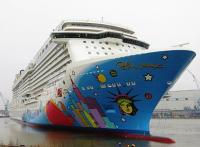 The Norwegian Breakway is one year old this week. Unfortunately, it wasn’t a particularly auspicious birthday. As the cruise ship entered New York harbor yesterday, after a seven day cruise, the captain reported some sort of problem related to the ship’s azipods, which prevented it from docking. Like most new cruise ships, the 1,068-foot Norwegian Breakway, which can carry 3,969 guests plus its crew of 1,651, does not have conventional shaft mounted propellers or rudders. Instead, it is powered by propellers mounted on streamlined pods, which can rotate, and therefore also serve as the ship’s rudders. The ship also has three bow thrusters.
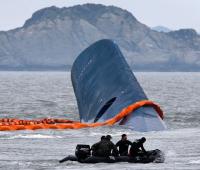 It is not always easy to decipher the news being reported on the tragic sinking of the Korean ferry Sewol , which capsized in the Yellow Sea on April 16, leaving more than 300 dead or missing. There have been numerous reports that the ferry was overloaded when she sank, yet by all indications, the likely problem was that the ship had inadequate stability. The ferry sank while under the command of a relief captain. Last week the
  Last August we asked “
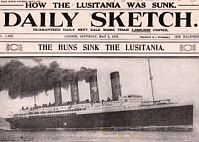 When the Cunard liner
  Update:
  This year, the
  Would the world’s first purpose-built oceangoing roll-on/roll-off ship make a good museum? The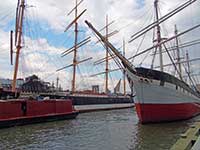
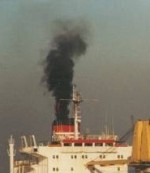 We have noted before the paradox of ocean shipping — it is simultaneously the most energy efficient means of transportation with the lowest carbon footprint while at the same time, it is a major polluter. (See our post from back in 2010 —
  For roughly fifty years, scientists have listened to an unidentified sound in the Southern Ocean, which has been described as a sort of mechanical quacking noise. It has been come to be known as the