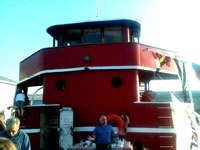

Senator with “Pirate” Eyepatch
I was under the impression that the State of Michigan had serious problems – a $2 billion budget shortfall, its largest city in dire economic straits, schools closing for lack of funding, that sort of thing. Things must be better than I realized as Sen. Roger Kahn (R-Saginaw) proposed and the Senate passed a resolution officially recognizing “International Talk Like a Pirate Day”. If they have time for this sort of resolution in the Senate, things must not be as bad as I thought. One can only hope that the eye patch that Senator Kahn wore while presenting the resolution is not also his proposal for ophthalmic heath care.
The resolution itself notes that “International Talk Like A Pirate Day” was started “as a way to express [the event founder’s] individual passion for nautical plundering.” The resolution goes on to say that the State of Michigan is responsible for “promoting worthy maritime initiatives” and that “Talk Like a Pirate Day” “celebrates beloved maritime activities.” Linking “nautical plundering” with “worthy maritime initiatives” and “beloved maritime activities” all in one very short resolution is just dumb. Really dumb.
One event that the State of Michigan did not choose to endorse is the IMO International Day of the Seafarer held on June 25 of each year to recognize “the invaluable contribution seafarers make to international trade and the world economy, often at great personal cost to themselves and their families.” Apparently the Michigan Senate prefers pirates.

 Recently, we celebrated the
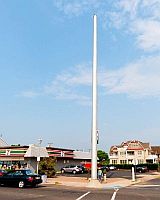 Next to a 7-11 convenience store on 8th Avenue, about a half block from the beach, in the New Jersey shore community of
 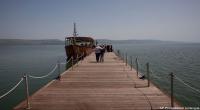 It is a conical shaped structure built of boulders, roughly 230 feet in diameter, 30 feet high and weighing an estimated 60,000-tons, 40 feet underwater in the Sea of Galilee. And archaeologists have no idea what it is. Based on the build up of sediment, it is between 2,000 and 12,000 years old, which is too wide a range to help identify it. It’s not even clear if the structure was built on land when the sea levels were lower, or if it was constructed underwater. The structure was located in 2003 by sonar scan. Now ten years later, researchers from the Israel Antiquities Authority are mounted an expedition to attempt to learn more about the unexpected mound of boulders, which they speculate could have been a burial site, a place of worship or even a fish nursery.