An underwater expedition led by Amazon CEO Jeff Bezos successfully recovered the mangled wreckage of two rocket engines from NASA’s Apollo Moon program from the bottom of the Atlantic Ocean. The F-1 engines, which powered the first-stage Saturn V boosters that fell back to Earth after their fuel was depleted, were found at a depth of 14,000 feet, Bezos’ expedition announced Wednesday. NASA will not try to determine on which Apollo mission the rocket engines were used. Thanks to Alaric Bond and Tony Seideman for passing the news along.
 Interesting news about the US Coast Guard training ship, the barque Eagle. As reported by The Day, The Coast Guard barque Eagle may go to Baltimore for extensive repairs so future officers can keep training on the ship for years to come. The barque underwent a service-life extension at the Coast Guard Yard in Baltimore, Md., more than 30 years ago and it is due for another.
“The Coast Guard is looking at Eagle being the training vessel for cadets and officer candidates for hopefully another 40 years,” said Capt. Raymond “Wes” Pulver, Eagle’s commanding officer. “A final decision has not been made on the service-life extension project for Eagle but I’m optimistic we’re going to do something to keep Eagle in very valuable service.”
 Accomplished historian and archivist, Allan Janus has reviewed the Lord Nelson action figure now available on Amazon. His review:
“An excellent action figure of Horatio, Viscount Nelson – complete with sword, eyepatch, empty sleeve and chelengk. The one minor negative is that Nelson’s stance is quite wide, making it difficult at the outset for him to stand. But a bit of judicious leg-bending brought him round, and now he’s quite upstanding and quarterdeck-ready. Probably the finest Nelson action figure available today.”
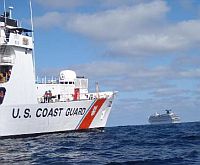 Carnival Cruise Line pays virtually no Federal taxes, yet without the docks, roads, and airports provided by local, state and the federal governments, it would be unable to operate its cruise line. And, when one of its ships gets into trouble, Carnival feels free to call on all the support that the US Coast Guard and Navy can offer. Overall, the company pays about 1% of its profits in US taxes. Forbes magazine recently reported that Micky Arison, the CEO of Carnival has a net worth of $5.7 billion.
Senator Jay Rockefeller in his capacity as chairman of the Committee on Commerce, Science and Transportation recently wrote Mickey Arison a letter asking if Carnival intended to reimburse the $4.2 million dollars spent by the US Coast Guard and Navy in responding to the Carnival Splendor and Carnival Triumph casualties.
Early on Saturday, the 80 m coaster MV Danio hit the rocks on the Farne Islands off the Northumberland coast, after sailing from Perth, Scotland to Antwerp, Belgium with a cargo of timber. The German-owned, Antigua-registered vessel is stuck near the Longstone Lighthouse, close to where heroine Grace Darling and her lighthouse keeper father carried out the famous rescue from the steamship Forfarshire in 1838. The Farne Islands are internationally known for the thousands of puffins which live there, as well as 6,000 grey seals and more than 20 bird species that breed there. Plans to salvage the ship and crew may be delayed until next week due to the bad weather. Thanks to Alaric Bond for passing along the news.
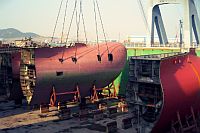 Over the next several months, Maersk Lines will be giving ten container ships in its fleet nose jobs. They will be cutting off the existing bulbous bows and retrofitting them with new more energy-efficient designs.
It all has to do with slow steaming. Bulbous bows are designed to work at a particular range of speeds and drafts. A well designed bulbous bow can reduce fuel consumption by 10-12%. Many of the Maersk ships were originally designed to operate at around 24 knots. With the dramatic rise in fuel costs and continued container ship overcapacity, many ships are now operating at speeds as low as 12 knots. At such slow speeds the original bulbous bow designs can actually increase hull resistance and increase fuel costs. The new bulbs should save 1-2% in fuel costs.
The nose job: Why 10 of our ships are getting a new bulbous bow
Just for fun. A video about a geriatric sea otter named Eddie, who plays basketball to help with arthritic elbows. (No, I am not making this up.)
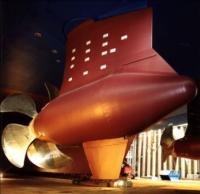
Azipod
As passengers are being flown home from an cancelled cruise on the Carnival Dream, another Carnival Cruise ship, the Carnival Legend, is limping to port with a damaged Azipod. Unlike more conventional designs where the ship’s propeller is connected to a ship’s engine by a shaft through the hull, the Azipod contains an electric motor in a rotating pod connected to the propeller. Because the pod can rotates it serves as both the ship’s propulsion and its rudder. The Carnival Legend has two Azipods and one is apparently broken.
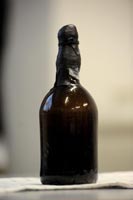 The “World’s Oldest Beer” to be will soon be brewed again by an Åland brewery in Finland. In 2010, we posted about the discovery in a shipwreck in the Baltic off Finland’s Åland archipelago which contained what was believed to be several bottles of the worlds oldest champagne and five bottles of the world’s oldest beer. Both the champagne and the beer are believed to date from the 1780s. A bottle of the Veuve Clicquot champagne subsequently sold at auction for 30,000 euros ($43,500.)
The beer recovered from the wreck has been analysed by the Technical Research Centre of Finland. The analysis is being used by the Stallhagen brewery to recreate the beer. The new “shipwreck” brew is expected to hit the shelves in time for summer 2014. A portion of the proceeds from each sale will go to support “marine archaeological research as well as conservation programmes to improve the quality of the marine environment,” according to Johan Ehn, Culture Minister in the Åland government.
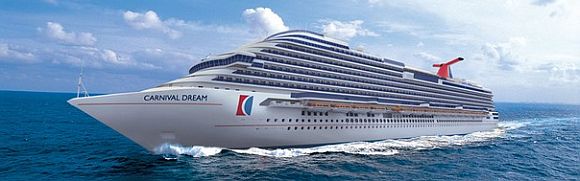 The story sounds disturbingly familiar – a Carnival cruise ship with generator problems, overflowing toilets and passengers sent home from an interrupted cruise. The good new is that the generator failure on the Carnival Dream, the largest cruise ship operated by Carnival Cruise Line, occurred on Wednesday while the ship was dockside at Philipsburg, St. Maarten, in the eastern Caribbean. The power has said to be restored to the ship but the ship is still unable to sail. Passengers onboard the ship will be flown home rather than completing the remainder of their cruise back to Florida. The ship’s next voyage which was scheduled to depart on Saturday, March 16 has also been cancelled. The ship is reported to have suffered some sort of damage to its electrical system following a test of the emergency generator.
Here is a video of the scuttling of HMS Implacable in 1949. She was originally the French Navy’s Téméraire-class ship of the line Duguay-Trouin, launched in 1800. The Duguay-Trouin fought in and survived the Battle of Trafalgar, only to be captured by the British in the Battle of Cape Ortegal and renamed Implacable. When scuttled in 1949, HMS Implacable was the second oldest ship of the Navy after HMS Victory. There were major protests against her disposal, but given the post-War austerity, the British government decided against the cost of her restoration. In 1947 the British government had offered her to the French, who also declined the offer based on restoration costs. The Implacable’s figurehead and stern galleries were removed prior to scuttling and are on display in the National Maritime Museum at Greenwich, while her capstan is on display at the maritime museum at Rochefort.
The protests over the scuttling of HMS Implacable are believed to have contributed to the British government’s decision to preserve the clipper ship Cutty Sark. Thanks to Andrew Reinbach for pointing out the video on Facebook.
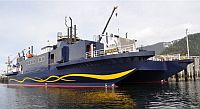 The Alaskan high-tech ferry MV Susitna cost $78-million to build. More than just a ferry, it is also an ice-capable amphibious assault vessel for the Navy, which was supposed to have carried commuters from the Matanuska-Susitna Borough (or Mat-Su as it is known) across upper Cook Inlet. Mat-Su’s largest city is Wasilla, best known as the home of Sarah Palin. The ferry project was championed by the late Sen. Ted Stevens, who was famous for the “bridge to nowhere,” a proposed $400 million bridge between Ketchikan and Gravina Island, Alaska. The “bridge to nowhere” was subsequently cancelled. Likewise, the Susitna has never been put into service. The Mat-Su borough is now trying to give the ferry away to anyone who will take it.
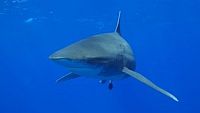 We recently posted about a report by the journal Marine Policy which estimated that around 100 million sharks are being killed each year in the commercial fisheries, a rate far higher than is sustainable for most shark species. On Monday, delegates to the Convention on the International Trade in Endangered Species (CITES) meeting in Bangkok voted to provide addition protection for five threatened species of sharks – oceanic whitetip sharks, porbeagle sharks, scalloped hammerheads, great hammerheads and smooth hammerheads. They also voted protection for two species of manta rays. The votes must still be confirmed in a plenary session later this week. The actions will not ban shark and ray fishing but will regulate the number of fish caught.
 I am very pleased and excited to be speaking with Norman Brouwer and Captain Margaret Flanagan at the Working Harbor Committee of New York and New Jersey program “Sailing Ships at Work – Then and Now.” The presentation is on April 10th at the Community Church of New York, 40 E. 35th Street, in New York City. It is shaping up to be quite a program. If you are in the area be sure to stop by and say hello.
Join the WHC for an evening of film, discussion and refreshments as we revisit the great Age of Sail and highlight today’s use of sailing vessels to transport cargo. We will also venture into the future to look at some revolutionary designs for large sail-assisted cargo vessels. With the rising cost of fuel, designers are investigating new ways to add wind energy to a ship’s power plant. Are we headed for a new Age of Sail?
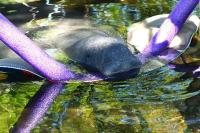
Photo: Tampa Bay Times
An outbreak of Red Tide, a deadly algae bloom, in the Gulf of Mexico off Florida is killing a record number of endangered Florida manatees. The Red Tide bloom has been killing at least 10 manatees a day and shows no sign of letting up any time soon, according to state biologists. Roughly 40% of the state’s manatee population of only 4,00-5,000 lives in the area impacted by the bloom. The current Red Tide bloom affects about 70 miles of the southwest Florida coast, extending along the shores of Sarasota County south through the middle of Lee County.