Yesterday we posted about Wisdom, an albatross who is at least 70 years old, who recently hatched another chick, making it the oldest breeding bird in recorded history. In a comment on the post, Irwin Bryan pointed out a video that has gone viral of an albatross making a less than perfect landing at the Otago’s Royal Albatross Centre nature reserve in New Zealand, which seems like a perfect post for a Monday.

Photo: John Klavitter/U. S. Fish and Wildlife Service
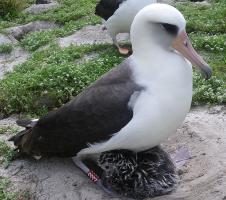
A Laysan albatross named Wisdom, first identified and banded on Midway Atoll in 1956, has hatched a chick at the age of at least 70. Wisdom, who returns each fall to Midway Atoll National Wildlife Refuge, outlived most of her mates, and raised over 40 chicks. The typical albatross life span is generally estimated to be 40-50 years.
The United States Geological Survey (USGS) has tracked Wisdom since she was first tagged, and has estimated that Wisdom has flown over 3,000,000 miles (4,800,000 km) since 1956 (approximately 120 times the circumference of the Earth). To accommodate her longevity, the USGS has replaced her tag a total of six times. She and her chick survived the 2011 Tōhoku earthquake and tsunami that killed an estimated 2,000 adult Laysan and black-footed albatrosses, and a much larger number of chicks, at the refuge.
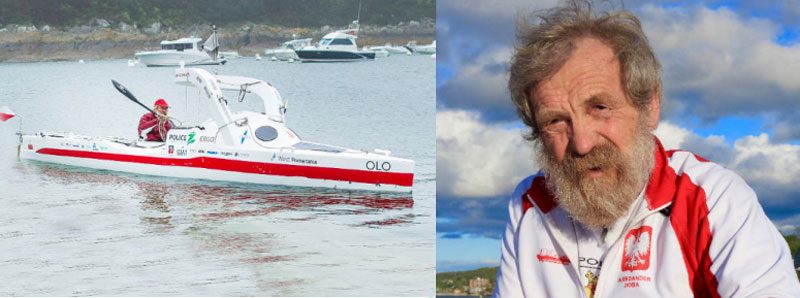
Aleksander Doba died late last month at the summit of Mount Kilimanjaro at the age of 74. He will be best remembered as an irrepressible, record-setting kayaker who paddled across the Atlantic three times while in his 60s and 70s.
Born in 1946, in Swarzęd, Poland, near the city of Poznań, Doba got into kayaking relatively late, at 34.
And it wasn’t until he was 65, in 2010, that he would embark on the first in a series of three journeys across the Atlantic Ocean, earning Doba, a retired engineer, the nickname the “pensioner adventurer”.
After a tie in the first two America’s Cup races, the defender Team New Zealand and the challenger Luna Rossa finished races 3 and 4 of the best of 13 race series tied again with one win each. Brief highlights of races 3 and 4 after the page break.
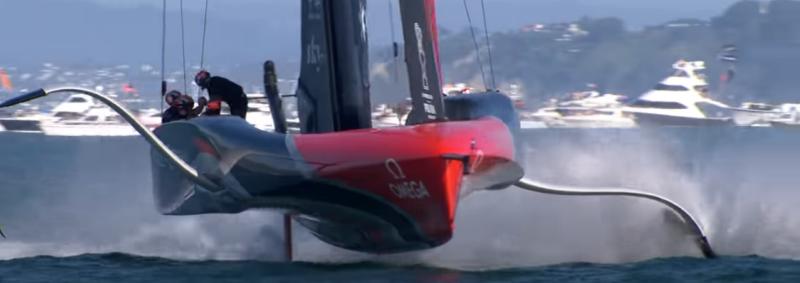
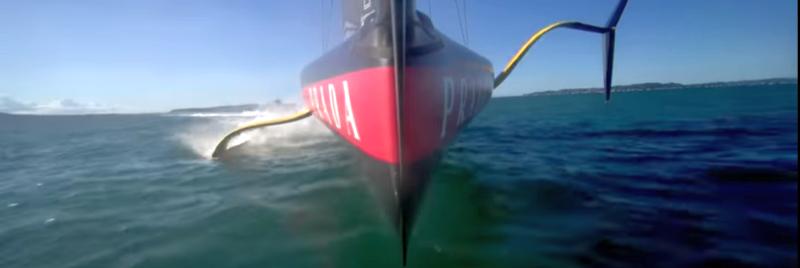
The America’s Cup races in Aukland restart again tomorrow. The defender and challenger will be sailing AC75 class boats — keel-less, flying, foiling wonders of carbon fiber, packed with hydraulics, cutting-edge electronics, and powered by soft wing sails, capable of speeds of over 50 knots.
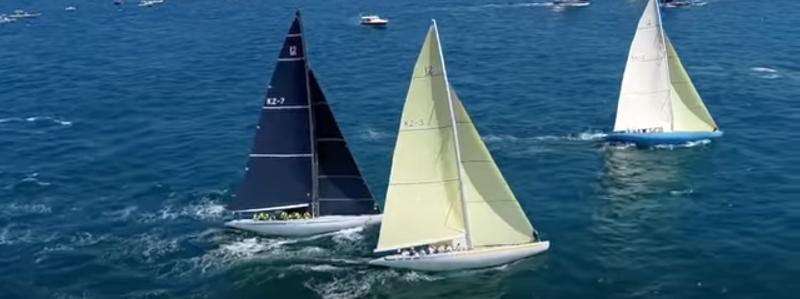
Here is a short documentary of America’s Cup racers of another era — the beautiful 12 metre class boats. Filmed during the 2019 12mR World Championship in Newport R.I., highlights include racing footage and competitor interviews paired with the experienced insights of the 12MYC’s Station Steward Gary Jobson who also wrote and narrated this documentary.
On the first day of the final races in Aukland, NZ, of the 36th sailing of the America’s Cup, the defender Emirates Team New Zealand and the challenger Luna Rossa Prada Pirelli, each won one race, ending the day in a tie. Team New Zealand won the first race by a margin of 31 seconds, while Luna Rossa won the second narrowly with a lead of only seven seconds. The best of 13 race series starts again on Friday. Short video highlights of both races are beyond the page break.

One day after the observance of International Women’s Day, there is still time to remember and honor Admiral Grace Hopper. Grace Hopper was a pioneering computer scientist and a United States Navy Rear Admiral. Hopper received a master’s degree and a Ph.D. in mathematics from Yale. She was nicknamed “Amazing Grace” and is often referred to as the “mother of computing.”
In October of 2020, the U.S. Naval Academy officially opened Hopper Hall, the academy’s new center for cybersecurity studies, named in her honor. The cybersecurity facility is the first building named after a woman at the three main service academies.
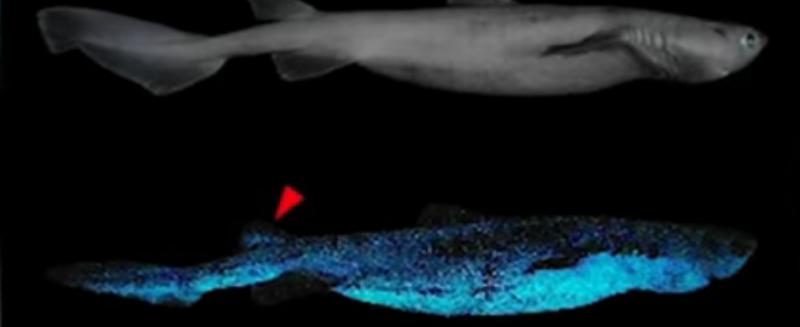
Researchers have photographed a large bioluminescent shark in deep water off New Zealand. The kitefin shark was a known species of ocean predator but was only recently discovered to be able to glow in the darkness of its deep-ocean environment. The kitefin shark, which can grow to 180cm, is now the largest-known luminous vertebrate in the world, on land or sea.
The researchers also identified two smaller species of shark — the blackbelly lanternshark, and the southern lanternshark that are also bioluminescent.
David Morris was taking a walk along the coast near Falmouth, Cornwall, in the UK, when he saw what looked to be a large tanker hovering in the air above the horizon. He documented what he witnessed with several photographs. Apparently, Mr. Morris saw a “superior mirage” also known as a Fata Morgana.
The BBC quotes meteorologist David Braine said the “superior mirage” occurred because of “special atmospheric conditions that bend light”.
The 9th sailing of the Vendee Globe Race is over. After 116 days at sea, Ari Huusela sailing Stark has crossed the finish line at Les Sables d’Olonne. While he was the last sailor to complete the race at 25th place, in terms of bragging rights, he is also the first Finnish sailor to finish the race.
In a larger sense, anyone who succeeds in completing the single-handed non-stop round-the-world race is indeed a winner. As Lydia Mullan writes in Sail Magazine, “In a race this difficult, making it to the finish is a victory in its own right. Though the last skipper to cross the line, Huusela will finish in 25th place of 33 and ahead of giants like Alex Thomson, Sam Davies, and Fabrice Amedeo who were unable to complete the course.”

Marco Polo on the beach at Alang
Every year, on average, close to 1,000 ships are sold for scrap, or in more current language, to be recycled. Over the past year during the pandemic, there has been a particular surge in the number of older cruise being sent to shipbreaking yards. Many of these cruise ships have been sent to Turkish shipbreakers.
The BBC reported recently of two UK cruise ships sent instead to Alang, India for scrapping. The problem is that ships sent to scrap yards are considered to be hazardous waste and it is illegal to send them to developing countries from the UK. UK and EU regulations require that ships being recycled be sent to approved shipbreaking facilities that meet environmental and worker safety rules. As of this November, the approved list contains 43 yards, including 34 yards in Europe, 8 yards in Turkey, and 1 yard in the USA.
There are currently no approved ship recycling yards on the EU list in Asia, where over 90% of the world’s ships are scrapped. Continue reading
A short and lovely video from two years ago about sailing from Milwaukee on the three-masted, wooden schooner Denis Sullivan. Like so many other vessels, the schooner’s 2020 sailing season was canceled due to the pandemic and sadly, her future is uncertain.
Tighe – Primetime Edition of Sunday Morning – Denis Sullivan from Jessica Tighe on Vimeo.
A tidal turbine, built and tested in Scotland, has been installed in waters off Naru Island, part of Japan’s Goto Island chain. Simec Atlantis Energy said its pilot turbine had generated 10 megawatt-hours in its first 10 days of operation.
The AR500 turbine was put together at a facility in Scotland before being shipped to Japan. According to SAE, the overall project involves the leasing of tidal generation equipment as well as the provision of offshore construction services to Japanese company Kyuden Mirai Energy.
Last Friday, the Spanish Navy training ship Juan Sebastian De Elcano arrived in Guam on its journey to retrace the first circumnavigation of the globe 500 years ago. As reported by Stars and Stripes, the four-masted ship — named for the explorer who finished the voyage after the death of Ferdinand Magellan — was greeted at Naval Base Guam on Friday by Gov. Lou Leon Guerrero, Lt. Gov. Joshua Tenorio, and Rear Adm. John Menoni, commander of Joint Region Marianas, Indo-Pacific Command.
The ship, built in 1927, is said to be the third-largest tall ship in the world. It was greeted by a flotilla of canoes from seafaring organizations upon its arrival off Oka Point in Tamuning, on its way toward Apra Harbor, on Friday, the Pacific Daily News reported that day.

Image: Bjørn Christian Tørrissen
A start-up company in Maine is testing the feasibility of combatting climate change by growing kelp to capture carbon dioxide. Once the kelp is mature, it will sink to the bottom becoming part of the sediment and trapping the carbon for millions of years. The company, Running Tide Technologies is prototyping the concept this winter.
One often hears the recommendation to plant more trees to help reduce climate change. Saltwater plants like mangroves and seagrasses are estimated to take up 20 times more CO2 per acre from the atmosphere than land-based forests. Kelp could potentially capture far more.