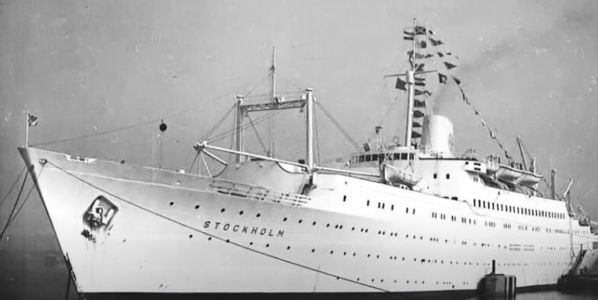
 The 77-year-old cruise ship MV Astoria has been sold for scrap. The Belgian recycling firm Galloo was the only bidder, acquiring the ship for €200,000.
In her over seven decades of service, she sailed for multiple owners, under many names, including Völkerfreundschaft, Volker, Fridtjof Nansen, Italia I, Italia Prima, Valtur Prima, Caribe, Athena, Azores, and finally Astoria. Ultimately, she will probably be best remembered as the MV Stockholm, which collided with the ocean liner SS Andrea Doria, on July 25, 1956, killing 51 people and prompting one of the largest civilian maritime rescues in history.
The tragic collision also serves as a lesson about the relationship between technology and seamanship that too often remains unlearned to this day.
On the night of July 25, 1956, the Italian passenger liner SS Andrea Doria entered the heavily trafficked sea lanes off Nantucket, westbound for New York City. The Swedish passenger liner Stockholm had begun its homeward journey eastbound to Sweden from New York. Despite heavy fog, Captain Calamai, master of the SS Andrea Doria, had ordered only a minor reduction in speed to stay on schedule for an early morning arrival in New York. Stockholm, meanwhile, was steaming north of the recommended eastbound route in the hope of shaving time off its journey.
Both the Stockholm and the Andrea Doria were fitted with modern radars of their day. Despite their electronics, one or both ship’s officers seriously miscalculated the positions of the two ships. At 11:11, the eastbound Stockholm rammed into the westbound Andrea Doria. The collision occurred 180 miles east of Ambrose Lightship, the main entrance to New York Harbor.
The Stockholm’s ice-strengthened bow cut deeply into the Andrea Doria‘s hull at a point directly under her bridge on the starboard side. The approximately right-angle collision killed 51 passengers and crew. The casualty is often described as the first “radar-assisted collision.”
The Stockholm was seriously damaged while the Andrea Doria sank 11 hours after the collision.
Who was at fault? That remains an open question. Six months after the disaster, the official inquiry was terminated, concluding that guilt or innocence could not be clearly ascertained. Both steamship companies agreed to assume equal responsibility for the disaster.
Of course, we have far more sophisticated technology on today’s ships. Between global positioning system (GPS) receivers, electronic chart display information Systems (ECDIS), automatic Identification systems (AIS), and automatic radar plotting aids (ARPA), among other devices, the frequency of ship collisions has been reduced, and yet ships are still running into each other or onto reefs and coastlines. These days, the talk is often about “GPS-assisted collisions.” GPS spoofing is becoming a real concern. Likewise, the introduction of autonomous and remotely operated ships is raising new questions and challenges.
Advances in technology provide the illusion of precision, which makes the independent confirmation of one’s position seem superfluous. Old concepts like maintaining adequate sea-room seem antiquated and unnecessary.
The Andrea Doria, which rests rusting in 240 feet of water in the approach to New York Harbor, has continued to take lives. At least 22 scuba divers have died diving on the wreck.
The Stockholm, in all its incarnations, has done rather better. writing in the Washington Post, describes the ship’s post-collision career:
In the years that followed [the collision with the Andrea Doria], the Swedish-built ship continued having brushes with history, becoming a kind of Forrest Gump of maritime vessels. It carried members of East Germany’s Communist Party for pleasure cruises in the 1960s and ’70s and housed Middle Eastern refugees seeking asylum in Norway in the ’80s. It was later converted to a cruise ship and has become one of the few remaining classic cruise ships still on the water, a “Love Boat”-era vessel that, [until 2020, sailed] out of the Mexican resort town of Puerto Peñasco under the name Astoria.
The recycling firm Galloo reports it plans to move the ship as early as July to a recycling yard in Ghent. The ship, which is 160 meters (525 feet) in length, with accommodations for over 500 passengers, is expected to account for more than 12,000 tonnes of material, including ferrous and non-ferrous metals, wood, glass, and plastics. It expects 97 percent will be recycled into renewable raw materials.