
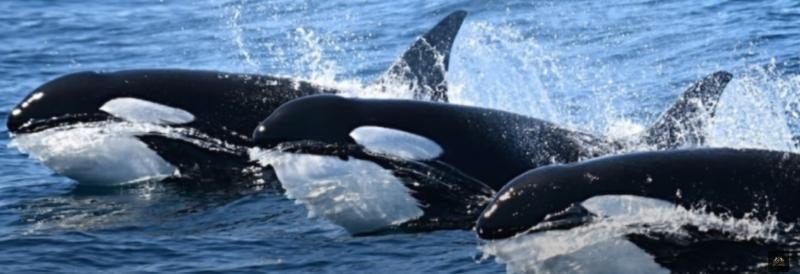
 There is so much we do not understand about orcas, also known as killer whales. Scientists and sailors have been mystified in recent years by pods of orcas attacking sailboats near the Strait of Gibraltar and the Iberian Peninsula. Multiple theories have been proposed to explain the attacks that have disabled and in some cases sunk sailboats, yet there is currently no consensus to explain the behaviour.
Likewise, recently, some orcas on the Northwest Pacific coast of North America have started wearing salmon hats again, bringing back a bizarre trend first described in the 1980s. And off South Africa, orcas have begun to hunt and kill great white sharks, eating only their livers, leaving the rest of the carcass alone.
Now, scientists have identified two additional surprising orca behaviors. Southern resident orcas in the Salish Sea have been observed using tools to groom each other. A new study also documents orcas in the wild offering food to people, in what may be an attempt to develop relationships with humans.
Orcas using tools
Drone footage of Southern resident orca pods has recorded some orcas carrying green objects in their mouths and rubbing against each other for up to 15 minutes at a time.
Over just two weeks in 2024, researchers documented 30 examples of these curious interactions. They found that the southern resident orcas were detaching strands of bull kelp from the seafloor to roll between their bodies in a behavior the scientists dubbed “allokelping.” Allokelping could be a form of grooming for skin hygiene, as well as a way to socially bond with other members of the pod, the researchers reported in a new paper published Monday in the journal Current Biology.
The discovery marks the first time cetaceans — marine mammals including whales, dolphins, and porpoises — have been observed using an object as a tool to groom.
Orcas sharing food with people
A new study, published in the Journal of Comparative Psychology, reveals that orca whales sometimes offer to share their prey with people, hinting that some intelligent orcas may be attempting to develop relationships with humans.
The study documents 34 interactions over two decades involving orcas attempting to offer food to humans. These incidents took place across the world, in the oceans off California, New Zealand, Norway, and Patagonia.
“Orcas often share food with each other. It’s a prosocial activity and a way that they build relationships with each other,” study lead author Jared Towers said. “That they also share with humans may show their interest in relating to us as well.”
“Offering items to humans couviour, expld simultaneously include opportunities for killer whales to practise learned cultural behavior or play and, in so doing, learn about, manipulate or develop relationships with us,” the study said.
“Given the advanced cognitive abilities and social, cooperative nature of this species, we assume that any or all these explanations for, and outcomes of such behaviour are possible.”
Thanks to Alaric Bond for contributing to this post.
I have always been fascinated by these mammals.
Eating only the shark’s liver reflects that of seals taking a single bite out of a salmon that so annoyed our local salmon fishermen I remember growing up with on the West Coast of Scotland as they harvested the fish from their boxnets. That bite was around the liver and reflected the seal’s desire to target the essential nutrients it contained.