
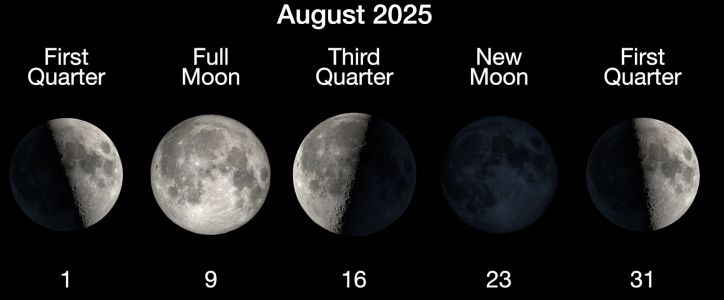
 On Saturday, August 23, a black moon will rise in the night sky. Of course, you won’t be able to see it, but weather permitting, the stargazing should be phenomenal all the same.
A black moon is defined as the third new moon in a season of four new moons or as the second new moon in the same calendar month. Normally, each season has three new moons, but the lunar cycle doesn’t line up perfectly with our calendar. Every so often, an “extra” new moon sneaks in, and that occurred on May 19, 2023.
A new moon refers to the phase when the moon’s Earth-facing side is fully in shadow. A new moon is, in essence, the opposite of a full moon when the moon’s Earth-facing side is fully illuminated by sunlight. A blue moon is the full moon equivalent of a black moon, when there are two full moons within the same calendar month.
Summer 2025 in the Northern Hemisphere began with a new moon on June 25, followed by July 23, August 3, and September 21. With four new moons squeezed into the season, the August 23 new moon becomes the black moon. Seasonal black moons, like the one on August 23, happen only about once every 33 months.
Unlike a supermoon or lunar eclipse, a black moon isn’t something you can watch unfold in real time as, the moon is positioned between Earth and the sun, so its unlit side faces us, rendering it invisible against the bright sky.
Nights with a new moon are, however, ideal for astronomers, photographers, and skywatchers in general, as the absence of moonlight makes faint celestial objects much easier to see. This black moon offers stargazers a clear view of stars, constellations, and bright planets, including Venus, Saturn, Jupiter, and Mercury.
The new moon is up during the day. Sometimes you can see it very faintly