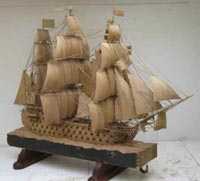
 We previously posted about a model of the Mayflower crafted from timber believed to used on the original ship that carried the Pilgrims to America. Alaric Bond passed along an article about a model of the HMS Victory by sculptor and woodcarver Ian G Brennan carved from original centuries old oak beams removed from HMS Victory’s lower gun deck during the restoration program in 1991. Beautiful work.
Embarrassing and rather bad timing. Billed as the “world’s most advanced nuclear submarine,” the recently christened HMS Astute ran aground this morning off the Isle of Skye.
Nuclear submarine runs aground
HMS Astute: world’s most advanced nuclear submarine runs aground
Continue reading
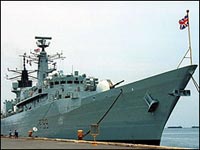
Photo: AP
The announced British budget cuts will slash spending across the board but will hit the Royal Navy hardest of all of the military services.
Anchors away: Britain’s once-proud navy falls prey to budget cuts
In all the carnage, the worst damage, at least to the island’s national pride, is the torpedoing of the Navy. For a kingdom defined by its sea battles, heroes, and ships, Britain is witnessing a humiliating shrinkage of its once-world-conquering maritime force. In the next five years, it will lose four ships (bringing the total to 19), 5,000 personnel (down to 30,000), and perhaps, most ignominiously, will soon have two aircraft carriers with no aircraft to outfit them.
In a final appeal to the National Security Council, navy chiefs offered to make cuts that would reduce the senior service to its smallest since the time of Henry VIII.
Continue reading
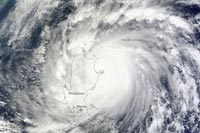 After killing more than 20 people in the Philippines and lashing Taiwan, where dozens are reported missing, “super-typhoon” Megi is poised to make landfall in South China today or Saturday. Typhoon Megi is the the strongest storm to hit the region in more than a decade.
Southern China awaits slow-moving super-typhoon
Continue reading

Joseph Conrad
The final essay in Joseph Conrad’s wonderful, if somewhat odd book, The Mirror of the Sea, is entitled “The Heroic Age.” It starts out rather disappointingly as a paean to Nelson. There is nothing wrong with praising Nelson, except that everyone does it, so another bit of hagiography doesn’t necessarily add anything new.
Then, well into the essay, Conrad does something rather remarkable. He wonders what would have happened if the wind had shifted on that morning of the 21st of October.
Continue reading
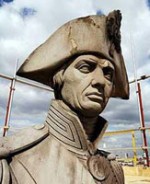 Horatio Nelson ‘was French football captain’, say children
Research carried out to mark the anniversary of the Battle of Trafalgar shows many schoolchildren believe that Horatio Nelson was captain of the French national football team in the 1990s.
Almost one-in-four also said that ships evacuated British troops from Dover – not Dunkirk – during World War Two, Walter Raleigh invented the bicycle, Captain James Cook was the captain of the Starship Enterprise and Christopher Columbus discovered gravity.
Continue reading

A letter which only recently resurfaced gives an ordinary seaman’s view of the famous battle which was fought 205 years ago today.
‘They won’t send their fleets out again in a hurry’: Remarkable letter from hero who survived the Battle of Trafalgar
Continue reading
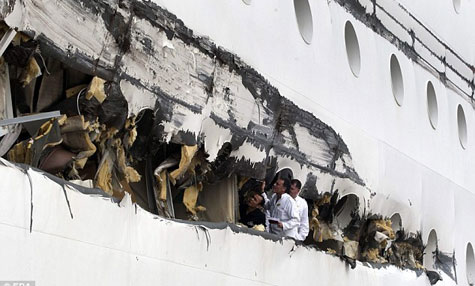
The Costa Classica‘s current cruise has not gone well. First, on a stop at Korea’s southern resort island of Jeju, 44 Chinese tourists abandoned the tour group en masse. South Korean police have located eleven of the group, but 33 remain unaccounted for. Jeju has been a frequent stopover for illegal immigrants from China seeking employment in Korea.
44 Chinese Tourists Abandon Tour Group in Jeju
Then early yesterday, the ship collided with a cargo vessel at the mouth of the Yangtze River. The collision left a gash over 60 feet long in the side of the ship. Three passengers where taken to the hospital. Other minor injuries were also reported.
Three people hospitalised after cruise ship collides with cargo vessel in Asia
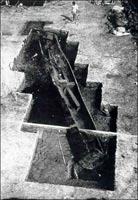 The Hasholme boat, discovered in 1984 in a former inlet of the Humber estuary near Holme on Spalding Moor, dates from the late Iron Age ( 750-390 BC ). The boat was cut from a single oak tree and was originally roughly 42 feet long (12.87 m), with a beam of 4.6 feet (1.4 m) and a depth of 4.1 feet (1.25 m). Now after attempts to preserve the boat by spraying it with chemical wax preservative have failed, archeologists are considering allowing the boat to air dry.
Experts forced into rethink after bid to preserve prehistoric Hasholme Boat fails
Continue reading
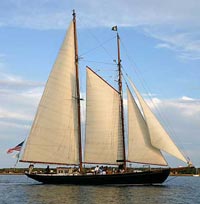
When and If
In 1939 then Colonel General George S. Patton had a 63’5″ John Alden designed schooner built for himself and his wife. Another world war was looming on the horizon and Patton said that he planned to sail the schooner, “When the war is over, and if I survive.” He named the schooner “When and If.“ Ironically, Patton survived the fighting but died in a traffic accident just as the war ended.
Continue reading
 This morning we posted about the possibility of the immediate lay-up of the UK’s flagship, the aircraft carrier Ark Royal. We now read that one of the two new £3 billion aircraft carriers will never carry aircraft and may sail into lay-up or be put up for sale, shortly after she is delivered.
Navy aircraft carrier will be sold after three years – and never carry jets
Continue reading
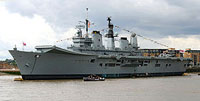
HMS Ark Royal
If the recommendations of a UK defense review are implemented, Britain will have the same capacity to launch aircraft from ships as Nelson did, which is to say, none at all, prior to 2019 when new aircraft carriers come into service.
Defence review: HMS Ark Royal to be scrapped
Continue reading
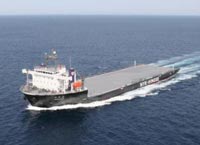
NYK Yamatai
Two years ago, an article appeared in Scientific American, Slippery Ships That Float on Air, describing the various attempts to reduce frictional resistance on ship’s hulls by injecting air bubbles or introducing pockets of air beneath the hull. At the time, the research looked promising but had failed to develop a fully practical technique.
Now Mitsubishi Heavy Industries, Ltd may have gotten closer to getting it right. Earlier this year they launched the NYK-Hinode Line heavy lift ship/module carrier Yamatai equipped with the the proprietary Mitsubishi Air Lubrication System (MALS) designed to reduce frictional resistance by injecting air bubbles beneath the hull. The Yamatai is the the world’s first application of an air-blow type air lubrication system on an ocean-going vessel for permanent use. Testing is now ongoing.
Continue reading
The Brooklyn Navy Yard, in New York on the East River in Wallabout Basin, has always seemed to me to be equal parts working industrial park, living museum, and ghost town. The land was purchased by the Federal government in 1801 and it became an active U.S. Navy shipyard by 1806.
An effort is being made not to lose the history of the shipyard. A new exhibition and visitors center is now under construction in the old Building 92 and is slated to open in late 2011. The 1857 Marine Commandant’s House is also under restoration and will feature a six-gallery exhibit.
Over 100 ships were built at the yard. At its peak, during World War II, the yard employed 70,000 people. The yard was sold to the City of New York in 1966 and space is currently leased to over 200 companies employing around 5,000 people. The tenants include dry-docking and ship terminal services.
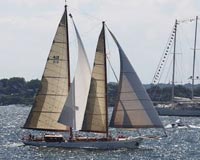
King's Point schooner Summerwind
The Summerwind, a 1929 Alden schooner, donated to the US Merchant Marine Academy at Kings Point just last year by Mr. and Mrs. J. Don Williamson, won the Class AA division of the Great Chesapeake Bay Schooner Race on corrected time. The other top contenders in Class AA (rated length greater than 50 feet) were the Pride of Baltimore II and the Lynx, both sharp built privateer replicas. Congratualtions to King’s Point. A very impressive performance.