
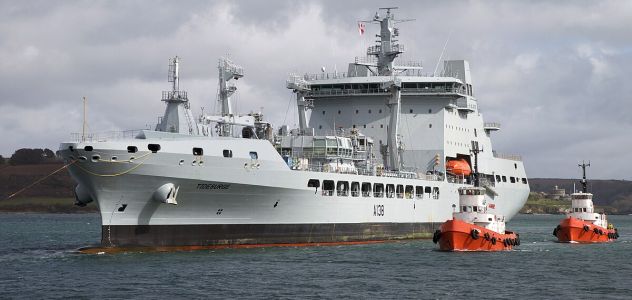
 The search for a crew member who was lost overboard from the Royal Fleet Auxiliary (RFA) tanker Tidesurge, off the north-west coast of the Republic of Ireland, has ended without finding any sign of the missing sailor.
First Sea Lord General Sir Gwyn Jenkins said in a statement that “after an extensive search for a missing crew member of a Royal Fleet Auxiliary ship’s company, the individual has not been found and the search has been ended.”
He added that “my thoughts are with the family and friends of those involved in this tragedy and I would like to thank all those in the Royal Navy, the RNLI and Irish Coast Guard who took part in the search and rescue with such determined efforts.”
The Tidesurge crew member was last seen at about 22:30 (local time) on Friday. The Irish Coast Guard received a distress call from a Royal Navy support vessel before 09:00 on Saturday. A large-scale multi-agency search and rescue effort was launched immediately in the sea off the north-west coast between Tory Island, County Donegal, and Eagle Island, County Mayo.
No further details have been released about the crew member, and their family has been informed.
RFA Tidesurge is a Tide-class replenishment tanker of the British Royal Fleet Auxiliary (RFA). Built by DSME in 2017, she entered service with the RFA on 20 February 2019.
The Royal Fleet Auxiliary is a civilian-manned service that provides vital logistical support to the Royal Navy. Its ships deliver fuel, supplies, and operational assistance, ensuring the fleet can sustain missions worldwide. RFA sailors are employed as civil servants rather than enlisted personnel, but their work is integral to Britain’s defence capability.
Critics argue that the disappearance of a Tidesurge crew member highlights the risks faced by those serving at sea, even outside combat zones. It also raises questions about whether the demands placed on the RFA workforce—often operating under challenging conditions—are stretching resources too thin.
The incident off the coasts of Ireland underscores the human cost of these pressures. While the circumstances of the sailor’s disappearance remain under investigation, the tragedy has reignited debate about whether Britain’s naval workforce is adequately supported and resourced.
The Royal Navy’s support ships, which refuel, rearm, and resupply British warships, are stuck in ports in a “decrepit” state, naval experts have said.
Commander Tom Sharpe, a retired frigate captain, said that the condition of the Royal Fleet Auxiliary (RFA) was “absolutely crippling” the navy.
“The RFA is the logistics branch of the Royal Navy,” Sharpe told The Daily Telegraph. “If you don’t have logistics, you’re simply not a blue-water navy. You can’t support it at range, so what’s the point of being a navy?”
Thanks to David Rye for contributing to this post.