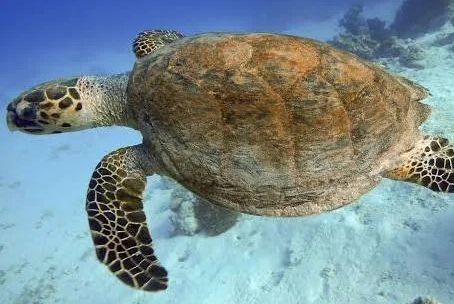
 Who would have imagined that the Trump regime would use its current war of choice in Iran to push for the gutting of the Endangered Species Act? A powerful panel of Trump administration officials voted unanimously on Tuesday to exempt oil and gas drilling in the Gulf of Mexico from measures to protect endangered whales and other imperiled species. The Trump administration is targeting protections for species such as the Kemp’s ridley sea turtle, the world’s most endangered sea turtle, along with whales, manatees, Gulf sturgeon, and other marine wildlife.
The NRDC (the Natural Resources Defense Council) is reporting that the Trump administration just used the so-called “God Squad” – a committee of presidential appointees with the power to condemn endangered species in the Gulf of Mexico to extinction. In less than 20 minutes, they voted to give the oil industry a free pass to endanger wildlife in the Gulf of Mexico.
The panel, the Endangered Species Committee, a high-level group that is often called the God Squad because it essentially holds the power to decide whether a species lives or dies, adopted the move during a brief, closed-door meeting at the Interior Department.
It was the Trump administration’s latest move to weaken the Endangered Species Act, the bedrock environmental law intended to prevent plant and animal extinctions.
Until Tuesday, the God Squad had convened only three times, and never in the past three decades.
“Recent hostile action by the Iranian terror regime highlights yet again why robust domestic oil production is a national security imperative,” Mr. Hegseth said, although he clarified that these concerns predated the Middle East war and the resulting spike in gasoline prices.
The United States is the world’s biggest producer of oil and gas, and the Gulf accounts for about 15 percent of U.S. crude oil output.
Environmentalists strongly rejected the administration’s claims.
“This is nonsensical,” said Jane Davenport, a senior attorney at Defenders of Wildlife, a conservation group. “Oil and gas activities in the Gulf have been proceeding apace, and there is not a shred of evidence that the E.S.A. has resulted in any restrictions on the amount of oil produced there,” she said, referring to the Endangered Species Act.
The act requires federal agencies to ensure that activities like drilling are not “likely to jeopardize the continued existence” of a species. But the God Squad can grant exemptions to the law for activities deemed essential to national security, even if they risk extinguishing a species.
Congress created the obscure but influential committee in 1978. It is led by the interior secretary and composed of five other officials: the agriculture secretary, the Army secretary, and the heads of the Council of Economic Advisers, the Environmental Protection Agency, and the National Oceanic and Atmospheric Administration.
The God Squad met most recently in 1992, when it granted an exemption for logging that would have harmed the northern spotted owl. (The request for the exemption was ultimately withdrawn.)
In 2010, the Deepwater Horizon disaster spilled millions of gallons of oil in the Gulf, killing more than 20 percent of the Rice’s whale population. According to federal estimates, around 50 Rice’s whales remain on Earth, and they are found only in the Gulf.
Boat strikes pose a major threat to the species’ survival, according to the National Marine Fisheries Service. The noise associated with oil and gas exploration can also interfere with the whales’ hearing, which they rely on to communicate and to find food and mates.
The Gulf is also home to the Kemp’s ridley sea turtle, the world’s smallest and most endangered species of sea turtle. Its shorelines also provide critical habitat for imperiled birds like the whooping crane and piping plover.
Andrea Woods, a spokeswoman for the American Petroleum Institute, a trade group for the oil and gas industry, welcomed the committee’s decision and defended the industry’s conservation record.
“Our industry has a long track record of protecting wildlife while developing offshore energy responsibly,” Ms. Woods said in a statement. “Over the long term, American energy leadership depends on getting that balance right through reasonable, science-based protections while meeting growing energy demand.”
“What’s happening has virtually no connection with science,” said Barry Noon, an emeritus professor of wildlife ecology at Colorado State University who testified at the 1992 God Squad meeting.
“One would hope that any decisions we made about a particular species or an entire ecological system would be well-informed by data,” Dr. Noon said.
The God Squad’s decision, adopted in a voice vote, is final and not subject to a public comment period. But a legal battle over the move is still unfolding.
The Center for Biological Diversity, a conservation group, has sued the Trump administration over the convening of the committee. The lawsuit argues that the administration failed to follow procedures required by the Endangered Species Act, such as specifying who requested the exemption.
During Mr. Trump’s first term, the Interior Department made several changes to the way that agencies apply the Endangered Species Act. But on Monday, a federal judge struck down some of those changes, saying the agency had overstepped its authority.
The second Trump administration is now working to finalize fresh changes to the law’s implementation. That process is expected to conclude by the end of the year.
NRDC filed a federal lawsuit challenging the Trump administration’s use of the Endangered Species Committee, known as the “God Squad,” to exempt Gulf of Mexico oil and gas activities from the Endangered Species Act. The suit, filed in the U.S. District Court for the District of Columbia, argues that the exemption lacks any rational basis and otherwise fails to comply with the law.
During the first Trump administration, the NRDC sued 163 times—and emerged victorious in nearly 90 percent of the cases resolved.
Thanks to Alaric Bond for contributing to this post.