 Millennium Challenge 2002
Just over two decades ago, the United States ran a major war game exercise called Millennium Challenge 2002 (MC02). Millennium Challenge was a hybrid exercise that combined live troops, real ships, and aircraft. Massive computer simulations operated across more than two dozen locations. Overall, more than 13,500 service members participated. The cost reached roughly $250 million, making it the most ambitious and expensive war game in U.S. history.
The simulated combatants were the United States, referred to as “Blue”, and a fictitious state in the Persian Gulf, “Red”, often characterized as Iran or Iraq. US Marine Corps Lt. Gen. Paul Van Riper played the part of an enemy commander waging a bloody defensive campaign against a much more powerful US force. The Red force possessed a hodgepodge of troops, ships, and planes that was similar in organization and capability to Iran’s actual forces.
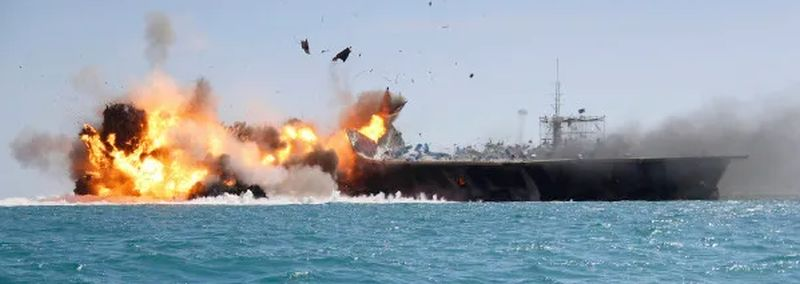
When the game began, the mighty Blue fleet steamed up to the Red fleet. The Blue Admiral issued an ultimatum demanding surrender. The enemy commander refused. Instead, Riper attacked and hit the larger Blue fleet hard. Missiles from land-based units, civilian boats, and low-flying planes tore through the Blue fleet. His order to initiate the attack was a coded message sent from the minarets of mosques at the call to prayer.
Simultaneously, swarms of speedboats loaded with explosives launched kamikaze attacks. The carrier battle group’s Aegis radar system — which tracks and attempts to intercept incoming missiles — was quickly overwhelmed. “The whole thing was over in five, maybe ten minutes,” Van Riper said. Against all odds and expectations, Lt. Gen. Paul Van Riper was wholly victorious.
When the dust settled, 19 US vessels were gone, including an aircraft carrier, multiple cruisers, and most of the amphibious fleet. In real-world terms, it would have been the deadliest day in US naval history, with tens of thousands of casualties.
Inside the command centers, the reaction was disbelief. Blue Force commander Lt. Gen. B. B. Bell later acknowledged the magnitude of the loss, admitting that the centerpiece of American power projection had been rendered ineffective almost immediately. The reaction to the near-complete destruction of the Blue force was shock and outrage. The simulation was restarted with Blue forces fully restored, and Red forces heavily constrained from free-play “to the point where the end state was scripted”, resulting in a Blue victory.
Millennium Challenge 2002? vs Trump’s War 2026
How does the history of the Millennium Challenge 2002 impact Trump’s war on Iran?
The largest lesson of the war games was that a weaker, less technologically advanced fleet could damage or destroy a larger opponent if creative and asymmetrical tactics are employed.
Earlier this month, Iran’s Supreme Leader Ayatollah Ali Khamenei made a direct threat against the United States Navy’s warships operating in the Middle East. In a social media post, Khamenei suggested the Islamic Republic could attempt to attack and even sink a U.S. Navy vessel, possibly an aircraft carrier. Khamenei will never know how realistic his threats may be, as he was killed by an airstrike on the first day of the US/Israeli attack.
On the other hand, the results of the Millennium Challenge 2002 war games were a shock and a surprise to the US Navy. The games were two decades ago, and the US Navy has trained and prepared for the tactics used by Paul Van Riper in his unexpected war game victory.
The Houthi rebels, supported by Iran, have also given the US Navy and other Western navies real world experince defending against swarm tactics in multiple drone and missile attacks on ships transiting the Red Sea and the Bab-el-Mandeb.
The Iranians have newer and more sophisticated weapons systems than they had in their arsenals in 2003. Iran is well known for its Shahed drones, which are unmanned combat aerial vehicles (UCAVs) and loitering munitions. Over 20 different design variants have been produced.
Interest in Iran’s Shahed-series drones stems mainly from their affordability and extended operational range. Reuters reports that the Shahed-136 is much less expensive than traditional cruise missiles, creating a cost disadvantage when expensive air defense systems are used to counter them.
The US has not released data on the munitions it faced and shot down. Information from the United Arab Emirates’ Defense Ministry shows that Iran has launched hundreds of Shahed drones at the Gulf state, of which just over 90% have been intercepted.
Those interceptions have come at a high cost. The U.S. and its allies generally deploy aircraft or the Patriot air defense system to protect from bombardment, but while the price of one Shahed is estimated to be $30,000 to $50,000, one interceptor can cost 10 times that or more, while exhausting already dwindling stockpiles.
As the US‑Israel‑Iran war continues, analysts warn that the conflict has become a race of attrition between expensive interceptor missiles and Iran’s low‑cost drones and missiles. Iran’s repeated launches are straining Western air defense stocks, which are costly and slow to replenish.
The Iranian naval forces are split into two main groups, the Iranian Navy and the Islamic Revolutionary Guard Corps Navy IRGCN. The regular Iranian Navy operates Tehran’s large surface combatants and submarines as part of a blue water force while the sectarian IRGC is responsible for coastal defense and security in the Strait of Hormuz, primarily with a fleet of small surface attack and missile craft.
The US has made the destruction of Iranian naval forces a priority. Trump announced that as of Sunday, nine Iranian Navy ships have been sunk.
Satellite imagery has revealed the extent of the strikes across Tehran’s primary Persian Gulf naval bases at Konarak and Bandar Abbas. Image captures of the facilities from Vanter show multiple fires, sunken vessels, and destroyed buildings.
Struck and sunken vessels include several frigates from the Bayandor, Alvand, and Jamaran classes. Drone carrier IRIS Shahid Bagheri (C110-4), a converted containership, was attacked by U.S. forces at its berth in Bandar Abbas within the initial hours of Epic Fury, according to a post from CENTCOM. Satellite photos also show the Iranian forward basing ship IRIS Makran (441) struck while at the pier at Bandar Abbas.
The U.S. command also said the strikes have targeted Iran’s small submarine fleet, composed of numerous midget submarines and a handful of Russian Kilo-class attack boats. While it is unclear how severely the strikes impacted Tehran’s subsurface capability, several submarines were present at Bandar Abbas following an attack, according to satellite photos.
Iran has flaunted an asymmetric naval force of missiles, midget submarines, naval mines and anti-ship missile batteries in its threats to shut down the Strait of Hormuz in previous years. American naval forces in the region have been geared against these swarm threats, including Hellfire-armed Seahawk helicopters aboard Abraham Lincoln. Littoral combat ships forward deployed to the US 5th Fleet also have the potential to equip a surface warfare mission package designed to defeat small boat and drone attacks.
Strait of Hormuz
Despite strikes on key regular and sectarian Iranian naval assets, the commander of the IRGC declared Monday that the country’s forces would enforce a closure of the Strait of Hormuz – threatening to open fire on any vessels attempting to transit the strategic waterway crucial to the world’s natural gas and oil network. Over the last several decades, the Iranians have built a vast inventory of sea mines designed to block the flow of crude from the Gulf States for export.
The IRGC has a fleet of 3,000 –5,000 armed speedboats with a displacement below 10 tonnes. Depending on the class, these boats are armed with missiles, rockets, and heavy machine-guns. These speedboats have operating speeds between 35 and110 knots.
Many of these speedboats can also be fitted with the Hoot is an Iranian supercavitation torpedo claimed to travel at approximately 360 km/h (220 mph), several times faster than a conventional torpedo.
The US Navy vs the Swarm
If the Islamic Revolutionary Guard Corps Navy follows through on its threat to close the Strait of Hormuz, the US Navy may have to engage the IRGC swarm near the entrance to the strait.
Naval News comments that Iran’s Gulf defense plan is multi-layered, requiring the simultaneous use of air, ground, and naval weapons to saturate the enemy’s defense systems. This tactic aims to deter opponents by posing a significant threat to them, and it makes it impossible to penetrate the Gulf without incurring a significant loss of combatants. As a result, the Iranians have acquired a huge armament of asymmetric naval equipment, including naval mines, midget submarines, hundreds of armed speedboats, anti-ship cruise missiles on land and sea, UCAVs, and so on.
Swarm attacks utilizing manned/unmanned speedboats can act as a backbone for deterring opposing surface assets, and Iran frequently displays its capabilities in this area with speedboat parades. Iran conducts military drills in the Gulf and elsewhere in the country on a regular basis to boost the readiness of its armed forces.
Analysts and naval enthusiasts may find it amusing to compare a speedboat to a destroyer. However, evaluating the capabilities of assets on paper can lead us astray when doing a real-world examination. Because naval warfare is not a cage fight, it is more appropriate to compare force compositions and make assessments based on compatibility with the geographical location, performance of weapons and sensors in the area, and, of course, naval tactics that can be adapted in littoral seas.
Because of their small radar cross-section, high speed, and agile maneuverability, fast boats are unlikely to be struck with standard gunfire. These boats, however, can be engaged by guided missiles, and the probability of a strike improves when laser-directed munitions are used. A single boat rarely poses a substantial threat to a combatant, but what happens when a ship or task force is attacked by a swarm of dozens of similar speed boats?
Swarm attacks are high-risk, coordinated assaults that sometimes target numerous targets. They are extremely difficult to defend for a variety of reasons, one of which is simply numbers and redundancy; if there are so many spread-out, yet fast-approaching small boats, deck-mounted ship guns or overhead assets such as drones or helicopters may struggle to destroy enough approaching targets at once. Because of sensor and weapon saturation, radar tracking issues, limited time for kill evaluation, and automatic sensor weapon allocation issues, it is nearly impossible to counter all of the targets.
Sinking a Super Carrier
One open question relates to the claim made by Ali Khamenei, who suggested that the Islamic Republican Guard Navy could sink an American aircraft carrier. After Ali Khamenei’s assassination, the Islamic Revolutionary Guard Corps issued a statement saying the carrier USS Abraham Lincoln was struck by four ballistic missiles. The Pentagon quickly labeled the claim “a lie,” saying the missiles or drones involved did not come close to hitting the carrier.
The US Navy had a very difficult time sinking the retired Kitty Hawk-class supercarrier USS America (CV-66) in 2005. During a SINKEX live-fire test to document carrier survivability, the carrier endured nearly a month of intense, weaponized testing and was finally scuttled via internal explosive charges.
Most American military analysts believe that sinking a modern supercarrier is virtually impossible, whether the ship is a Nimitz-class ship like the Abraham Lincoln, or the latest and greatest, USS Gerald R. Ford, the largest and most powerful ship ever built.
If the Iranians manage to sink or even significantly damage a US supercarrier, it would be a major blow to American prestige. As difficult as carriers are to sink, it could happen. Advances in carrier design have been matched and possibly exceeded by new hypersonic missiles known colloquially as “carrier killers.”
Hypersonic missiles are missile weapon systems that travel at speeds of at least Mach 5—five times the speed of sound (mph or km/h)—and are capable of maneuvering within the atmosphere to evade detection and defense systems. Unlike traditional ballistic missiles with predictable trajectories, these weapons offer high precision, rapid, long-range, and hard-to-counter strike options.
Fattah-2, the new Iranian hypersonic missile, is equipped with a hypersonic glide vehicle (HGV) warhead, a top speed of Mach 14, and a range of 1,400km (870 miles). A report published by a prestigious military website indicates that existing air defense systems worldwide are largely unable to intercept Iranian-made missiles.
Iran is close to finalizing a deal to buy China’s Ship-Killer CM-302 supersonic anti-ship cruise missiles. The CM-302 flies at over Mach 3, has a range of nearly 290 kilometers, skims low over the sea to avoid radar detection, and carries a 500-kilogram warhead powerful enough to severely damage or even sink large warships.
The prospective sale would deepen China-Iran military ties, potentially defy reimposed UN sanctions, and come as US carriers, including the USS Abraham Lincoln and USS Gerald R. Ford, move into striking distance, depending on the variant and launch platform – either sea, air, or land launchers
.
Missile Defense Advocacy Alliance (MDAA) says the CM-302 uses a combination of inertial and satellite guidance and can perform evasive maneuvers, complicating interception. It mentions that these capabilities – supersonic flight and evasive maneuvers – make it well-suited for anti-access/area-denial (A2/AD) roles against high-value naval targets such as aircraft carriers.
Could Iran sink or seriously damage a US super-carrier? Would the US Navy be able to effectively defend against layered attacks by swarms of heavily armed speed boats, massed drones, submarines, and hypersonic missiles? Will the smaller and weaker Iranian naval force be able to hold its own against the largest, most powerful navy in the world?
The Iranians are creative and highly dangerous adversaries, defending their nation against a powerful enemy. They should not be underestimated. The damage that the Iranians can do to the world economy by disrupting shipping could be serious, and the potential for a spreading regional and even a global conflict continues to grow.
The tragedy of the impending bloodshed is that it is so pointless. The current criminal in the White House tore up an imperfect but functional Nuclear Non-Proliferation Treaty with Iran over a decade ago. Whatever its flaws may be, diplomacy is invariably preferable to war.
The US military was shocked by a war game twenty years ago. It now appears that the Trump regime has launched us into a needless war with no clear plan or endgame, which itself is shocking. Time will tell as to whether we see a real-world replay of Millennium Challenge 2002?.
A convincing and thoughtful piece. Senior planners are obviously well aware of such a nightmarish scenario–and the real possibility of the consequential losses. What’s more terrifying is that our military professionals are hobbled by the chain of command which culminates with an aged and ill man whose actions are dictated by his narcissism, awareness of his power and need to prove his dominance. Trump acted at the behest of Israel to attack its traditional enemy. We sided with one religious theocracy against another. And it will continue and end as any religious war does-in an orgy of death and destruction.