
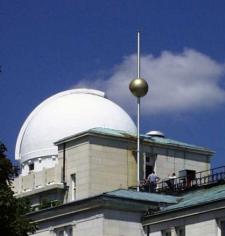
The USNO Millennium Time Ball
Tonight, roughly a million revelers will watch in person in New York’s Times Square, and over a billion viewers are expected to watch on television or online, as the New Year’s Eve ball drop rings in 2026 with a dazzling new time ball — the largest in the history of the event that started 118 years ago.
The Constellation Ball, as it has been named, is the ninth ball to usher in the new year at the famous Midtown Manhattan intersection. It measures 12.5 feet in diameter and weighs just over 12,000 pounds, is bejeweled with 5,280 circular Waterford crystals in three different sizes — 1.5-inch, 3-inch and 4-inch — as well as LED light pucks.
In another first, the dazzling new ball will be lowered twice, to celebrate both the arrival of the new year and the 250th anniversary of the founding of the United States. As the clock strikes midnight on New Year’s Eve 2025, the Constellation Ball will drop and then rise back up to be relit in red, white and blue for a second celebration.
The tradition of the ball drop began in 1907 after New York City officials banned New Year’s fireworks over concerns about the celebration setting the city on fire. Instead, they chose a time ball to mark the birth of the new year, But where did the tradition of dropping a ball to mark the time originate? The practice dates back to 1829 and was a key tool for making it possible for sailors to calculate their position at sea.
When out of sight of land, a navigator can determine latitude, his position north or south on the globe, by measuring the altitude of the sun using only a sextant and a nautical almanac. To determine longitude, his position east or west, however, a navigator must compare the time of the locally observed noon with the time on his chronometer, usually set to the time in Greenwich, UK. The first chronometers rugged enough for use at sea were developed by John Harrison and others in the mid to late 18th century. By the 19th century, marine chronometers were adopted on naval ships and many merchant vessels.
But how could a navigator easily and precisely set his ship’s chronometers? To solve this problem, the Royal Navy’s Captain Robert Wauchope invented the time ball in 1829. It was a large ball hoisted to the top of a pole on a building easily visible to ships in the harbor. The ball would be lowered at a precise time, usually noon or 1PM. When the navigators on ships in the local harbor saw the ball beginning to drop they could use it to set their chronometers to the exact time.
The first time ball was erected in Portsmouth in 1829, followed by a time ball at the Greenwich Observatory in 1833 and at the US Naval Observatory in Washington in 1845. Soon, time balls were installed in ports around the world.
In 1877, Western Union installed a time ball on its Manhattan headquarters, at Broadway and Dey Street. Its firing signal came from the Naval Observatory in Washington, via a dedicated telegraph line, which directed the ball to drop at noon New York time, or about 11:48 a.m. in D.C. At a distance, the ball appeared to be a solid ball. It actually was made up of a dozen thin semicircles made of sheet copper, half of which were crescents. This allowed for minimal wind resistance when dropped.
On April 5, 1913, the Titanic Memorial Lighthouse was installed on top of the Seamen’s Church Institute and overlooked New York Harbor from Battery Park on the southern tip of Manhattan. From 1913 to 1967, a time ball on top of the lighthouse would drop down the pole to signal twelve noon to the ships in the harbor. In 1976, the Titanic Memorial Lighthouse was moved to the corner of Pearl and Fulton Streets, near the entrance to the South Street Seaport, in downtown Manhattan.
With the advent of radio time signals in the 1920s, the time balls became obsolete. Nevertheless, the time balls at the Greenwich Observatory and the US Naval Observatory continue to drop every day to give both locals and ships on the rivers a means of setting their watches. And, when the ball drops at midnight every year at Times Square, whether watched by many or a few, the bejeweled ball pays homage to Robert Wauchope’s invention, the time ball.
Happy New Year to all.
There is a time ball in Lyttelton NZ too. Began operation in 1876. It is still working and can be visited by tourists
Interesting. Thanks.