
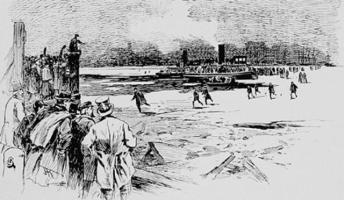
Strolling on the East River, 1867
As we posted recently, the Coast Guard has been busy breaking ice in New York Harbor. The current forecasts suggest that the frigid weather is likely to continue for several more weeks, so the ice breaking is also expected to persist. Nevertheless, it has been far worse in the past. Even the recent past. In 2015, ferry traffic was interrupted by heavy ice in New York’s East River, and sections of the Hudson River partially froze over. And that is nothing compared to conditions in the late 18th and 19th centuries.
When the Harbor Froze
Despite tidal currents that can run up to four knots, New York’s East River froze solid at least eight times between 1780 and 1888. The East River isn’t actually a river. It is a tidal strait connecting Upper New York Bay to Long Island Sound. Nevertheless, it froze often enough so that after the particularly hard winter of 1866-1867, there was a public outcry that led ultimately to the construction of the Brooklyn Bridge.
People continued to walk across the frozen East River even after the Brooklyn Bridge was completed in 1883. In the hard winter of 1888, the New York Times reported: The ice was fully six inches thick and covered with two inches of hard snow” and “was solid from shore to shore.” That day, New Yorkers tested the strength of the ice and “paid a boy his two-cent fee for the use of his ladder” to get on the ice on the Brooklyn side… when they reached Manhattan, they found a young employee of the fish market with a thriving side business, charging 5 cents to use the ladder he secured to help people up to land.
On the other side of Manhattan, the Hudson River has frozen solid at least three times — 1720, 1780, and 1821. During the American Revolution, British troops were put on high alert when the Hudson River in the Upper Harbor froze solid, and there were rumors of an attack by American soldiers ready to march across the ice from Staten Island.
When the river froze over in 1821, thousands of people crossed the ice from New York to New Jersey. Enterprising New Yorkers set up taverns on the ice in the middle of the Hudson river, half-way between Manhattan and Hoboken, NJ to warm those out for a walk across the frozen waterway.
River ice also brought tragedy. In 1815, Robert Fulton and a friend, Thomas Addis Emmet, were walking home from a social event one evening on the frozen Hudson River when Emmet fell through the ice. Fulton attempted to rescue his friend but was soaked in the icy water. He contracted pneumonia and then tuberculosis, and died at the age of 49.
New Yorkers Used To Walk Over The Frozen East River On “Ice Bridges”
So as those of us on the East Coast hunker down and wait for warmer weather, we can take comfort in a non-Biblical invocation, “Many are cold but few are frozen.”