
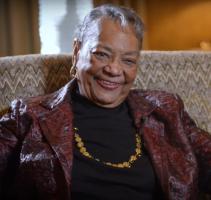
 In a time when the US Navy seems incapable of designing and building ships that are not significantly over budget and behind schedule, it is good to remember Raye Montague, a pioneering American naval engineer who helped revolutionize the way the Navy designs ships and submarines. She was also an African American who faced racism and sexism, and became an internationally registered professional engineer who shattered the glass ceiling at the Navy when she became the first female program manager of ships. She earned the civilian equivalent of the rank of captain.
In honor of both Women’s History Month and last month’s Black History Month, an updated repost about the barrier-shattering naval engineer Raye Montague, who died at the age of 83 in 2018.
At the age of 7, she was inspired to become an engineer after she toured a captured World War II German submarine with her grandmother. As an African-American girl, however, she was told that becoming an engineer was simply not an option.
She attended Arkansas Agricultural, Mechanical & Normal College (now University of Arkansas at Pine Bluff) and graduated in 1956 with a bachelor of science degree in business. At the time, the engineering program at the University of Arkansas did not admit African-American students.
Thirty years later, Raye Montague became the first person to use a computer program to rapidly develop a preliminary ship design for the U.S. Navy. The design process had previously taken the Navy two years. Montague completed the preliminary design of the Oliver Hazard Perry Class frigate in less than 19 hours. Her accomplishment revolutionized the way the Navy designs ships and submarines.
Raye Montague would become the program director for the Naval Sea Systems Command (NAVSEA) Integrated Design, Manufacturing, and Maintenance Program, the division head for the Computer-Aided Design and Computer-Aided Manufacturing (CAD/CAM) Program, and deputy program manager of the Navy’s Information Systems Improvement Program. In 1972, she was awarded the Meritorious Civilian Service Award.
Despite her accomplishments, Montague was largely invisible to the public and often to her colleagues. As noted by the New York Times:
Although she was decorated by the Navy, Ms. Montague, who retired from the service in 1990, was not acknowledged publicly until 2012, when The Arkansas Democrat-Gazette wrote an in-depth profile of her.
She was not recognized nationally until the publication in 2016 of “Hidden Figures,” Margot Lee Shetterly’s best-selling account of the black female mathematicians at NASA who facilitated some of the nation’s greatest achievements in space. Their acclaim was amplified later that year when the book became an Oscar-nominated movie.
The Navy honored Ms. Montague as its own “hidden figure” in 2017. She was inducted into the Arkansas Women’s Hall of Fame in 2018.