The bloody chaos of Trump’s war of choice in Iran continues to muddle forward. Most recently, Trump has announced that the US intends to blockage the Strait of Hormuz in order to break the blockade of the strait triggered by his own needless war. Trump has still not provided a coherent rationale for starting the war, nor has he had an overall plan to win the conflict. He also lacked an exit strategy. Trump is now claiming that the war is over, despite the obvious battles that nevertheless continue.
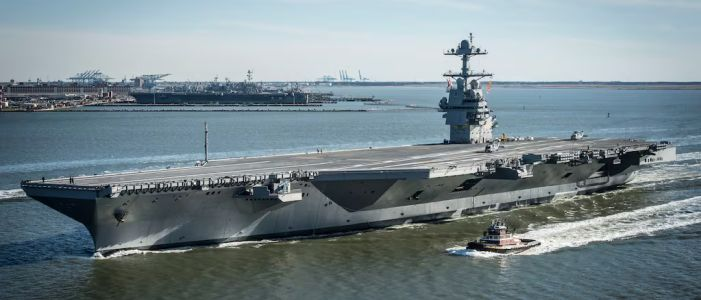
Trump did, however, assemble an armada of at least 16 ships led by the carrier USS Gerald R. Ford and the carrier USS Abraham Lincoln strike groups. At more than 16 ships, it was the largest naval deployment in and around the Middle East since 2023. Leading the armada was the USS Gerald R. Ford, the largest, most powerful, and most expensive aircraft carrier the world had ever seen.
Only days after Trump started his illegal war, the USS Ford was withdrawn from the Red Sea combat zone and sent to repair facilities in Split, Croatia. Oddly, the Ford was defeated, not in battle, but by broken toilets, laundry room lint, extended deployments, an exhausted crew, and failures in other major ship systems.
The immediate trigger for the ship’s withdrawal was, believe it or not, a March 12 fire, which originated in the ship’s laundry facilities and spread through adjacent areas. The fire was reported to have been caused by the ignition of laundry lint. The conflagration lasted over 30 hours before it was extinguished. Over 600 sailors lost their berths, forcing them to sleep on floors and tables. Two sailors were treated for non-life-threatening injuries.
Although the Navy confirmed that propulsion systems were unaffected and the carrier remained operational, the scale of the incident put the ship’s flight deck out of action, stopping sorties for two days.
The Ford has another major problem. In addition to having to work through teething problems with new systems on the ship without any time off, the crew has had to suffer through a horrific system failure — the roughly 650 toilets on board often just don’t work.
The toilet system is undersized and poorly designed, according to a General Accountability Office report in 2020. The system continues to fail during deployment, forcing the crew of 4,600 sailors to live with a system that randomly breaks down during their months at sea.
Problems with the Vacuum Collection, Holding and Transfer (VCHT) system increased in 2025. The vacuum system was adopted in part from the cruise ship industry. It uses less water, but the system used by USS Ford is more complex. Breakdowns have been reported since the $13 billion carrier first deployed in 2023.
The most expensive problem is calcium build-ups, which clog narrow pipes, especially in the lower decks of the ship. The 2020 GAO report said the Navy spends $400,000 for an acid flush to restore the system. A document showed the ship has been acid flushed at least 10 times since 2023. The work can only be done in port.
What makes the problem virtually inexcusable is that, unlike the cutting-edge technology of so many of the systems on the Ford, the problems with the ship’s sewage system are nothing new.
Fifteen years ago, we posted about the delivery of the tenth Nimitz-class carrier, the USS George HW Bush. The ship was the most advanced of the Nimitz class carriers. The one thing that the ship did not have, however, was working toilets.
Since it was deployed in May of 2011, the Bush suffered from widespread plumbing failures, which, at times, rendered the entire ship without a single working head. With remarkable understatement, the crew complained that the lack of toilets has “affected their morale, health and job performance.” The Navy blamed the sailors, who blamed the design of the vacuum toilet system.
The problem was carried over directly to the Ford Class carriers. In 2020, we posted USS Gerald R. Ford, Clogged Toilets and Overflowing Costs. This wage problem was reported in detail by the GAO in 2020.
The Ford is a brand-new ship packed with cutting-edge technology that was sent sailing into potential combat against a dangerous and well-prepared adversary. Prior to being sent to the Middle East, Trump used the ship to play games of gunboat diplomacy in the Caribbean. This was the third extended deployment of the ship, and the crew is reported to be exhausted. Several critical ship systems are malfunctioning, increasing the burden on the crew even further.
“President Trump’s decision to extend the deployment of the aircraft carrier is taking a toll on the ship’s sailors and their families, and leading some to consider leaving the Navy when they return to home port, according to interviews with sailors on board the ship and their family members back home,” according to a new report in the Wall Street Journal.
The Navy typically schedules ships for six-month deployments and tries to avoid having them go longer than seven. Members of the crew have told The New York Times that morale on the ship dipped after their deployment was first extended and has cratered since it was ordered to the Middle East. Beyond damaging morale, the extended deployments could lead to maintenance issues down the line.
Given that the status of the USS Ford is still unclear, the US Navy has dispatched the aircraft carrier USS George H.W. Bush and its strike group from the Naval Station Norfolk as a potential replacement for the USS Ford.
Yes, the USS George H.W. Bush has suffered from persistent issues that have plagued the newer USS Gerald R. Ford (CVN-78), confirming systemic design flaws with this vacuum technology. As of 2026, the plumbing issues continue to plague these vessels, causing significant maintenance headaches for the crew.
I understand the problems with the ship itself – those are beyond ridiculous and demonstrates to me that the Navy has lost its was being fiscally and operationally at a huge cost to the taxpayers. Thank you for sharing this. The part about the sailors puzzles me – infantry units can be on alert and in the field and for extended times. The Navy in WW2 deployed for far longer and in combat. What does having tired sailors in peace time do with this? We all got tired but we all had jobs to do.