
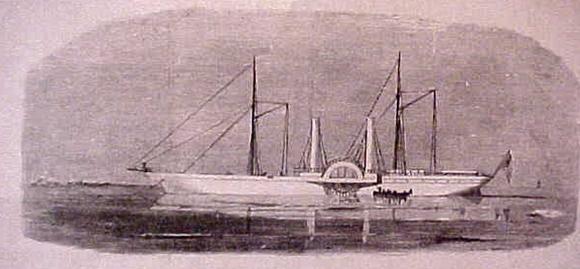
USS Cornubia, ex Lady Davis
Happy Juneteenth! Juneteenth is the oldest nationally celebrated commemoration of the ending of slavery in the United States. Juneteenth is also the newest Federal holiday, signed into law in 2020. The holiday commemorates the arrival of emancipation in Galveston, Texas, by steamship, 161 years ago today.
While the end of slavery is a landmark well worthy of celebration in a nation notionally founded on the truth that all men are created equal, the current administration has attempted to deny black history in part by slashing diversity, equity, and inclusion (DEI) programs and taking other actions as well that inflict disproportionate economic harm on African Americans.
President Joe Biden signed legislation in 2021 establishing Juneteenth National Independence Day as a federal holiday, after the measure received the Senate’s unanimous consent and passed the House on a 415–14 vote.
When President Trump was reelected, he was not happy with the new federal holiday. Without Congressional approval, he couldn’t abolish Juneteenth as a holiday, so instead, he got petty and cut free admission days in honor of Juneteenth and Martin Luther King Jr. Day at more than 100 national parks across America.
Instead, he substituted his own birthday, June 14, as a free admission day. As Robert Reich noted, “there you have it: the venal combination of Trump’s white supremacy and his malignant narcissism
The Trump administration considers the history of enslavement in America and much of the Civil War itself to be anti-white. It has taken legal action against the Smithsonian, the National Parks Service, among others, claiming that exhibits that relate to unpleasant history somehow claim that the nation is irreparably racist and hateful.
What Happened on Juneteenth and Why it Still Matters Today?
Although the surrender at Appomattox Court House, Virginia, signaled the end of the nation’s Civil War on April 9, 1865, emancipation did not arrive in Texas until two months later, when two ex-Confederate steamships sailed into Galveston Harbor. (The Emancipation Proclamation was signed two years before, but was enforceable only in areas occupied by the Union Army)
On June 5, 1865, emancipation arrived in Texas when two Union Navy ships, USS Cornubia and USS Preston, steamed into Galveston harbor. Both ships had been captured from the Confederacy. USS Cornubia was a 210′ long British fast iron paddle steamer. Purchased by Confederate agents as a blockade runner and renamed Lady Davis, she was then captured by the Union Navy in 1863.
USS Preston was a 170′ twin-screw British blockade runner named Annie, captured in 1864. The ex-blockade runners carried Captain B. F. Sands with a detachment of Union troops to raise the United States flag over the federal customs house on the Texas island city. On June 18, 1865, Union General Gordon Granger arrived at Galveston Island with 2,000 Federal troops and took full control.
The war was over. Lee had surrendered at Appomattox Court House on April 19th, 1865, but word of the surrender took time to travel west to Texas. The Army of the Trans-Mississippi, the last major Confederate army in the field, finally surrendered on June 2.
On June 19, standing on the balcony of Galveston’s Ashton Villa, General Granger issued five “general orders.” General Order No. 3 read in part:
The people of Texas are informed that, in accordance with a proclamation from the Executive of the United States, all slaves are free. This involves an absolute equality of personal rights and rights of property between former masters and slaves, and the connection heretofore existing between them becomes that between employer and hired labor.
Former slaves in Galveston celebrated in the streets after the announcement, and in 1866, freedmen organized the first of what would become annual celebrations of Juneteenth in Texas. Barred in some cities from using public parks because of state-sponsored segregated facilities, across parts of Texas, freed people pooled their funds to purchase land to hold their celebrations, such as Houston’s Emancipation Park, Mexia’s Booker T. Washington Park, and Emancipation Park in Austin.
The celebration of Juneteenth has waxed and waned over the years. Given that racist attacks are again on the rise, and that white supremacists pose the greatest threat of domestic terrorism, this seems like a critical time to celebrate the national holiday.
Why does Juneteenth matter today?
Juneteenth matters because the challenges of emancipation remain with us today. This nation made significant progress toward racial justice before sliding back again toward white nationalism.
The epic legislation of the 1960s has been reversed by corrupt legislators and courts. Voting rights are again being denied to Americans based on skin color and ethnicity.