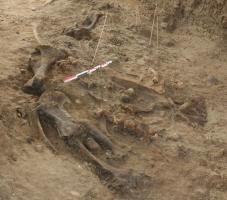
 Researchers have dated stone tools and bones from a butchered rhinoceros and other ancient fauna found in the Philippines’ northern island of Luzon, that date back over 700,000 years, or several hundred thousand years before modern man evolved. So far no human bones have been discovered, but as reported in a recent report in the journal Nature, recent excavations in the Cagayan Valley of northern Luzon in the Philippines that have yielded 57 stone tools associated with an almost-complete disarticulated skeleton of Rhinoceros philippinensis, which shows clear signs of butchery, together with other fossil fauna remains attributed to stegodon, Philippine brown deer, freshwater turtle, and monitor lizard.
The discovery raises many questions. Who were these early hunters? When did they arrive in the Philippines? How did they cross the seas to reach the islands? Because Homo sapiens, or modern man, did not arrive until around until around 300,000 years ago, the rhino hunters on Luzon were most likely Homo erectus, the first the first hominin believed to have ventured out of Africa.
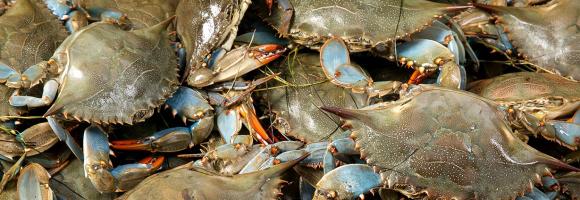 The good news is that the waters of the Chesapeake are getting progressively cleaner and the crab population has experienced a significant rebound. The bad news is that anti-immigrant politics have plunged the Chesapeake crabbing industry into chaos.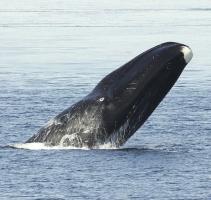
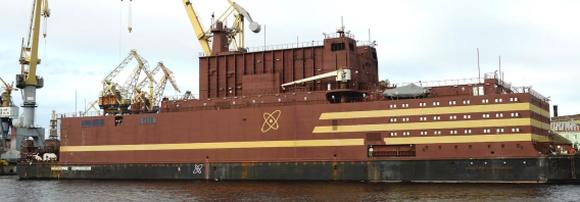 The media has called the Russian floating nuclear power plant Akademik Lomonosov a
  The saga of the US Navy’s
  A
A 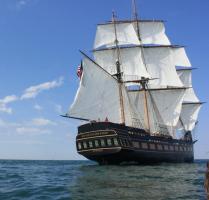
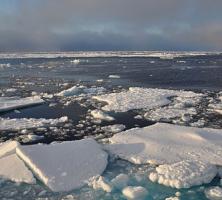 A new study has found record quantities of microplastics in sea ice. The
  A new race is being organized for 2019 and 2020 to celebrate the 500th anniversary of the discovery of the
  We have been following the
 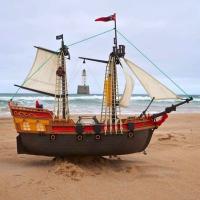 The extremely small ship Adventure sails on. Last year
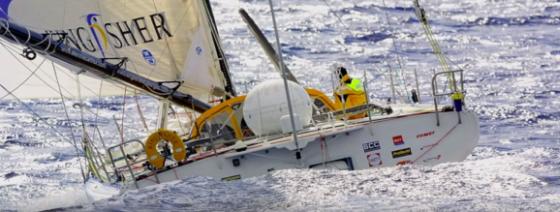 I realize that I am in a rut. Every Earth Day, I say the same thing. Over 70% of the surface of this planet is covered by water, so referring to the planet as “earth” is just wrong. But be that as it may, the misnamed planet is still called Earth and Earth Day is a worthwhile celebration of protecting the planet, both the soil and the watery portions. Below is a TED talk by one of the world’s great sailors, Dame Ellen MacArthur, about what she learned when she was sailing around the world alone. As she circled the globe alone, she began thinking about the idea of “the circular economy,” an intriguing insight. Definitely worth watching.