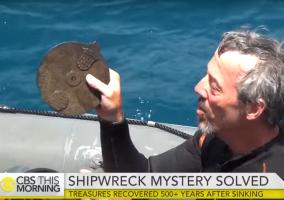
 A year ago last March, marine archeologists determined that the wreck of a ship found off the coast of Oman was the Esmerelda, one of the ships in a fleet led by Portuguese explorer Vasco da Gama in 1502. The wreck was discovered in 1998, but excavation didn’t begin until 2013, and since then, researchers have recovered more than 2,800 coins and artifacts. One of the more interesting artifacts is a bronze mariner’s astrolabe, a device used to measure the altitude of celestial bodies. The astrolabe, a primitive precursor to a sextant, is believed to be the earliest of its type ever located.
When the bronze disk was brought up from the wreck in 2016, it was suspected to be an astrolabe but was sufficiently worn so that no markings used in navigation were visible. Subsequently, laser scanning by scientists at the University of Warwick revealed etches around the edge of the disc, each separated by five degrees, confirming that it was indeed used for navigation. The Portuguese coat of arms and the personal emblem of Don Manuel I, the King of Portugal at the time of the sinking, were also found on the disk.
 Last Thursday evening, a man described as being
 A fleet of seven teams of racers set off this morning from Alicante, Spain bound for Lisbon, on the first leg of the
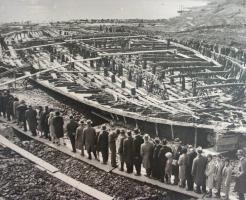 Part of one of
  His name is Rimas Meleshyus. He recently showed up adrift on his 30-foot sailboat, Mimsy, off
  The 2017 Great Chesapeake Bay Schooner Race turned out to be a great race indeed. The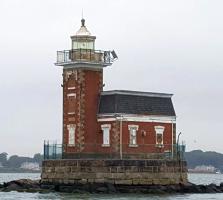
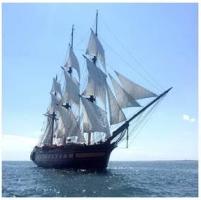 The 200′ long three-masted square-rigger
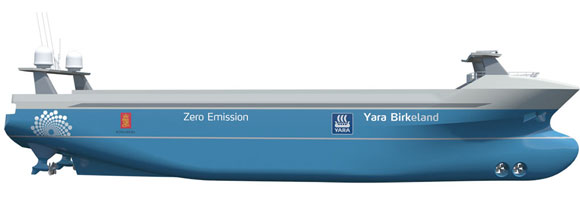 The first autonomous container ship, the 120 TEU feeder vessel,
 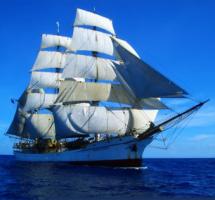 In March of 2018, the barque
 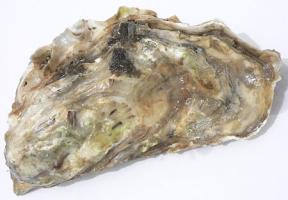 As one who is very fond of oyster-flavored oysters, I am not sure that a raspberry, ginger, shallot or muscat flavored oyster is necessarily a good idea. Nevertheless, French oyster farmer Joffrey Dubault, 29, is working to bring these
 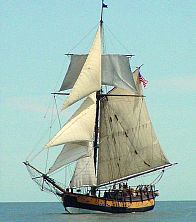 I had kind of lost track of the replica Revolutionary War sloop Providence. In January 2015,
  A new study released this week suggests that