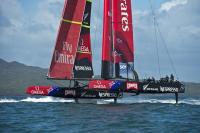
 Dick Newick, the brilliant multihull designer, has died at 87. His designs, particularly his trimarans, revolutionized the world of multihull sailing. His designs are remarkably graceful, simple, light and astonishingly fast. In a very real sense, the history of multihull design can be divided into Before-Newick and After-Newick. Before-Newick, trimarans were ugly and boxy. Newick’s designs, when they first arrived in the 70s and 80s, seemed almost other-worldly, with sweeping lines and amas that rested lightly on the water.
The first Newick design to catch the world’s attention was not a trimaran but a proa. Newick designed Cheers, for Tom Follett who placed third in the Observers Single-handed Trans-Atlantic Race (OSTAR) of 1968, the first multihull to place in the race. Soon Newick designed trimarans were winning ocean races around the world. In 1980 Phil Weld sailed, Moxie, a Newick designed trimaran to win OSTAR, the first American ever to do so. Weld set a new race record of 17 days 23 hours and 12 minutes.
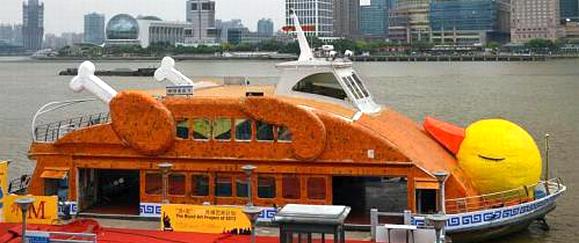 In June, we posted about the Dutch artist Florentijn Hofman’s traveling
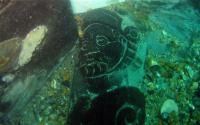
 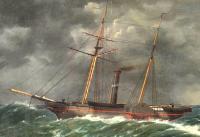 In 1970, fisherman discovered a shipwreck in about 85 feet of water, ten miles off the Absecon Inlet on the New Jersey coast. For more than 40 years, divers have visited the unidentified wreck. Now the National Oceanic and Atmospheric Administration (NOAA) has positively identified the wreck as the iron-hulled side-wheel steamer, Robert J. Walker, a U.S. Coast Survey vessel that sank in 1860 after a violent collision with a 250-ton schooner. Twenty sailors aboard the Walker died, making it the worst accident in the history of the U.S. Coast Survey or its successor, NOAA.
 The two headlines in the BBC are from the same day and posted only an hour apart. The first reads “
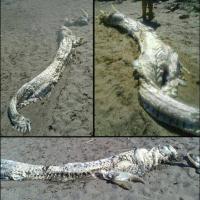 It is around 13 feet long, appears to have horns and stinks to high heaven. A carcass washed ashore on Luis Siret Beach in Villaricos, Spain which is being widely referred to a “
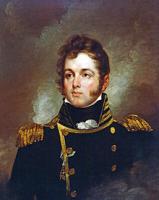 Oliver Hazard Perry
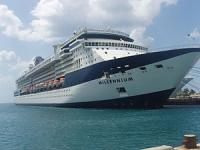 Is pod propulsion the best or worse thing to ever happen to cruise ships?
 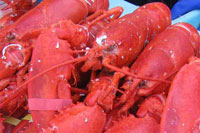 Maine has been experiencing a lobster boom. After catching an average of 20 million pounds of lobster per year for decades, Maine’s 5,500 lobster-men landed a record 125 million pounds of lobsters last year. Will this boom, however, end in a bust? Some experts think so. The question is important because the other ground fisheries in the Gulf of Maine; cod, haddock, pollock and hake; have been effectively fished out. Lobster accounts for 80% of the total value of the Maine fisheries. If lobster yields drop dramatically, the economic impact on the coast could be dire.