 The US Navy’s newest strategic weapon may be a Massive Multiplayer Online Wargame. If it works for HALO and gears of War, why not the Navy? The project is a joint effort between the Office of Naval Research (ONR), Naval Postgraduate School (NPS) and Institute for the Future (IFTF). The approach is to “crowdsource ideas and strategies that may provide insight to some of the Navy’s toughest problems.”
The game’s first round was “piracyMMOWGLI” in Summer of 2011 and focused on countering Somali piracy. The next round, energyMMOWGLI, is launching this month. As the name suggests, this game deals with energy, specifically asking the question, “How can the Navy best meet future energy demands?” The game is focused on reducing fossil fuel dependency. ironically, as pointed out by TPM, “the timing of the new game’s launch is somewhat unfortunate given that the Republican-led House Armed Services Committee voted last week to effectively prohibit the Department of Defense from purchasing any alternative fuel that costs more than petroleum. That effectively eliminates biofuels, at least for the near future.” Of course, biofuels are only one component of energy policy, but they could play an important role.
Continue reading →

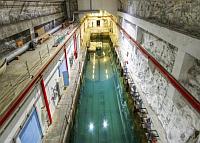 For only 105 million Norwegian krona (thats € 14 million or roughly US$17.5 million) you too can own an Arctic submarine base. Norway’s
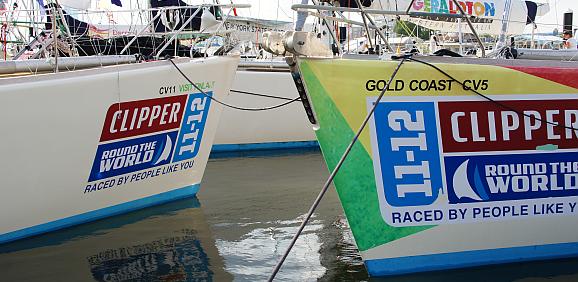 The ten boat fleet of the
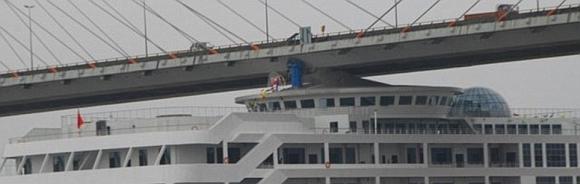 This seems like a suitable post for a Monday morning. The tide was high, the bridge was low and the ship was light. Captain Guo Lai, 48, was in command of the brand new luxury cruise liner, Pearl No 7, on her maiden voyage from the shipyard, when they passed under a suspension bridge on the Oujiang River near Wenzhou City, Zhejiang Province, China. Or at least most of the ship made it under. The ship’s two funnels were sheared off when the clearance between the ship and the bridge turned out to be negative. The Pearl No. 7 has the capacity for 1,000 passengers and cost $44 million to build. She has now returned to the shipyard, Wenzhou Mingzhu Yacht Co., Ltd., for funnel repairs.
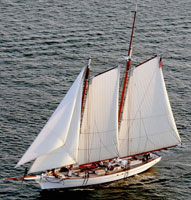 The old cliche that a boat is a hole in the water into which you pour money applies far too well to tall ships. They are expensive to build or restore and chronically costly to maintain and keep running. It should come as no surprise that most of the ships in the recent
 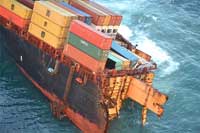 On October 5, 2011, the containership