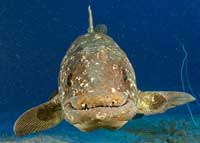
 Coelacanths apparently evolved in their current form around 400 million years ago. They were thought to have gone extinct 65 million years ago, during the Cretaceous-Tertiary extinction – that is, until 1938 when a fisherman in South Africa pulled one up in his nets. Not surprisingly, they are often referred to as “living fossils.” Since their discovery off South Africa, they have also been found in the waters off the Comoros, Kenya, Tanzania, Mozambique, Madagascar. In 1999, coelacanths were also found in the waters of Indonesia off Sulawesi.
Now German scientists have found something else quite remarkable about these rare fish. After a twenty year study they have determined that coelacanths can live up to a hundred years and possibly even longer. This would make the coelacanth not only one of the world’s oldest fish species, but possibly also the longest-lived. Thanks to coelacanth savant and prodigious polymath, Allan Janus for pointing out the article.

 In November,
  The US Navy wants to install a $100 million offshore training range, which would include an undersea array of cables and sensors for training warships, submarines and aircraft about 50 miles off the Atlantic coast of southern Georgia and northern Florida. Environmentalists are seeking to block the project, saying it’s too close to waters where North Atlantic right whales migrate near shore each winter to birth their calves. Right whales are highly endangered. Only about 400 North Atlantic right whales remain. A Federal judge is being asked to rule on the lawsuit filed against the Navy by a dozen conservation groups.

 This week we posted that the Pacific nation of
 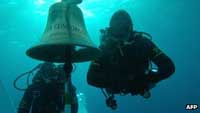 The ship’s bell on the
  Retirement has not been easy for the

 Not long ago, we posted about the
  After 18 months in dry dock and 15,500 volunteer hours of labor, a wholly rebuilt