 Yesterday we posted that the Independence Seaport Museum doesn’t have the money to support the upkeep of the USS Olympia nor does it have the money to dredge the channel to tow her away. On the other side of the river the USS New Jersey Battleship Museum is also having financial troubles. Given the current troubles centered around the Delaware River it almost seems a shame to report that the SS United States, which has been sitting of at Pier 84 in South Philadelphia for the last fourteen years, is now being inspected by scrap dealers. Then again, she is a rusting, gutted shell. Perhaps it is time to let the old lady go. As reported in Maritime Matters:
 Sunken Canadian ship spewing oil off Alaskan coast: U.S. Coast Guard
A storied Canadian steamship that offered luxury cruises for decades along the British Columbia coast, then served a crucial role during the Second World War transporting troops, supplies and Jewish refugees is now adding an unfortunate chapter to its rich history: the polluting of a major Pacific Ocean inlet.
Continue reading
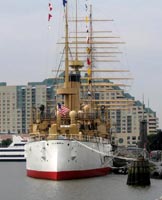 Recently we posted that the Independence Seaport Museum is seeking a new owner for the USS Olympia which it cannot afford to support. See Philly Museum Sends SOS to Care for Historic Ship. Sadly it appears that not only can’t the museum afford to keep the Olympia at dockside, but that it can’t afford to move it either.
Historic ships steel-hulled ships should be drydocked for maintenance at least every twenty years. The Olympia has been in the water continuously for 56 years, since 1945.
Olympia needs $30m in repairs, new caretaker
Continue reading
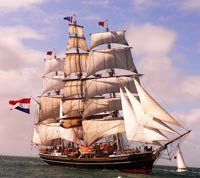 Stad Amsterdam arriving in Melbourne
Back in September we posted about a group of historians and naturalists, as well as a film crew for Dutch VPRO Television sailing on the Stad Amsterdam. The ship is retracing the voyage of HMS Beagle on the 150th anniversary of the publication of Darwin’s On the Origin of the Species. See Retracing Darwin’s Journey – 150 Years Later. The ship arrived in Sydney, Australia earlier this month and last week called at Melbourne. Visit the project website here (in Dutch and English.)
In the ongoing somewhat surreal operation against piracy off Somalia, the HDMS Absalon, a Danish destroyer, sank a pirate “mother ship” but allowed the pirates to return to shore. The official goal appears to be to “disrupt” rather than stop pirate activities. Thus far the naval flotilla has proven itself a significant inconvenience to the Somali pirates but little more. It appears that the nation states involved continue to lack the will to arrest and charge the pirates under international law. A policy of ”catch and release” works well for stocking trout streams but does little in stopping piracy in one of the most important shipping lanes in the world.
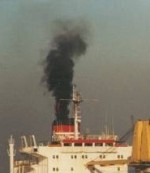 Is a ship the “greenest”, most efficient means of transportation or is the dirtiest? It is easy to be confused about hoe clean or dirty ocean transportation may be from reading the newspapers.
Transportation by water has always been the most efficient means of moving goods over distance. At the turn of the 19th century the cost of transporting an item across the Atlantic by ship was roughly the same cost as moving it 30 miles inland. With canals, railroads and highways, overland efficiency has improved, but, nevertheless, things haven’t changed so much.
A study by National Geographic on the transport of wines reflects this, as expressed by the carbon footprint of the shipment. If you live in New York, a French wine, transported by ship, can have a carbon footprint of only an equivalent to only 0.3 pounds of CO2, whereas a California wine, transported overland by truck, has a carbon footprint of 4.4 pounds.
Ship or Truck Transport Makes All the Difference in Wine’s Carbon Footprint
Continue reading
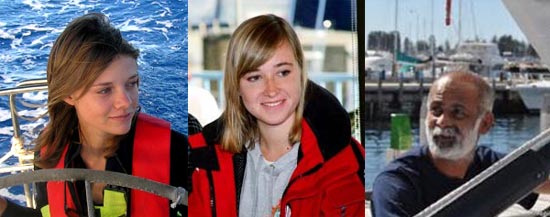
Jessica, Abby, & Dilip
Here is an update on the circumnavigation attempts under way by Jessica Watson, Abby Sunderland and Commander Dilip Donde. The last name may not be as familiar as those of the blonde teenagers. The 42 year old Indian Navy Commander is on the last leg of his quest to be the first Indian to circumnavigate the globe singlehanded. He recently stopped at Cape Town on his way to Mumbai, literally one ocean away from his destination.
Continue reading
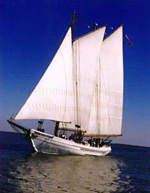 The Port Norris Rotary presents the 13th annual “Run for the Schooner” a 5K run, walkathon & 1 mile fun run/walk on Saturday, April 10, 2010, to benefit the A.J. Meerwald, the official Tall Ship of the State of New Jersey.
To learn more call 856-785-2060, or visit the Bayshore Discovery Project .
The A.J. Meerwald is an authentically restored 1928 oyster schooner operated as a hands-on sailing classroom throughout the region as well as offering shore-based programs and events in her home port of Bivalve on the scenic Maurice River in Cumberland County.
Continue reading
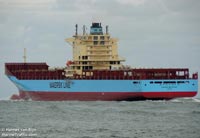
MAERSK BEAUMONT Photo: Hannes van Rijn http://www.marinetraffic.com
We have recently posted about the roller coaster ride that has been container ship design over the last few decades. See Containerships – from Slow to Fast to Slow to Fast to Slow Again. The smartest minds in the shipping industry have not been able to predict what the right speed for the box boats will be. One example of this are the seven virtually new 4,000 TEU Maersk B Class ships designed to operate at 30 knots, all of which went almost directly into layup. What a difference a couple of years makes – Maersk, which spent an estimated $350 million dollars to build these 30 knot ships, is now “slow steaming” much of its fleet at 12 to 14 knots. Financial Times had a recent article about the plight of the Maersk B Class Ships.
World’s fastest container ships mothballed
Continue reading
 After having their toy racing boat, Ady Gil sunk in a collision with a whaling ship; after experiencing engine problems as well as having the registration of their converted whaler, the B0b Barker, pulled by the Togolese; after having the captain of the Ady Gil arrested when he boarded a Japanese whaler; and then after using the Steve Irwin to pelt the Japanese ships with crocodile bath toys, the Sea Shepherds have ended their season of harassment and are sailing for home. They have proclaimed it their “most successful” season yet. And so another year of this dangerous farce comes to a close.
Anti-whaling activists end Antarctic campaign
For the record, we also oppose Japanese whaling, but we do not support the vigilante violence of the Paul Watson and his bumbling seagoing circus. Thanks to Captain D. Peter Boucher of the Nautical Log for the heads up
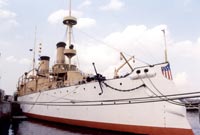
USS Olympia
Terrible news from Phildelphia.
Philadelphia maritime museum says it can’t afford to care for historic USS Olympia
A Philadelphia maritime museum says it can no longer afford to care for a historic ship that served in the Spanish-American War.
Continue reading
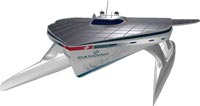 The windjammers liked the higher latitudes where the winds are stronger. This solar craft will try to still as close to the equator as possible to maximize the sunshine. The catamaran reminds me of something out of Star Trek, perhaps a Romulan transport ship.
 After rosy announcements about the restoration of the Cutty Sark an article in the Telegraph has a very different view of the ongoing project.
Cutty Sark restoration turning into a fiasco
The restoration of the Cutty Sark is turning into a fiasco which could seriously damage or even destroy one of Britain’s most famous ships, it can be revealed.
Continue reading

Heinz Stahlschmidt
Heinz Stahlschmidt, a renegade former member of Germany’s World War Two navy, who thwarted plans to wreck the French port of Bordeaux by retreating Nazi forces, has died at the age of 91, officials said. Thanks to Andy Hall at the Maritime Texas Blog for pointing it out.
Renegade German war hero who saved French port dies
Heinz Stahlschmidt was serving as a petty officer in the Kriegsmarine when he was ordered to help prepare the destruction of the southwestern city’s port facilities as the Germans pulled out ahead of advancing allied troops.
Instead, he set off an explosion in the bunker holding detonators and time fuses for the planned demolition, preventing mass carnage in the port area and, according to some historians, possibly saving up to 3,500 lives.
Continue reading
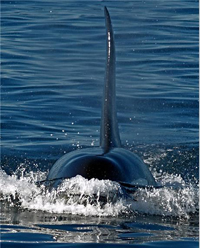 SeaWorld tragedy — a reminder of why orcas should swim free?
For wildlife conservationists, the tragic death of SeaWorld trainer Dawn Brancheau is a sobering reminder of why creatures as large and majestic as killer whales simply should not live in captivity.
The World Society for the Protection of Animals and the Whale and Dolphin Conservation Society are just two of the organizations that have campaigned against the practice. First, they say, killer whales in captivity often get sick and live on average only into their 20s (though there are exceptions). In the wild, the females typically live into their 50s or beyond and the males at least into their 30s.
Continue reading