 General Order 99
One hundred and eleven years ago on July 1, 1914, Secretary of the US Navy Josephus Daniels issued General Order 99, banning “the use or introduction for drinking purposes of alcoholic liquors on board any naval vessel, or within any navy yard or station.”
The US Navy had ended the rum ration in 1862 and imposed progressively more stringent restrictions on what alcohol sailors could have on shipboard. General Order 99 ended even the serving of alcohol in the wardroom and the captain’s cabin. An updated repost.
Prohibition and Ice Cream
Six years later, in 1920, the entire country followed the Navy’s example. With the ratification of the 18th Amendment, the United States banned the production, importation, transportation, and sale of alcoholic beverages. The thirteen year period known as Prohibition led to the growth of criminal gangs and the proliferation of “speakeasies,” illegal drinking establishments.
Prohibition also had a surprising and unexpected result — the growth in the popularity of ice cream. During Prohibition, many American breweries, including Yuengling and Anheuser-Busch, switched from brewing beer to making soda and ice cream. Ice cream parlors became popular places to socialize for both young and old. By the end of the decade, Americans were consuming more than a million gallons of ice cream per day—and, crucially, associating it with the comfort and diversion formerly assigned to alcohol.
World War II and the Navy’s Ice Cream Barge
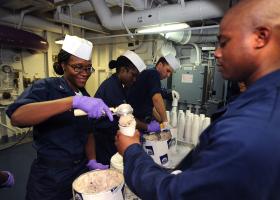
With the end of Prohibition and the outbreak of World War II, the still dry US Navy was provided with ice cream on almost every ship. In the Pacific theater of war, the US Navy even operated a large concrete ice cream barge. The Navy spent $1 million dollars retrofitting a barge they got from the Army to allow it to produce 10 US gallons of ice cream every seven minutes, or approximately 500 US gal per shift, and could store 2,000 US gallons of the finished product. Smaller barges, known as ice cream ships, were built to distribute the ice cream throughout the Western Pacific.
Ice cream was important for morale. In 1942, the U.S.S. Lexington was slowly sinking from a Japanese torpedo attack, before the crew abandoned ship, they broke into the freezer and ate all the ice cream. Survivors describe scooping ice cream into their helmets and licking them clean before lowering themselves into the Pacific.
Ice Cream as a Reward
In addition to the daily rum ration, when the captain of a naval sailing vessel wanted to reward the crew when things went exceptionally well, he might order a tot for all hands. The US Navy developed its own reward system. As there was no alcohol to be had, they used ice cream.
Ice cream became a reward for meritorious service. Specifically, on carriers, a reward system was set up for every pilot rescued by destroyers, escorts, submarines, or any other craft that brought a downed pilot back to the ship. During World War II; ten, twenty, or even thirty gallons of ice cream might be the payoff for a rescued pilot.
Tom Kocurko spent World War II in the Navy and found out about the ice cream tradition while serving on a destroyer escort. “We’d get 10 gallons of ice cream every time we picked up a pilot, which was a real treat. So we started joking, ‘Let’s shoot one down.”‘
Sometimes ice cream may be better than even a tot of rum.
Cyril Tawney the submariner folk singer had this collected at sea.
There`a buzz going around the harbour that the Yanks are going to sea,
With a bottle of cocacola and a damn` great ice cream cone,
They are damn` fine boys in harbour but oh! by Christ at sea;
Tune after `The halls of Montezuma.
This must have followe the abolition.
Chris R
This history makes this bad explanation of “How to Play Battleship” even better.
“Milton Bradley is not afraid to portray these sailors as the sugar-crazed maniacs they are.”
https://www.youtube.com/watch?v=GcOC1nJCuXA
Never knew ice cream played such a major role in military morale. Wild that the Navy went from daily booze rations to building literal floating ice cream factories. Love how something so simple became a psychological tool.
Pingback: Prohibition and ice cream in the US Navy by speckx - HackTech.info
Yep! Served on a destroyer that, for a while, was doing carrier escort duty. One day during flight ops, pilot ended up ditching after his plane’s engine coughed its cookies. We picked him up and eventually high-lined him back to his bird farm. A big tub of ice cream was part of the exchange. 🙂