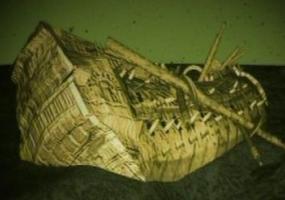
Civilian divers were on an archeological dive on the London, a Royal Navy ship built-in 1656 which exploded and sank in 1665 in the Thames Estuary. They were shocked to find a large World War II bomb in the wreck. And it wasn’t just any bomb. The BBC reports that it was a German parachute ground mine, at 987kg (2,175lbs) one of the biggest bombs used by the Luftwaffe during the war.
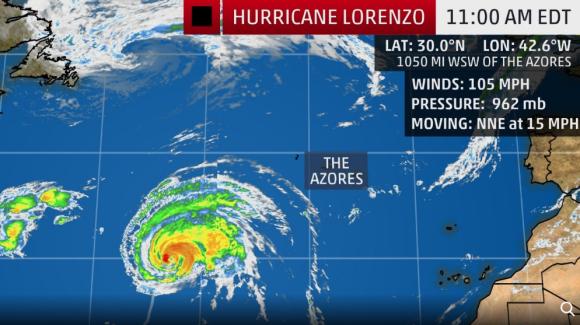
Hurricane Lorenzo strengthened briefly to a Category 5 storm over the weekend, becoming the strongest hurricane on record so far north and east in the Atlantic Ocean. On Saturday, we posted about the sinking of the tug-supply vessel Bourbon Rhode in the hurricane. Eleven of the fourteen crew are missing and presumed dead. Three of the crew were rescued following the sinking.
Lorenzo is unusual in that it strengthened so dramatically while so far east. Most hurricanes strengthen after moving farther west and remaining in warmer southern waters. According to weather.com, Lorenzo is by far the farthest east in the Atlantic Ocean any of the previous 35 Category 5 hurricanes that have occurred in records dating to the 1920s.
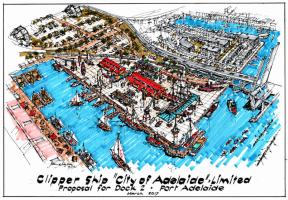
The world’s oldest clipper ship, City of Adelaide, may be one step closer to having a permanent home.
Last March we posted about how the clipper ship City of Adelaide was being kicked off Dock 1 in its namesake port city and was expected to be moved to Dock 2. Unfortunately, Dock 2 was described as a largely inaccessible, industrial wasteland. Promised improvements had not been made in preparation for moving the historic ship.
On Friday, on its Facebook page, it was announced that an agreement has been signed to make Dock 2 a permanent home with suitable infrastructure and access.
The clipper ship City of Adelaide was built in Sunderland, England, and launched on May 7, 1864.
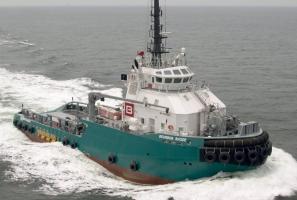
Three sailors have been rescued from a lifeboat following the sinking of the 164′ tug supply boat Bourbon Rhode in Hurricane Lorenzo. The remaining eleven crew members are missing.
The tug had sent a distress signal on Thursday and a rescue effort was mounted by the French and US governments assisted by commercial ships. The tug’s owner confirmed in a press release on Saturday that the Bourbon Rhode had sunk.
In an upcoming PBS documentary, Octopus: Making Contact, a scientist observes an octopus changing color while sleeping upside down in a tank. Is it dreaming? Marine biologist Dr. David Scheel speculates what the dream might be in accordance with the particular shade of camouflage being exhibited at each moment.
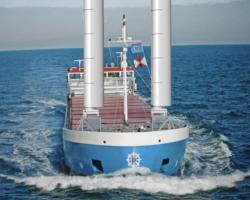
Van Dam Shipping, based in Spijk, Netherlands, has signed a contract for the installation of an eConowind propulsion system on its 3,600 DWT general cargo vessel Ankie. At first glance, two vertical structures in the graphic of the ship look like Flettner rotors. They are different, although a related technology. The two “sails” are a Ventifoil system, a development of Jacques Cousteau’s turbosail design which he used on the research vessel Alcyone in the mid-1980s.
A disturbing new report by the U.N. Intergovernmental Panel on Climate Change concludes that the rate at which the world’s oceans are heating up is accelerating and that sea levels are rising more quickly than previous predictions. The Special Report on the Ocean and Cryosphere in a Changing Climate notes that “the ocean is warmer, more acidic and less productive. Melting glaciers and ice sheets are causing sea level rise, and coastal extreme events are becoming more severe.”
NPR reports that the report is a synthesis of the most up-to-date climate science on oceans and ice, and it lays out a stark reality: Ocean surface temperatures have been warming steadily since 1970, and for the past 25 years or so, they’ve been warming twice as fast.
The recent activation by TRANSCOM of 28 cargo ships, makes it a good time to take a look back at eight iconic shps from the 1970s still in service today.
When I was a young student of naval architecture at the University of Michigan in the early 70s, I attended a Society of Naval Architects and Marine Engineers (SNAME) convention in New York City. In our visit, we took a field trip across the river to the Sea-Land container terminal at Elizabeth, New Jersey to tour a new SL-7 class container ship.
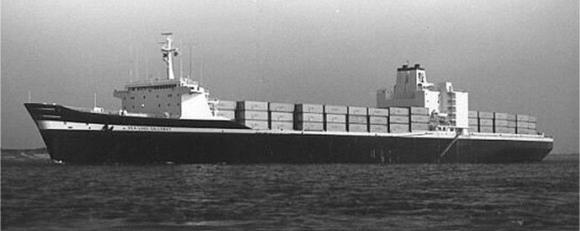
The eight SL-7s were Malcom McLean‘s modern-day clipper ships. As I stood on the pier looking up at the ship, I remember finding the long hollow water line to be breathtaking. And whereas the clipper ship Sovereign of the Seas was just over 250′ long, the SL-7s were close to 1000′ overall. With steam turbines producing 120,000 HP, these ships could cross oceans at 33 knots. They would each carry over 1,000 containers, making them the largest container ships in the world at that time.
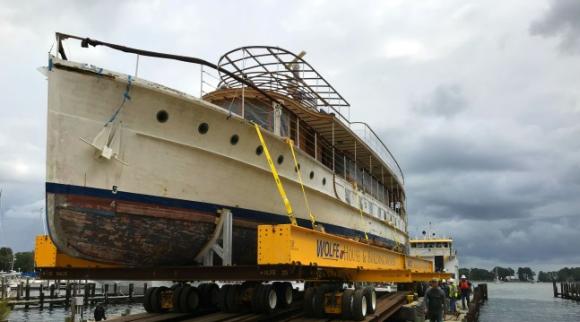
Back in 2016, we posted about a new owner for the ex-presidential yacht Sequoia, which had been sitting, deteriorating in a boatyard in Deltaville, VA. Now, three years later, the 104′ long motor vessel has been loaded aboard a barge to be transported ultimately to Maine for restoration. The Sequoia served as a presidential yacht during the administrations of Herbert Hoover through Jimmy Carter and is a National Historic Landmark.
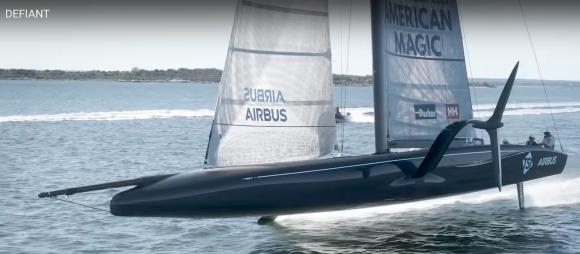
The 36th America’s Cup Races, featuring foiling monohulls, is still 18 months away but are beginning to look very interesting. Two very different AC75 contenders have taken to the water recently — The New York Yacht Club Team American Magic‘s Defiant. and Emirates Team New Zealand’s Te Aihe.
Richard Gladwell writing in Sail-World commented about the two boats: The two AC75’s launched to date have little in common other than they are 75ft long, are sloop-rigged, and are 13.5ft between the Foil Arm rotation pins. The basics – hull profile, rig style, foil fairings, foil wing shapes, deck, and cockpit layouts – are all markedly different. And that is just comparing the pieces we can see or have been shown.
Photographer Onne van der Wal’s “The Beauty of Sail,” a selection of videos and photographs which portray just that. Onne is a full time pro nautical shooter and sailor based in Newport, RI and has been at it since 1987.
Paradoxically, whale watching by tourists to Iceland is booming. At the same time, the primary economic support for the hunting of whales by Icelandic whalers are also tourists to the island.
Iceland is the largest whale watching destination in Europe. Around 20% of all tourists who visit Iceland go whale watching, which is to say somewhere between 300,000 and 400,00 tourists yearly.
Along with Japan and Norway, Iceland is also one of only three countries still engaging commercial whaling. And who is eating all the whale meat? Tourists. Tourists eat about 70% of all whale meat from Icelandic whaling. Icelanders eat around 2%. The rest is exported, mostly to Japan.
So, basically, tourists support both the growth of Icelandic whale watching while at the same time providing an economic foundation for Icelandic whaling.
In November 2017, Sarah Thomas, a marathon swimmer from Colorado, was diagnosed with an aggressive form of breast cancer. She underwent chemotherapy, surgery, and radiation to fight the disease. One of the ways she coped was by continuing to swim.
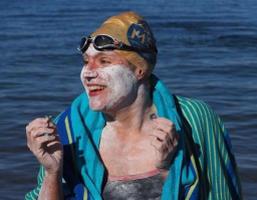
And cope she has indeed. From Sunday to Tuesday, over a period of 54 hours, Sarah Thomas, 37, swam the English Channel four times, nonstop, becoming the first person ever on record to do so. Only one year out of treatment for cancer, she swam nearly 134 miles (215km) in the open sea, a swim made more challenging by strong tides and choppy conditions.
Four ships from the Navy’s carrier Harry S. Truman Strike Group are deploying from the East Coast this week. Notably, the aircraft carrier Harry S. Truman is not one of the ships being deployed as it is still undergoing repairs for an electrical system failure.
Military.com reports that “the guided-missile cruiser Normandy and guided-missile destroyers Lassen, Forrest Sherman, and Farragut — will form a surface action group (SAG) as the Truman continues undergoing repairs.”
Vice Adm. Andrew Lewis, U.S. 2nd Fleet’s commander, said in a statement that the deployment demonstrates the Navy’s ability to maneuver and flex to accomplish its tasks on hand. But in an interview with USNI News, which first reported the unique deployment, Lewis also called the situation “unfortunate.” He added that it is the first time a surface action group has deployed from the East Coast in 13 years.
In what may or may not be unrelated news, the U.S. Transportation Command (Transcom) has begun the largest turbo activation of the ready Reserve Fleet since 2003 to stress-test the military’s ability to quickly deploy the cargo ships required for a massive troop movement.

Panorama in calmer water
When crossing the Equator for the first time, sailors have traditionally undergone a “line-crossing ceremony” which often includes being dunked in the ocean three times. Recently, on my first northern line crossing, I inadvertently presided over my own unexpected dunking, a baptism of sorts in the early morning hours, just as we were crossing Latitude 66.56 N, the Arctic Circle.
My wife and I were on the Panorama, a 173′ motor sailing cruise ship, on a week-long trip on the west coast of Iceland, from Akureyri to Reykjavik, making five port calls along the way. Like most cruise ships, the Panorama did most of her sailing at night so the 34 passengers aboard would wake up at a different port every morning.