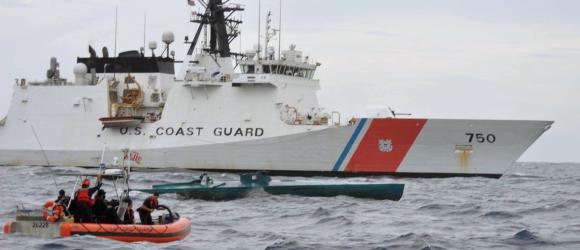
Last weekend, two men and a woman carrying a toddler stole a two-foot-long gray horned shark from an aquarium in San Antonio, TX. They wrapped the shark in a blanket, shoved it in a plastic bucket and hid the bucket in a baby-stroller, which they rolled out of the aquarium. The theft happened to take place on the last day of “Shark Week,” the Discovery Channel’s yearly week of programming about sharks. And no, you can’t make this stuff up.
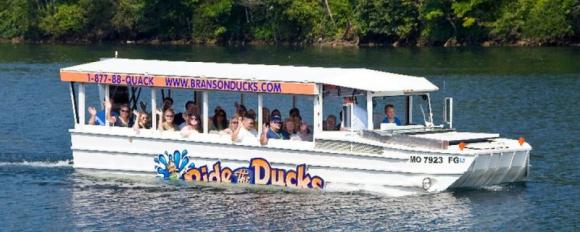
The Coast Guard has begun a high-level investigation into the recent duck boat capsize and sinking on July 19th, which cost the lives of 17 aboard. The boat, designated as Stretch Duck 07, which sank on Table Rock Lake, near Branson, MO, was inspected by the US Coast Guard as a Small Passenger Vessel, under Subchapter T of the Code of Federal Regulations. The boat’s Certificate of Inspection (COI) has been made public and what it reveals is disturbing, if not entirely surprising.
Under “Route Permitted and Operation” it specifies that :
Vessel shall not be operated waterborne when winds exceed thirty-five (35) miles per hour, and/or the wave height exceeds two (2) feet.
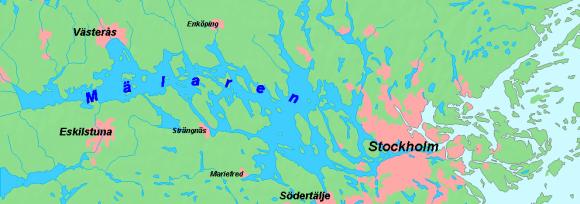
This sounds like a scene from a 1960 or 1970s “caper” movie. Around mid-day on Tuesday, two men walked into a medieval cathedral in Strangnas, in broad daylight, stole part of the Swedish crown jewels, and then escaped across a lake by speedboat. They are reported to have stolen two gold crowns and an orb made for King Karl IX and Queen Kristina. The objects dated from the 1600s. One of the crowns was jewel encrusted.
The crowns and orb were on display in the Strangnas Cathedral, 60 kilometers (37 miles) west of the capital of Stockholm. The thieves are said to have smashed the glass case protecting the objects and then to have run to two black bicycles left outside, which they had previously stolen. They rode the bicycles a short distance to Lake Mälaren where a white speedboat was waiting for them. They escaped in the speedboat, apparently disappearing into the vast archipelago of islands in the lake west of Stockholm. Mälaren is the third largest freshwater lake in Sweden.
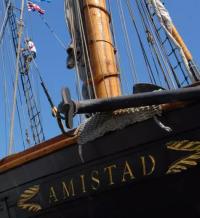
I was fortunate enough to be able to stop by the schooner Amistad last week when she tied up alongside Portside NewYork’s tanker Mary A. Whalen in the historic Atlantic Basin in Redhook, Brooklyn. She is a beautiful schooner with an important story to tell. Amistad is a replica of the original Baltimore clipper of the same name which, in 1839, was seized by captive Africans from Sierra Leone. A few photos.
Amistad will be returning to the Atlantic Basin and the Mary A. Whalen August 11th and will be open to the public for free tours from 10am – 1pm & 2pm – 5pm. For directions to Portside NewYork and the Mary A. Whalen, click here. Amistad is Connecticut’s flagship and tall ship ambassador.
[tribulant_slideshow gallery_id=”7″]

Wendy Tuck
The top two spots in the Clipper Round the World Race were, for the first time, won by women. Australian Wendy Tuck has become the first female skipper to win the Clipper Round-the-World race. British skipper Nikki Henderson, 25, came in second with her team in the 40,000-mile contest. Thousands watched the race finish in Liverpool, nearly a year after 12 yachts set out from the city.
In 1565, Captain Jean Ribault sailed from France with ships and 800 settlers to resupply and reinforce the French colony of Fort Caroline in what is now the state of Florida. The French colony was being threatened by the Spanish at nearby St. Augustine. Ribault’s fleet was caught in a hurricane and his flagship, la Trinité, sank just off Cape Canaveral, FL.
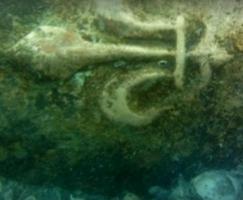
Now a US judge has ruled that a wreck off Cape Canaveral is Ribault’s la Trinité and therefore the protected property of France. The State of Florida supported France’s claim to the wreck against Global Marine Exploration Inc., which argued that the shipwreck’s identity couldn’t be definitively established. Artifacts from the ship, specifically, a granite monument bearing the French coat of arms, convinced U.S. Magistrate Judge Karla Spaulding that the shipwreck is la Trinité .
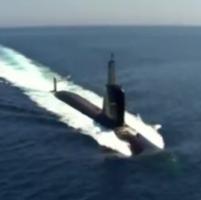
Spain’s S-80 Plus submarine is an advanced design featuring Air Independent Propulsion (AIP), which is reported to have cost around € 1 billion. The original design came in overweight, so it necessary to lengthen the submarine by 10 meters. Now, it appears that the newly delivered sub is too large for the Spanish naval dock at Cartagena. The dock will require dredging and an extension. Oops.
Three more submarines of the class are under construction in the Spanish shipyard Navantia in Cartagena.
It has been a challenging Friday, so we might as well end it with some slightly educational humor. Here is another of the wonderful “True Facts About …” series. In this case “True Facts About the Cuttle Fish.”
This Friday there will be a total eclipse of the moon. The eclipse will be total in much of Africa, the Middle East, and India, while Europe, the rest of Asia and most of South America will see a partial eclipse. Those of us in North America will miss it all. The total eclipse of the moon is called a “Blood Moon” because light refracting from Earth gives moon’s surface a reddish glow. This Blood Moon will also be the longest, so far, in the 21st century, at 1 hour and 43 minutes of total eclipse. The entire eclipse, including the partial phases, will last for over 6 hours.
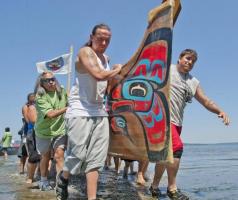
Every year, thousands of people join in on a canoe journey across the Pacific Northwest to celebrate traditional Native American culture. The long paddle includes multiple stops hosted by local tribes along the route. This year’s journey is called Power Paddle to Puyallup. Paddlers in canoes, some traveling as far as British Columbia and California, are expected to arrive in Puyallup, WA, this Friday, July 28. More than 10,000 people are expected for the welcoming ceremony. The Puyallup Tribe will host the event for eight days, July 29-Aug 4, which includes feasting, singing, dancing, drumming and sharing through giveaways. This year’s theme is “Honoring Our Medicine.”
We are a few days late in celebrating AMVER‘s 60th birthday. Originally called the Atlantic Merchant Vessel Emergency Reporting System, AMVER became operational on July 18, 1958. When it expanded beyond the Atlantic, the name was changed to the Automated Mutual Assistance Vessel Rescue System. As we wrote eight years ago, AMVER is the most amazing world-wide maritime search and rescue network that you probably have never heard of. And it has been saving sailors’ lives for over 60 years.
AMVER is a voluntary system sponsored by the US Coast Guard. Vessels registered in the program agree to automatically report their positions. When the Coast Guard receives a distress call from an EPIRB or other means, it sees which ships are the closest to those calling for help and vectors the ship to assist.

Photo: Chris Kreussling
As part of the continuing Erie Canal Bicentennial celebration, the Waterfront Alliance is sponsoring a harbor tour on August 2. During the tour, I will be providing commentary and narration on the enormous impact that the Erie Canal has had on the harbor and in making New York the remarkable city that it is today.
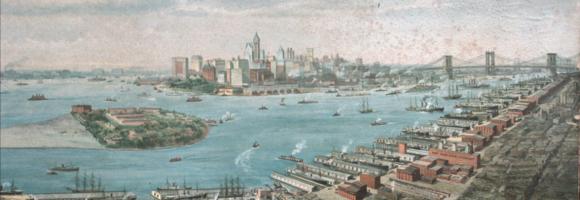
Departing from Pier 81, at W 41st Street on the Hudson River, we will sail down the Manhattan shore with a brief detour to the mouth of the Morris Canal Basin, part of the 40 years of canal building inspired by the success of the Erie Canal. We will also be passing the Central Railroad of New Jersey Terminal at Liberty State Park, a portion of the rail network that gradually grew more competitive than the canals, but still required barges to cross the Hudson. Then we’ll cross around the Battery, down Buttermilk Channel, and slowly cruise around the Atlantic and Erie Basins.

Photo: Smith Aerial Photography
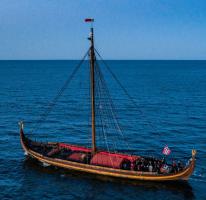
We have been posting about the ongoing East Coast tour by the Viking longship Draken Harald Hårfagre. Here is a lovely drone video by Ryan Smith of the longship as she departs Plymouth, MA bound for Rockland, ME.
The 115 foot long Draken Harald Hårfagre is the largest Viking longship built in modern times. In late April 2016, Draken Harald Hårfagre set out from her home port in Haugesund, Norway on an epic voyage across the Atlantic to America. She visited ports on the US and Canadian East coasts as well as in the Great Lakes before wintering in Mystic Seaport. She was on display at Mystic in the summer of 2017.
Following her port call in Rockland, the longship will sail for Portland, ME. Additional port calls will be announced. Draken Harald Hårfagre will be returning to Mystic Seaport in October.
The schooner Amistad is coming to PortSide NewYork, at Pier 11 in the Atlantic Basin, in Red Hook, Brooklyn. Amistad will tie up alongside the historic tanker, Mary A. Whalen, and will be available for free public tours on Tuesday, July 24th and Saturday, August 11th. The visit by the Amistad is part of the African American Maritime Heritage program of PortSide NewYork
The Amistad, known as the “Freedom Schooner”, is a replica of the original Baltimore clipper of the same name which, in 1839, was seized by captive Africans from Sierra Leone, who had been sold as slaves. The schooner was ultimately intercepted off New London, CT where the Africans were jailed and charged with murder. Abolitionists from Connecticut and surrounding states supported the captives in their case which was ultimately brought before the U.S. Supreme Court. In 1841, the court agreed with the lower court decisions, ruling that “…it was the ultimate right of all human beings in extreme cases to resist oppression, and to apply force against ruinous injustice.” The captives were freed and returned to their homes.
At least 11 people died on Thursday when an amphibious duck boat capsized in Table Rock Lake near Branson, Mo. Six people are still missing. The boat capsized in a thunderstorm in winds reported to be 70 or 80 mph. Of the 31 people on the boat, 29 were passengers and two were crew members. Seven people were taken to a hospital, and two people are reported to be in critical condition at Cox Medical Center Branson. Two duck boats were on the lake when the storm hit. One boat was able to make it to shore.