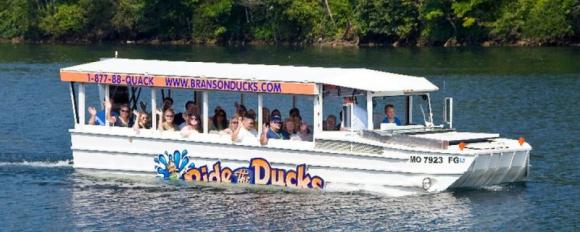
 At least 11 people died on Thursday when an amphibious duck boat capsized in Table Rock Lake near Branson, Mo. Six people are still missing. The boat capsized in a thunderstorm in winds reported to be 70 or 80 mph. Of the 31 people on the boat, 29 were passengers and two were crew members. Seven people were taken to a hospital, and two people are reported to be in critical condition at Cox Medical Center Branson. Two duck boats were on the lake when the storm hit. One boat was able to make it to shore.
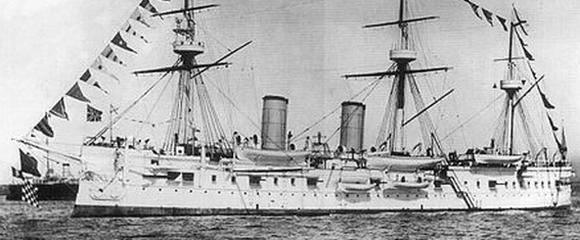 Salvors have announced the discovery of the wreck of the Russian armored cruiser, Dmitrii Donskoi, which was scuttled in 1905 during the Russo-Japanese War following the Battle of Tsushima. The wreck was found in 1,400 feet of water about one mile off the South Korean island of Ulleungdo. The salvors also claimed that the ship may contain 200 tons of gold, which would be worth around $133.4 billion (£102bn) in today’s prices. Allegedly, the Dmitrii Donskoi, which was designed as a commerce raider, was carrying the entire supply of gold for the Russian Second Pacific Squadron.
There appears to be little doubt that the Seoul-based maritime salvage company Shinil Group has found the wreck of the Dmitrii Donskoi, based on photos and video. A diver in one of the submersibles picked out the name in Cyrillic characters on its stern. But, is there really a vast cache of gold aboard? That is the really interesting question. What evidence is there that the Imperial Russian Navy saw fit to put 200 tonnes of gold aboard a lightly armored commerce raider?
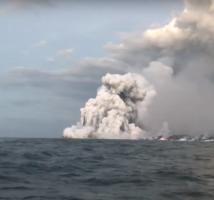 On Monday, the name “Hot Spot“ proved dangerously prophetic for a tour boat operating in waters off the coast of Kapoho on the Big Island of Hawaii. The tour boat was carrying about 49 passengers at around 6 AM, observing the flow of lava into the sea from the Kilauea volcano, when the boat was struck by a lava explosion.
A basketball-sized “lava bomb” hit the roof of the tour boat, injuring at least 23 passengers. One woman who suffered a broken femur was later airlifted to the Queen’s Medical Center on Oahu for emergency treatment. The boat named “Hot Spot” returned to Wailoa Harbor in Hilo with the injured passengers. Four passengers, including the woman who was later airlifted to Oahu, were taken by ambulance to the Hilo Medical Center.
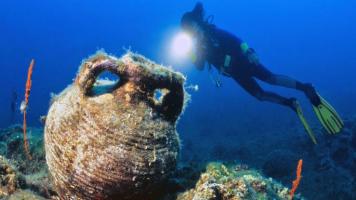 Can Albania both protect and profit from the veritable treasure trove of shipwrecks, ancient and modern, which lie off its coast? Along a 220 stretch of the Ionian coast, there are dozens of wrecks dating from the 6th century B.C. through World War II. The Albania National Coastline Agency thinks that there is the potential to make underwater archeology part of the tourism industry. The immediate concern, however, is whether they have the resources to chart and protect the largely undocumented wrecks before they are stripped by looters. Some looting has already begun. Amphorae from the wrecks are not infrequently seen decorating restaurants along the Albanian coastline.
This video, another in the “True Facts About” series, seems appropriate for a Monday. Informative, yet likely to generate a chuckle.
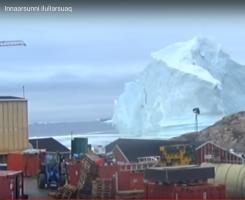 A 300 foot high, 11-million-ton iceberg is threatening the tiny Greenland village of Innaarsuit. The massive iceberg has grounded just off the coast. The concern is that if the iceberg should calve, the plunging ice could create a tsunami-like wave that could inundate the village of 170. Those living closest to shore have been evacuated to higher ground. The village’s power station and fuel tanks, however, are also located close to the shore.
The Guardian quotes William Colgan, a Geological Survey of Denmark and Greenland researcher — “Iceberg production in Greenland has been increasing in the past 100 years as climate change has become stronger,” he said, while the rising number of icebergs were in turn “increasing the tsunami hazards”.
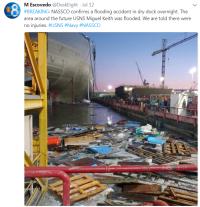 Oops. Last Wednesday, the graving dock at the General Dynamics NASSCO yard in San Diego, CA flooded after the dock gate at least partially collapsed. The ship under construction in the graving dock, the USNS Miguel Keith, floated off the docking blocks while also flooding the ship through cuts in its hull. No one was injured and there is no estimate of damage to the ship which was expected to be delivered in August of 2019.
A graving dock is a type of drydock built as a narrow basin closed by gates or by a caisson, into which a vessel may be floated and the water pumped out, leaving the vessel supported on blocks. The graving dock at the NASSCO yard is the 1,000-foot long and 174-foot wide.
The USNS Miguel Keith is the third Expeditionary Sea Base built for the US Navy. The two Navy Expeditionary Sea Bases now in service are the USNS Lewis B. Puller (T-ESB 3) and the Hershel “Woody” Williams (ESB 4).
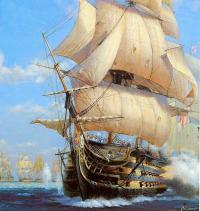 On July 21, the fore topsail set on HMS Victory at the Battle of Trafalgar of 1805 will go on display in all its perforated glory. The sail has 90 shot holes and will be displayed for a limited time over the summer at the Portsmouth Historic Dockyard. The sail’s area is 3,618 feet, equivalent to the size of two tennis courts.
Matthew Sheldon, Director of Heritage at the NMRN, said: ‘HMS Victory, Nelson and the Battle of Trafalgar are key to our history. The sail is an amazing object, scarred by battle and, like HMS Victory herself, a proud survivor of an iconic battle. ‘But it is also a vast handmade object from Georgian times that required great skill and knowledge to create. Seeing it is a real treat.’
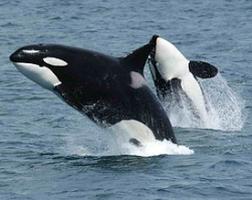 The resident orcas of the Salish Sea are dying. They now number only 75, a 30-year-low. They are being starved as their primary prey, the Chinook, or king salmon, are dying off. They are also being poisoned by pollutants in their waters and hurt by noise pollution from ships and boats. For the last three years, not one calf has been born to the three orca pods in the Salish Sea They have been listed as endangered in both the U.S. and Canada since 2005, but little has been done to reverse their steady decline.
There are three distinct groups of orcas, also known as killer whales, on the coast of the Pacific Northwest. Two groups of orcas referred to as residents, eat almost exclusively fish and return to the same areas immediately along the coast year after year. They are divided into Northern and Southern groups.
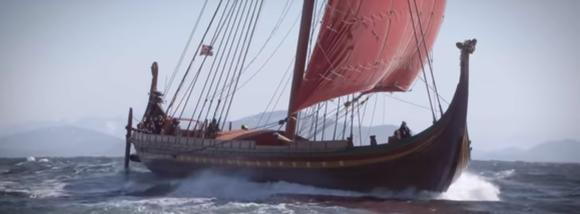 The Draken Harald Hårfagre, the largest Viking longship built in modern times, has begun its summer tour of the East Coast of the United States. After departing from Mystic Seaport on July 9th, it is now bound for Boothbay Harbor, Maine. Only the first three ports of call have been announced as follows:
- Boothbay Harbor, ME — July 13-15
- Plymouth, MA — July 17-20
- Rockland, ME — July 22-25
An additional eleven port calls will be announced. Draken Harald Hårfagre will be returning to Mystic Seaport in October.
 At one point in her long and storied career, the 1885 built, 131-foot schooner yacht Coronet was owned by a rather dodgy religious group which called itself “The Kingdom.” The group was led by Frank Sandford who circumnavigated the globe on the yacht in 1905. What was odd about the voyage was that no one ever went ashore. Instead, Sanford claimed to “subdue the world for Christ” through prayer and by sounding brass instruments as they passed by the various continents. He was not notably successful and on a subsequent voyage, several of his crew died of scurvy. The Coronet, however, has survived and is now being restored by the IYRS School of Technology and Trades in Newport, Rhode Island.
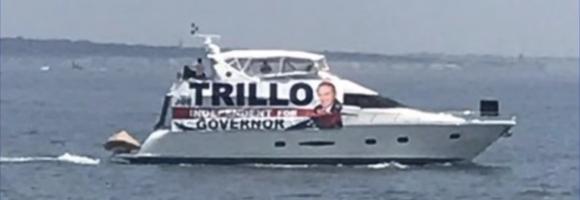
A recent event not too far from Newport reminded me of the story of the Coronet and the sounding of brass offshore. Joe Trillo, an ex-Republican state legislator is running for governor as an independent in Rhode Island this year. His campaign style is almost as unusual as Frank Sandford’s on the Coronet. He is campaigning by yacht and had rather a rocky weekend.
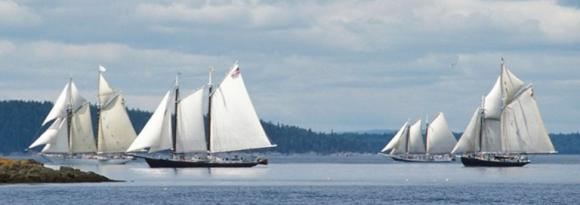
Photo: Maine Windjammer Association
On July 6th, 11 schooners raced from Gilkey Harbor in Islesboro, Maine on Penobscot Bay to the finish line at the Rockland Breakwater Lighthouse in the 42nd Annual Great Schooner Race, sponsored by the Maine Windjammer Association. The race honors, as reported by Village Soup–Knox, went to:
Continue reading
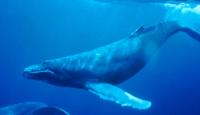 The Trump administration announced that it would cancel a rule designed to protect whales and turtles, which was first implemented in 2016, at the request of the fishing industry. The rule helped limit the number of endangered whales and turtles ensnared in fishing nets and had been recommended by the 14-member Pacific Fishery Management Council, which manages fisheries in California, Oregon, and Washington, in 2015. The rule applies only to the 20 gill-net fishing vessels still operating on the West Coast. The measure protected endangered fin, humpback, and sperm whales; short-finned pilot whales and common bottlenose dolphins; as well as endangered leatherback sea turtles, loggerhead sea turtles, olive ridley sea turtles and green sea turtles. The Trump administration has declared that the protection is unnecessary.
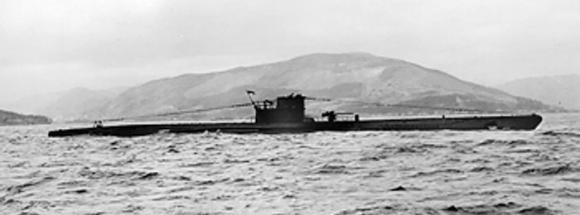 In June, three Spanish divers located the wreck of the German World War II submarine U-966 near the coast of Galicia in north-west Spain. The BBC reports that the submarine’s wreckage is spread widely in a very rocky area where rough weather often makes diving impossible. The debris was photographed at a depth of 24-26m (79-85ft). One of the divers, naval historian Yago Abilleira, said they had found the wreckage near Estaca de Bares. They are not revealing the exact location, as it is a war grave.
 I recently learned the slungshot, not to be confused with a slingshot. The slungshot is a monkey’s fist’s nasty cousin.
As most are probably aware, a monkey’s fist is a knot, shaped like a ball (or a fist), used to provide weight to the end of a heaving line. Typically one end of a moderately heavy line is tied into a monkey’s fist while the other end is finished in an eye splice. The monkey fist knot is often tied around a stone or a piece of lead or iron to give it additional weight. A light heaving line is tied to the eye splice and the monkey’s fist is thrown from a ship or boat to a line handler on the dock as the ship or boat is approaching. The heaving line is then attached to a heavier hawser.
A monkey’s fist is a practical, as well as an attractive bit of marlinspike seamanship. These days, they often appear as decorative knots on keychains and jewelry.
But then what is a slungshot? Continue reading