
Queimada Grande is a Brazilian island in the Atlantic Ocean roughly 90 miles from São Paulo. It is off limits to most visitors, not because it harbors secrets or treasure, but rather because it has more snakes, between one and five per square meter than perhaps any other spot on the face of the earth. And these are not just any snakes, but a unique and deadly species of pit viper, the golden lancehead. Not surprisingly, Queimada Grande is nicknamed Snake Island.
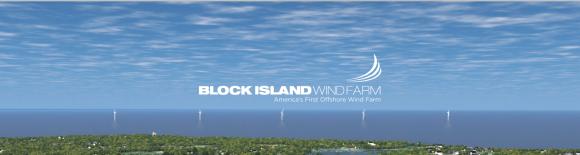
Off the coast of Europe, offshore wind turbines with an installed capacity of over 6,600 MW generate enough electricity to power almost five million households. In the United States, the number of households powered by offshore wind is almost zero, though, with luck that, is about to change, if only slightly. The foundations for the first US offshore wind farm are rising above the waters off Block Island, RI. The 30 megawatt, 5 turbine Block Island Wind Farm is scheduled to be online in 2016. The Block Island Wind Farm will supply most of Block Island’s power and will help to reduce air pollution across southern New England. Of course, opponents of clean energy have filed another lawsuit to stop the project. Deepwater Wind, the lead firm behind the project, has condemned the suit as baseless and says that “the project is proceeding at full speed.”
While this may be the first US offshore wind project, Block Island, an island in the Atlantic Ocean about 13 miles south of the coast of Rhode Island, is no stranger to wind power. The first wind mill, known as the Harbor Mill was originally built in 1770 and transported to Block Island around 1810. A second wind mill, the Littlefield Mill was installed around 1815. Both stood through the turn of the twentieth century.
The Wavertree, an iron-hulled windjammer built in 1885, has been a museum ship in at New York’s South Street Seaport Museum since 1969. In May, the historic ship shifted to the Caddell Dry Dock in Staten Island to undergo stabilization and restoration. The $10.6 million dollar project is one of the largest of its kind undertaken by a museum in the United States. The Wavertree was built in Southampton, England and was one of the last large sailing ships built of wrought iron. She is one of the largest iron sailing vessel afloat.
The first reports from accidents are often wrong. In the case of the capsizing of the whale-watching boat, Leviathan II, off Tofino on Vancouver Island with the loss of six passengers, the initial reports from CBC News said that the vessel was originally a tug boat that had been modified as a whale watching boat. They also reported that the “refitted Leviathan II didn’t have to undergo more stringent stability tests outlined by Transport Canada that are reserved for larger vessels.” (In our blog post, we repeated these statements with a link back to the CBC article.)
Apparently, these statements were not accurate. Transport Canada, in response to this and related reporting, issued a statement saying that the MV Leviathan II did undergo both a stability assessment and an inclining test when it was refitted in 1996. An inclining test is a means of accurately determining a ship’s vertical center of gravity (VCG), which is a critical component of determining a ship’s stability. Once an accurate VCG has been calculated based on the results of the inclining tests, the ship owner must present calculations demonstrating that the vessel meets all stability requirements in accordance with national requirements. According to Transport Canada, Leviathan II met all stability requirements.
So, why did Leviathan II capsize? Continue reading

Red bellied piranhas
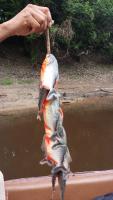
My wife and I recently took a trip on the riverboat MV Amatista from the jungle city of Iquitos upriver on the Amazon to the confluence of the Marañón and Ucayali rivers. Before we left, several friends warned us not to get eaten by the piranhas, the small meat-eating fish with the reputation as a ferocious man-eater. It turns out that we ate piranhas, not the other way around.
Our brochure for the trip promised that, among other river and jungle excursions, we would be able to go swimming with Amazon pink dolphins. We also could fish for the dreaded piranha. We did both and it turns out that we swam with dolphins in roughly the same area that we fished for piranha. So, yes, in addition to swimming with dolphins (who were actually some distance away, so whether we were swimming “with’ them might be open to debate,) we were also swimming with piranha. And we didn’t get eaten. No one in our group was so much as nibbled on.

USNS Apache
From a press release from the National Safety Transportation Board (NTSB):
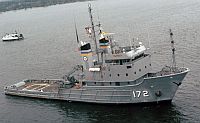
A search team on board the USNS Apache has found the wreckage of a vessel that they believe to be the cargo ship El Faro, which went missing on Oct. 1 during Hurricane Joaquin. The vessel was located at a depth of about 15,000 feet in the vicinity of the last known position.
Sophisticated sonar equipment towed from Apache first detected what are believed to be images of the vessel using Orion, a side-scanning sonar system, at about 1:36 pm ET on October 31 during the fifth of 13 planned search line surveys.
A beautiful Friday evening at the Sultana Downrigging Weekend in Chestertown, MD. The schooner Sultana, launched in Chestertown, Maryland, in 2001, serves as an educational vessel for schoolchildren as it travels around the Chesapeake Bay. Now in its fifteenth year, Sultana’s Downrigging Weekend Tall Ship and Wooden Boat Festival has evolved into one of the largest annual Tall Ship gatherings on the East Coast.
[tribulant_slideshow gallery_id=”3″]
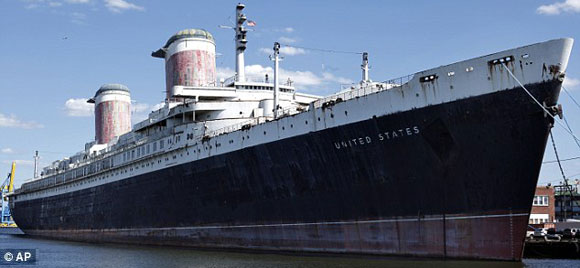
In early October, the headline in the Philadephia Inquirer was Is the S.S. United States headed toward the scrap yard?. After years of attempting to save the iconic cruise ship, the SS United States Conservancy announced that the SS United States, the fastest ocean liner ever built, might be “lost by the end of October.” The group has spent years attempting to find a developer to convert the 1951-built liner to a hotel, casino, museum, or some other form of tourist attraction. The ship has been sitting at a berth in Philadelphia for the past 19 years and is costing $60,000 per month in berthing fees. Now, a new berthing offer has emerged which may offer a reprieve for the ship.
John Quadrozzi Jr., owner of the Gowanus Bay Terminal in the Red Hook section of Brooklyn, has offered a rent-free berth at his facility to the SS United States to allow time to work on the development plans. There are still obstacles to the plan, not the least of which is raising the estimated $2 million dollars that it would cost to tow the ship from Philadelphia.
If the ship does move to Red Hook it will be very close to its original berth on the Hudson River. As noted by New York Magazine, “This may be the first recorded case of an elderly New Yorker moving back from Philadelphia because the rent is cheaper here.“

Photo: Albert Titian/Facebook
In 1998, the whale-watching boat Ocean Thunderer was hit by a wave and swamped, throwing all on board — three passengers and one boat operator — into the waters near Sea Lion Rocks, also known as Plover Reefs, off the western shore of Vancouver Island, Canada, near Tofino. The boat operator and one passenger drowned. The two other passengers were rescued, suffering from hypothermia.
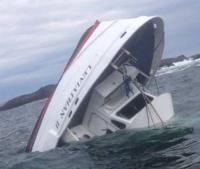
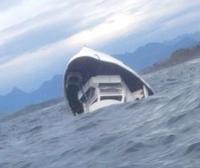
Last Sunday, the whale-watching boat Leviathan II broached and capsized, throwing most of its passengers overboard near Sea Lion Rocks, not far from where Ocean Thunderer swamped seventeen years before. Five of the Leviathan II’s passengers drowned and one is still missing and presumed dead.

Photo: Ben Talman
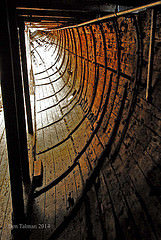
Ben Talman, a reader and contributor to the Old Salt Blog, visited the Edwin Fox in Picton, New Zealand and took a series of wonderful photos of the historic ship. The Edwin Fox is an East Indiaman built in 1853 of teak in Calcutta, India. She is the second oldest surviving merchant sailing ship. Only the whaling ship Charles W. Morgan is older. To see more and larger photos of the Edwin Fox, click here.
Her career is described on the Edwin Fox Society website: On her maiden voyage to London via the Cape of Good Hope she carried 10 passengers and a general cargo. Less than a year later she was purchased by Duncan Dunbar and was immediately put into service with the British Government as a troop ship for the Crimean War, reputedly carrying such illustrious passengers as Florence Nightingale. After the fall of Sebastopol she was refitted out to again carry civilian passengers and general cargo. Edwin Fox made her first voyage to the Southern Ocean on 14 February 1856 carrying 5 passengers and some cargo arriving in Melbourne on 28th May.
Recently, we posted that five nations were responsible for 60% of the plastic dumped in the world’s oceans. Why is plastic so destructive to the ocean environment? National Geographic put together the short animation below to explain all the damage that dumping plastic can do.

Photo: Albert Titian/Facebook
MV Leviathan II, a 65′ whale watching boat, sank late yesterday afternoon, off the port of Tofino on Vancouver Island, British Columbia, Canada. 27 were aboard when the vessel sank. Five are reported to have died and one person is still missing. Of the 21 rescued, 18 were sent to a local hospital.
Leviathan II is owned by Jamie’s Whaling Station & Adventure Centres and is one of the largest whale watching vessels in port Tofino. The boat sank near Plover Reefs, west of Vargas Island. The area is said to be a seal rookery. There is speculation that the boat hit a rock while observing seals. There are reports of a “mayday” call from the stricken vessel. The first responders on site were boats from the Ahousaht First Nation, whose members saw a distress flare. They were soon joined by local fishermen and the Canadian Coast Guard with a rescue boat and helicopter.
For several years now, we have posted about the so-called ocean garbage patches, the great swaths of the oceans where plastic and other floating debris accumulate while riding on vast circular currents. The problem is that an estimated 8 million metric tons of plastic are dumped into the world’s oceans each year. A new study by the Ocean Conservancy and McKinsey Center for Business and Environment, Stemming the Tide, identifies the leading plastic polluters. According to the study, five countries are responsible for 60% of the plastic dumped in the oceans — China, Indonesia, the Philippines, Thailand and Vietnam.
In 1998, the United States Naval Academy dropped celestial navigation from its curriculum. If a naval officer wished to know where he or she was, the officer simply had to read the display on a GPS (Global Positioning System) receiver. Sextants, chronometers, and nautical almanacs became artifacts of another, less technological time. Now, a decade and a the Navy has had second thoughts. Recent concerns about potential cyber-attacks on global positioning satellite software and data, which could disable or spoof GPS navigation systems world-wide, has led the Navy to return to teaching celestial navigation to midshipmen at the Naval Academy. Time to brush off the sextants.
When Ferdinand Magellan rounded the tip of South America in 1521, he encountered favourable winds. He named the ocean Mar Pacifico meaning “peaceful sea” in Portuguese. Today, Hurricane Patricia, the most powerful tropical cyclone ever measured in the Western Hemisphere, is expected to make landfall on the Mexican west coast near the resort cities of Puerto Vallarta and Manzanillo. This morning, the hurricane’s maximum sustained winds were measured an unprecedented 200 mph (320 kph). Weather.com reports that Hurricane Patricia now also holds the record for lowest pressure in any hurricane on record. With a minimum central pressure of 880 millibars (25.99 inches of mercury) at the 4 a.m. CDT advisory, Patricia broke the record of 882 millibars set by Wilma almost exactly 10 years ago. Perhaps, Magellan could have chosen a better name for the, so often, less than “peaceful” Pacific Ocean.