

Does SOX apply to grouper?
In 2007, Captain John L. Yates of the fishing vessel, Miss Katie, was caught with 72 undersized red grouper. After being ordered to bring the fish ashore by a Florida Fish and Wildlife Conservation officer, Captain Yates dumped the fish back into the Gulf of Mexico. He was convicted of violating the Sarbanes–Oxley Act, also know as SOX, which was intended to stop accounting fraud. At the end of last month, the US Supreme Court was called to rule on whether SOX also applied to fish. In a narrow vote, they decided that it does not.
Following the Enron and Worldcom corporate accounting scandals, in 2002 the US Senate passed the “Public Company Accounting Reform and Investor Protection Act” and “Corporate and Auditing Accountability and Responsibility Act” as it was known in the House of Representatives. The bill was more commonly called Sarbanes–Oxley, or SOX. The purpose of the bill was to increase corporate accountability. One provision of the bill imposes a maximum 20 year prison sentence for the destruction of “any record, document or tangible object” in order to obstruct an investigation.
 How do whales sleep? And do they dream? Many years ago on a kayaking trip on Blackfish Sound off Vancouver Island, our group of paddlers came across a pod of “sleeping” orcas. The pod was swimming very slowly, each orca swimming close to the next, diving and surfacing in the same sequence. Near the center of the pod was a baby orca, supported on either side by two females. This type of resting behavior is also common with dolphins. Apparently,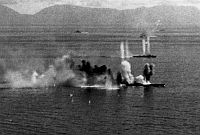
 As we mentioned in Part 1 of this post, two excellent nautical newsletters came out within the past few days —
  Two excellent nautical newsletters came out within the past few days —
  Over the last week, the internet has been overwhelmed by an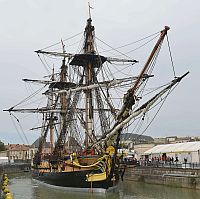
 Dr.
Dr. 

 The
The 
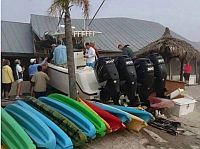 A quick quiz — you are the captain of a 39′ fast sports fishing boat with six passengers and a heavy sea fog has just set in. You either lack or are paying no attention to electronic navigational aides. What do you do? When Captain Matt Santiago was faced with this question yesterday, his answer was apparently to go faster. His See Vee sports fishing boat had four 300 HP outboard motors, or 1,200 HP in total, and