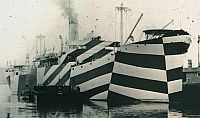
Cargo Ship SS West Mahomet in Dazzle 1918
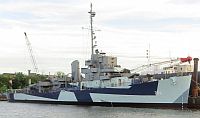
We posted earlier today about the USS Slater’s dazzle camouflage paint. Dazzle, sometimes referred to as razzle dazzle, is a very different approach to camouflage. Where most camouflage attempts to hide an object or person, dazzle camouflage on ships uses complex patterns of geometric shapes in contrasting colors, to make it difficult to identity the ship and to determine which direction it is traveling. If successful, the dazzle camouflage will confuse the targeting of the guns or torpedoes.
Norman Wilkinson is usually credited with developed the widely used disruptive coloration that became known as dazzle painting. Dazzle reached its peak usage in World War I but continued to be used throughout World War II. The color schemes ranged from checker-board or stripped patterns to wildly abstract geometric imagery. Many dazzle schemes were black, white and gray, while some used brighter colors, including red, blues and purples and greens.


 In recent years, there has been a significant increase in the number of whales off New York harbor. In 2011,
  In 2010,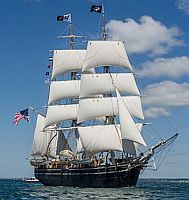

 What is the best way to celebrate sailing? My first response is to say, go sailing. Sailing, seems to me, to be its own celebration. There is that moment when everything falls into balance — when the force of the wind on the sails, the lift of water flowing across the keel, the drag of the eddies boiling off the hull — when you can feel the perfect equilibrium of all the forces of the sea and sky in the gentle tug on the tiller or wheel. That instant is, for me at least, the perfect celebration of sailing.
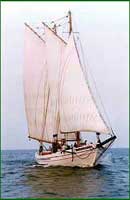 I wish that I had been sent to a summer camp aboard a historic schooner when I was a kid. Growing up in Texas, I remember summer camps notable for scrub mesquite trees, cactus and snakes, only some of which were poisonous. But I digress. This summer the 1928 Delaware Bay Oyster Schooner,
 I will admit that it was news to me that the