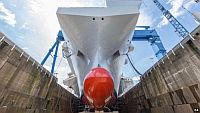
 Today, Great Britain’s Queen Elizabeth II christened the Royal Navy’s new aircraft carrier, HMS Queen Elizabeth. As the ceremony was held in Rosyth, Scotland, the queen christened the ship with a bottle of whiskey from the Bowmore Distillery, rather than the more traditional champagne. The new carrier will be the largest warship ever constructed for the UK. With a displacement of 65,000 tonnes, the ship is 280m long, about 70m wide, and carry some 1,600 personnel, including air crew. The new ship is roughly three times the size of HMS Illustrious, the Royal Navy’s remaining carrier.
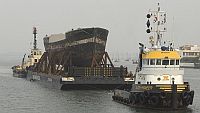 The composite clipper, City of Adelaide, built in 1864, is the world’s oldest surviving clipper ship. Between 1864 and 1887 the ship made 23 voyages from London and Plymouth to Adelaide, South Australia. Approximately a quarter of a million Australians can trace an ancestor that migrated, or was a passenger, on the City of Adelaide. The historic clipper was recently transported to its namesake city, following a lavish send off featuring Prince Philip, the Duke of Edinburgh, on the River Thames at Greenwich near London.
Apparently, the reception that the ship has received in Australia has been somewhat less enthusuastic. South Australia’s Department of Environment, Water and Natural Resources CEO Allan Holmes has called the clipper restoration project an “indulgence” and “eventual taxpayer burden.” He went on to say,”I’m not a supporter, I think it’s the last thing we need. As a government official I know where this is going to end up, they’ll come calling on government to pay the bill, there’s no doubt about that. Government will be under enormous pressure because we have this hulk, this wreck in the port with public expectation that something is going to be done about it.”
In contrast, a few years ago, the City of Adelaide zoo spent close to $30 million building a pavilion for borrowed Chinese pandas. It appears that borrowed pandas have a higher priority to government officials than Australia’s maritime heritage.
 Last December, we congratulated Admiral Michelle Howard on her nomination to serve as Vice Chief for Naval Operations. The nomination was confirmed and yesterday she was promoted to the number two position in the US Navy. She will be the first woman to serve as a four star admiral.
Indeed, Admiral Howard is associated with many firsts. She was the first African-American woman to achieve three star rank in the U.S. Armed Forces as well as being first woman and African-American woman to achieve the rank of admiral in the Navy. She was the first African-American woman to command a U.S. Navy ship, the USS Rushmore. She is the first African-American Vice Chief for Naval Operations. She was also the first admiral selected from the U.S. Naval Academy class of 1982 and the first female graduate of the U.S. Naval Academy selected for flag rank. Admiral Howard was also in command of the anti-terror strike force which rescued Captain Richard Phillips from Somali pirates following the attack on the Maersk Alabama.
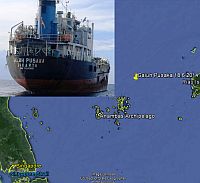
Graphic: Fleetmon.com
The owners of the product tanker Arsenal lost contact with the ship while she was underway in the South China Sea near the Anambas Archipelago, Indonesia. Fearing that the ship might have been hijacked by pirates, they contacted the Indonesian Navy, which began a search for the missing tanker. (Not long afterwards, the Arsenal re-established contact after apparently suffering a failure in its communication equipment.)
The Indonesia navy did find a tanker, however. At roughly 03 49 15 N, 106 33 20 E, they came upon the Indonesia-flagged product tanker Galuh Pusaka, drifting with engine and navigational lights off, without crew or cargo, but with fresh provisions in the galley. The ship was towed to the Indonesian naval base at Tarempa. The suspicion is that the tanker was used by pirates to siphon and transport stolen oil from hijacked ships. It may have been used by the pirates for some time, as the last AIS signal received from the tanker dates back to Sept 24, 2010. Lt. Col. Agung Jaya Saktika, Tarempa Maritime Authorities, said the tanker had significant damage and a lot of the communication and navigational equipment was missing. The Galuh Pusaka, IMO 7511060, is a product tanker of 2500 DWT, built in 1975, flying the Indonesia flag. The manager of record is Waruna Nusa Sentana, Sumatra.
Modern Mary Celeste – the mystery of tanker Galuh Pusaka, South China sea
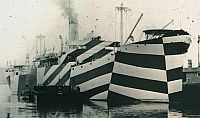
Cargo Ship SS West Mahomet in Dazzle 1918
We posted earlier today about the USS Slater’s dazzle camouflage paint. Dazzle, sometimes referred to as razzle dazzle, is a very different approach to camouflage. Where most camouflage attempts to hide an object or person, dazzle camouflage on ships uses complex patterns of geometric shapes in contrasting colors, to make it difficult to identity the ship and to determine which direction it is traveling. If successful, the dazzle camouflage will confuse the targeting of the guns or torpedoes.
Norman Wilkinson is usually credited with developed the widely used disruptive coloration that became known as dazzle painting. Dazzle reached its peak usage in World War I but continued to be used throughout World War II. The color schemes ranged from checker-board or stripped patterns to wildly abstract geometric imagery. Many dazzle schemes were black, white and gray, while some used brighter colors, including red, blues and purples and greens.
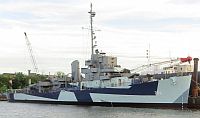
USS Slater in dazzle camouflage
In April we posted about the drydocking of USS Slater, the last World War II destroyer escort still afloat in the United States, at Caddell Dry Dock in Staten Island. Yesterday, her repairs completed, newly cleaned, and painted, she returned to her home port, up the Hudson in Albany, NY. Her new paint job is dazzling. Literally. She has been repainted in the “dazzle” camouflage scheme that she wore in service in 1945.

Photo: Weeki Wachee
I have recently discovered that mermaids are indeed real, well, after a fashion, though not in the sense suggested by cheesy fake documentaries shown on the Discovery Channel. There is a small cadre of women who perform as mermaids and models professionally. It is certainly one of the more unusual jobs, though no doubt providing steadier work than scuba-diving Santas, which does tend to be highly seasonal.
Well before the billionaire’s AC72 catamarans were rising up on foils to race in the America’s Cup, nimble Moth dinghies were flying on hydrofoils around the buoys. I will admit to being fascinated by the foiling Moths, although they appear to be rather challenging to sail. Perhaps beyond my capabilities. The Moths are light and relatively simple, while still being a wonder of design, engineering and fabrication. Here is a wonderful video by Onne van der Wal of a recent Moth regatta in Newport on Narragansett Bay, RI.
2014 11th Hour Cup – Moth Racing in Newport, Rhode Island
2014 11th Hour Cup – Moth Racing in Newport, Rhode Island from Onne van der Wal on Vimeo.
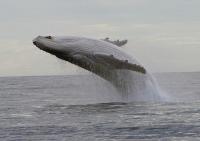
Photo: Ray Alley
Migaloo, the white humpback whale has been spotted making his way up Australia’s Queensland’s coast on his annual migration to warmer waters. Migaloo was first seen in 1991 and is believed to be around 28 years old and is one of a few albino humpback whales ever observed. This is the 23rd consecutive year Migaloo has been spotted on the Australia’s eastern seaboard. As whales go, Migiloo is something of a rock star. Fans track his yearly migration. He has several websites devoted to him and as well as a Twitter account and multiple Facebook pages.
This year there is increased concern that Migaloo’s albinism may have made the humpback susceptible to skin cancer. Continue reading
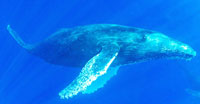 In recent years, there has been a significant increase in the number of whales off New York harbor. In 2011, researchers from Cornell recorded the sounds of fin whale, blue whale, humpback whale, minke whale, sei whale, and the North Atlantic right whale using an array of hydrophones off Long Island and New York harbor. The downside of increased whale activity is that the harbor has also seen an increase in the number of whales struck and killed by ships. Earlier this spring, we saw two dead whales carried into the harbor on the bows of ships in less than a month. On the positive side New Yorkers are able to watch humpbacks feeding just a mile of New York City beaches.
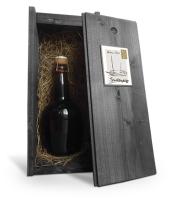 In 2010, we posted about a shipwreck in the Baltic, off the Åland Islands of Sweden, in which 30 bottles of champagne and 5 bottles of beer were found intact in the wreckage. In 2011, two bottles of the champagne were sold at auction for 54,000 euros ($78,400.) Now, the Aland brewery, Stallhagen, has recreated the beer based on an analysis conducted by the Technical Research Centre of Finland (VTT) of the original beer in the shipwreck. Wild yeast from the original brew was been used the in the new beer which is dubbed Stallhagen Historic Beer 1842. Don’t look for it in your local stores. It is being produced in a limited run and will be for sale only on Viking Line cruise ships.
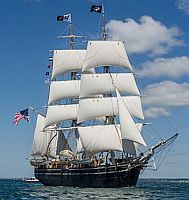
Photo: Mystic Seaport
In January 1841, the Hillman Brothers shipyard on the Acushnet River in New Bedford, MA delivered a new whaleship, the Charles W. Morgan. Yesterday, the Charles W. Morgan, the only surviving wooden whaling ship, sailed back into New Bedford, where she was built more than 170 years ago. She was last in New Bedford in 1941 before being moved to Mystic Seaport Museum. The historic ship has undergone a five year major rebuilding at the seaport museum. The Morgan will be open for visitors in New Bedford starting Saturday.
In her 80 years of active service more than 1,000 sailors of all nationalities brought home 54,483 barrels of sperm and whale oil and 152,934 pounds of whalebone.
New Bedford Celebrates Return Of World’s Only Remaining Wooden Whaleship
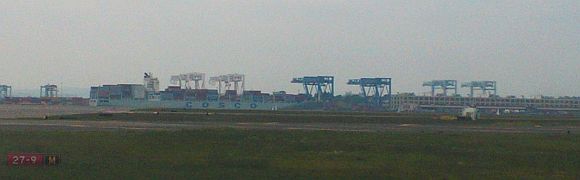
No, they are not Imperial Walkers
Today, June 25th, is the IMO sponsored International Day of the Seafarer. This celebration is intended to increase the awareness of the indispensable services rendered to all of us by the 1.5 million seafarers who deliver more than 12 billion tonnes of goods yearly, comprising 90% of all world trade. Without seafarers, the world as we know it simply could not exist. The problem is that shipping is literally an offshore industry. Unless, something bad happens, ships, and the seafarers who sail them, are largely invisible to the general public.
Great video of climbing to the royal yard on the Charles W. Morgan.
If you are having a lousy Monday, here is a reminder that things could always be worse. Below is a video of $24 million yacht, 102′ long, M/V Polar Bear, which caught fire last Thursday in Chula Vista, near San Diego, CA. The cause of the fire has yet to be determined, but there are reports that a welder was working aboard just before the blaze broke out. The yacht reportedly took five years to build and has been in service for only three years. The owner, understandably, is described as “devastated.”