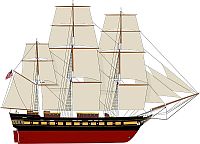
 I recently booked a berth on the SSV Oliver Hazard Perry on a passage next September from Newport to Bermuda under the command of Captain Richard Bailey. I find it hard to believe that it was so long ago, but nevertheless, 17 years ago, I sailed aboard the replica frigate HMS Rose from New York York to Bermuda with a group of Patrick O’Brian aficionados. Captain Richard Bailey was in command and he and his capable crew did a fine job managing the enthusiastic, but often clueless volunteers with skill and grace. (Who would have thought that herding cats would be a skill required of professional mariners.). I am very much looking forward to the upcoming voyage.
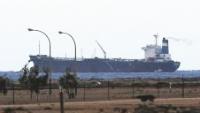 This morning, the press was abuzz with reports that last Monday, in the Mediterranean off Cyprus, US Navy SEALS boarded and took control of an oil tanker, Morning Glory, which had recently loaded a cargo of Libyan oil in the port of Sidra. The SEALs conducted the operation from the guided missile destroyer USS Roosevelt (DDG-80). The Morning Glory was returned to Libyan waters with a team of sailors from a second US Navy destroyer, USS Stout, aboard. There were no causalities reported in the raid.
The press has used a variety of adjectives to describe the tanker. It has been referred to as “hijacked“, “rogue“, “rebel“, “diverted” and “mystery.” The ship entered the port under a North Korean flag but North Korea denied that the ship was still under its registry. Pentagon Press Secretary Rear Admiral John Kirby described the Morning Glory as “a stateless vessel seized earlier this month by three armed Libyans.”
So, who owns the Morning Glory? Who owns the oil? And why did Navy SEALs seize the ship?
Here is a good video to start the week. Kite foiling is an amazing new niche in the world of sailing. To be fair, kite boarders have sticking foils on the the bottom of their boards for years. Now, however, it looks like the sport is really taking off, so to speak. The first Kite Foil Gold Cup is now ongoing in La Ventana, Mexico and will be moving on to Switzerland, Austria and France during the year.
(By the way — the still below, which features a woman in a bikini, oddly enough, never appears in the video itself. Still worth watching, despite the false advertising.)
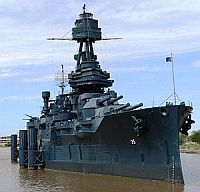
USS Texas (BB-35)
I remember visiting the battleship USS Texas in the San Jacinto River in Texas as schoolboy from Dallas while on a family vacation, almost fifty years ago. Her 14″ guns were impressive and I still recall climbing around her anti-aircraft guns on deck. This week marked the 100th anniversary of the USS Texas‘ commissioning on March 12, 1914.
USS Texas is a New York-class battleship and the last of the dreadnoughts. She fought in both World War I and World War II, providing artillery support in both the invasion of Normandy and the assaults on Iwo Jima and Okinawa. She has been a museum ship since 1947.
In recent years her greatest battles have been with rust and inadequate funding. We posted in 2012 about chronic leaks in the hull that have threatened to sink the ship. (See Update: 100 Year Old Battleship Texas Shutdown Indefinitely by Leaks). Plans to put the ship in a “dry berth” to preserve her have been put on hold due to lack of funding. Last year $17.5 million in funding was arranged to allow for critical repairs, while an estimated additional $18 million is still needed. To the question as to whether the glass was half full or half empty, ship manager, Andy Smith replied, “”At least, we’ve got a glass.”
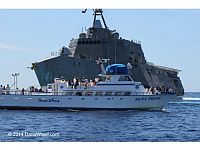 Last Sunday was the second of two weekends of the Dana Point Festival of Whales, which celebrates the annual migration of gray whales which passes the coastal California community. Captain Todd Mansur of Dana Wharf Whale Watching was following two gray whales, when he found himself and the whales in a crossing situation with the USS Coronado, a new Navy Independence-class Littoral Combat Ship (LCS). Captain Mansur was able to contact the Navy ship and alert them to the whales off their bow. The ship came to a complete stop and let the gray whales and the whale watchers pass. The LCS is a radical trimaran ship design meant to operate in coastal water and is capable of cruising at 40 knots, with a top speed of 46 knots. On Sunday, the USS Coronado was underway at only around three knots, so it had no trouble stopping to avoid the whales.
A re-post from four years ago that seems appropriate today. So Happy Pi day and a toast to Hakudo Maru, the Japanese celestial shipbuilder.
 Some call today Pi day, as the first three digits of the date (3.14) are the first three digits of the constant pi used to calculate the circumference and area of a circle. Which makes it a good day to raise a glass to toast Hakudo Maru.
By Japanese naming convention, merchant and private ship names end in the word “Maru,” meaning circle. There are several explanations for this convention, including that ships were thought of as floating castles and maru represents the defensive “circles” that protected the castle. Another explanation is that the suffix honors, Hakudo Maru, the celestial being in Japanese mythology who is said to have come to Earth 5000 years ago and taught humans how to build ships. A toast to Hokudo Maru.
My favorite explanation is that maru represents the hope that the ship leaves port, travels the world, and returns safely to home port, representing the complete circle of a successful voyage.
Safe Harbor Pictures recently released a short video about sail training on the Lady Washington. The Lady Washington is a replica of the first American ship to round Cape Horn. The original ship sailed from Boston Harbor on October 1, 1787. She rounded Cape Horn and traded furs with the coastal Native Americans in the Pacific Northwest, before sailing to China and Japan to trade for tea and porcelain. The modern Lady Washington sails from Grays Harbor Historical Seaport in Aberdeen, Washington.
Lady Washington – Safe Harbor Pictures
)
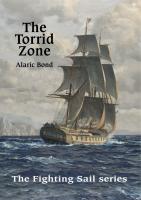 I am very much looking forward to Alaric Bond’s latest, Torrid Zone, due out in April or May. He recently posted about it on his blog.
I’ve now finished the second draft of The Torrid Zone, the next installment in my Fighting Sail series. There is still much to do, of course; the actual book is not due to appear until April or May but at least we have the roof on, as it were. This time I have strayed from home waters; HMS Scylla is heading for the South Atlantic, her destination: the small island of St Helena, and on board she has Sir Terrance Hatcher, the island’s new governor.
Lighthouses can be dangerous places. They are placed specifically near hazards to navigation, where the seas are the roughest and the rocks the most treacherous. Here is a brief look at three deadly lighthouses.
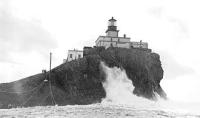
Terrible Tilly
Tillamook Rock Lighthouse — Off the coast of Oregon, about a mile off Tillamook Head and 20 miles south of the Columbia River, Tillamook Rock rises from the stormy Pacific looking some say like a basaltic sea monster. In 1879 before construction even began on the light house, a mason, John Trewavas, drowned while surveying the rock. The construction of the light was difficult took 500 days to complete. In early January 1881, when the lighthouse was near completion, the barque Lupatia was wrecked near the rock during a storm and sank, killing all 16 crew members.
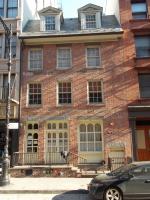
Captain Rose’s House, Later Kit Burn’s Sportsman’s Hall
On my way to an informal gathering of water-bloggers on Saturday, I passed by Captain Joseph Rose’s House at 273 Water Street in Lower Manhattan. I wanted to stop by because one scene in my next novel, The Shantyman, is set in the building. The scene takes place long after the Rose family had decamped, when the building was Kit Burn’s notorious Sportman’s Hall, better known as simply the “Rat Pit.”
Captain Rose had the house built in 1773. It is said to be the third oldest surviving building in Manhattan. (The oldest is apparently St. Paul’s Chapel, not far away at 209 Broadway, between Fulton and Vesey Streets. The second oldest is the Morris-Jumel Mansion in Washington Heights.) Captain Rose was a successful importer of Honduran mahogany. In those days, the East River ran directly behind his house on the aptly named, Water Street. Captain Rose kept his brig, Industry, just out his back door, at a pier that he shared with his neighbor and fellow ship owner, William Laight.
By the 1840s, Water Street and nearby South and Cherry Streets were the heart of New York’s “Sailortown.” The streets were lined with boarding houses, bars, brothels and gambling dens. Continue reading
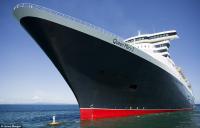 It is remarkably difficult to grasp how large ships can be. I remember, many years ago, being amazed how a full sized city bus, which looked so large on the pier, seemed to shrink dramatically as it was hoisted and lowered into the hold of a ship. The ship was not particularly large by today’s standards, yet the bus seem so small as it disappeared into the hold. This memory was triggered by the recent publicity photo of the captain of the Queen Mary 2 standing on the ship’s bulbous bow. Depending on the scale of the photo, Captain Kevin Oprey is barely visible with the bow of the ship towering over him.
But how does one even properly compare the sizes of different types of ships? Continue reading
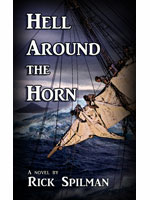 There was a very nice post this morning on the Working Harbor Committee blog about my novel “Hell Around the Horn.” My thanks to the editor, Mai Armstrong.
Have you read Rick Spilman’s novel Hell Around The Horn?
It’s a thriller that tells of the captivating story about a young ship’s captain and his family who sets sail on Lady Rebecca – a 1905 windjammer, from Wales bound for Chile, by way of Cape Horn in the Age of Sail. Based on an actual voyage, and written with historical accuracy, Rick draws you into the world of whipping westerly winds, mutiny and survival on the high seas. Read tugster’s review here.
Read the rest of the post on the Working Harbor Committee blog.
Captain standing on the bulbous bow. Click for larger images
In publicity photos to celebrate the tenth year anniversary of the Queen Mary 2 going into service, Captain Kevin Oprey is seen standing on the ship’s bulbous bow. The photos dramatically capture the size of the mighty ship. Click on the photo to the right to view larger images.
When the Queen Mary was delivered, a decade ago she was the largest cruise ship in the world. While she no longer holds that title, Cunard brags that she is still the world’s largest passenger liner. The distinction is significant, whether or not her current operation really qualifies as “liner” service. Passenger liners were ships that ran in regular scheduled service, carrying passengers. In the days before airplanes stole the passenger business, the great ocean liners were the best way to cross an ocean. Cruise ships are more like floating resorts, usually designed to operate in warm and calm waters.
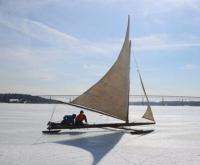
Photo: Issac Kestenbaum
Not all sailors in the Northeast are sick of winter. For some ice boaters on the Hudson, this has been a great season and isn’t over quite yet. Ice boating, or ice yachting, as some call it, is a cross between sailing, ice skating and drag racing. When the conditions are right, ice boats can achieve amazing speeds, sailing up to ten times faster than the speed of the wind. Some of the larger iceboats have topped 90 knots (170 km/h; 100 mph) and an unconfirmed speed of 130 knots (240 km/h; 150 mph) on one boat has been reported. Speeds of 30-40 knots are not considered unusual.
The sailing of ice yachts on the Hudson River dates back to 1790 and grew in popularity through the 19th century. Continue reading
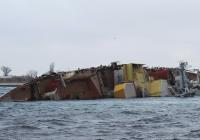 Ochakov, a Russian Kara-class cruiser, was decommissioned in 2011 and had been scheduled to be scrapped. Instead, the Russian Navy scuttled the ship late Wednesday in the navigation channel in the approach to Donuzlav Lake, in Novoozerne, in the Western Crimea. The scuttled ship now blocks Ukrainian naval vessels from leaving the nearby naval base. It is not clear how many naval vessels the Ukrainians might have had in the lake and ministry spokesman Maxim Prowta declined to say.The base had previously been blockaded by the Russian guided missile cruiser Moskva. Now that the channel is blocked by the scuttled cruiser, the Moskva and other Russian vessels are reported to have left the area.