
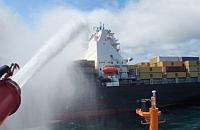
 In the middle of July, we posted about a fire and explosion on the 6,750 TEU container ship MSC Flaminia in the mid-Atlantic, resulting in the death of one of the crew and one crew member missing and presumed dead. The surviving crew abandoned the ship. The fire was subsequently brought under control by three salvage tugs and brought under tow back toward Europe.
For the last week or so, however, the ship and her escorting tugs have been in a holding position 150 miles off Land’s End while the ship’s owners plead with UK, France, Belgium, the Netherlands, Spain and Portugal to allow the ship to enter their coastal waters.
“I think it’s ridiculous that a ship sailing under a German flag in this situation can’t get permission from countries in the European community,” said Helmut Ponath, head of NSB shipping company.
 Consider these two statements:
 After being threatened the by Republican cost-cutters, the
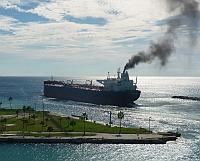
 Barbados Bound
 Two hundred and twenty years ago today on August 4th, 1790, Treasury Secretary Alexander Hamilton established the Revenue Cutter Service, predecessor to the United States Coast Guard. (In 1915, the service merged with the United States Life-Saving Service and adopted its current name.) So happy birthday to the US Coast Guard, the nation’s oldest seagoing service.

 One of the joys and pains of buying beer these days, is that there is are so many interesting craft beers to choose from. Some are marvelous, some are unremarkable, while a few are wildly over-hopped, which some American craft brewers think is cutting edge. (It isn’t. It is simply bitter.) Recently, there has been a interesting shift of focus away from hops alone toward
 In 1730, the third year of the reign of King George II, two brothers, Ralph and Robert Clarke, bought shares in a 300-ton sailing vessel. Their enterprise would become