
Photo: Department of Animal Care and Control/Associated Press
Toward the end of June, we posted about the minor media circus that grew out of a report of possible stowaways on the container ship, Ville D’Aquarius, bound for Port Newark. After a multi-agency task force swung into action to investigate, the media began reporting that there were between 20 and 60 Pakistani stowaways aboard the ship and making veiled and not so veiled references to terrorism. There turned out to be no stowaways found aboard the ship.
Recently, however,we have heard of a real, live, proven stowaway hiding in a sealed shipping container. A container, originally loaded in Shanghai, was opened at a business in Compton, California, near Los Angeles. Inside was a 3-month-old kitten, which had apparently survived without food or water for the up to 21 day that it often takes to make the 6,500 mile journey from China. Remarkably, the kitten appears to be in reasonable good health, despite the ordeal.
Kitten survives freighter trip from Shanghai to Los Angeles without food, water
The kitten, nicknamed Ni Hao (NEE’-How), which means “hello” in Mandarin, is not the first feline to surreptitiously take to the sea as a stowaway. In April 2011, a cat who vanished from his home in New Zealand was found stowed away in a container in Australia, after a voyage of 18 days and more than 2,200 miles. Likewise in November 2009, a cat was found in a container unloaded in the British port of Felixstowe after a after a 3,000 mile journey from Egypt.
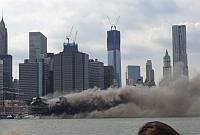
 This story just keeps getting stranger. A year ago last June, the Swedish treasure hunters,
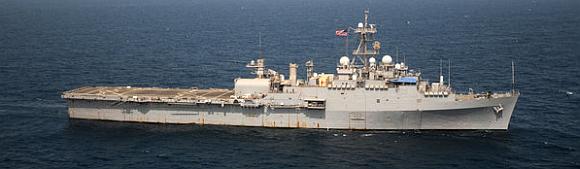 Last February, we posted about the modification to the
 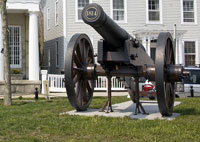 Yesterday, I went on a field trip with the New York Shiplore and Model Club to Stonington and Mystic, Connecticut. (Thanks to Lee Gruzen, Norman Brouwer and Linda Zatkowski for making the arrangements.) Our first stop was
 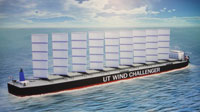 Early airplane wings were built of canvas stretched over a wooden frame, held together with wire rigging. Modern airplane wings are built of aluminum and other metals. The comparison to sails, masts and rigging on ships may not apply directly. Nevertheless, the last America’s Cup winner, the
 The City of New York is a city of islands, large and small, floating in a vast harbor and waterway. Only one of the five boroughs is on the mainland and that even borough, the Bronx, is on a peninsula, with water on three sides. The city and the metropolitan area of 20 million people only exist because of the harbor, the Hudson River estuary, and neighboring rivers and sounds. Once again the
 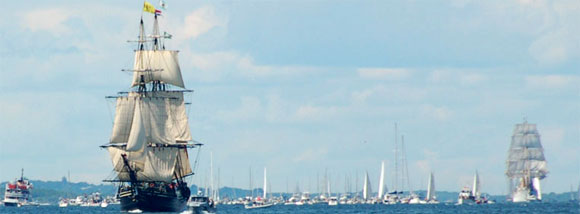 To say that this will be a busy weekend on the New England waterfront may be an understatement. Following the 4th of July festivities in Boston,
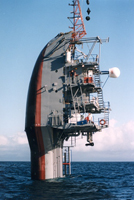 The Navy’s Floating Instrument Platform, better known as FLIP, went into service fifty years ago, in 1962. The 355-foot research vessel is capable of operating horizontally as a conventional, if somewhat odd-looking, ship. When on station, however, it “flips” vertically 90 degrees and becomes the equivalent of a massive spar buoy. Because the hydrodynamic forces act primarily on the bottom of the vessel, which is far below the surface waves, the ship is highly stable in heavy seas and up to 80′ waves.