A fitting tribute to the 29 men who went down with the Great Lakes ore boat, the SS Edmund Fitgerald, which sank 36 years ago today in Lake Superior. I am having a hard time believing that she sank that many years ago.
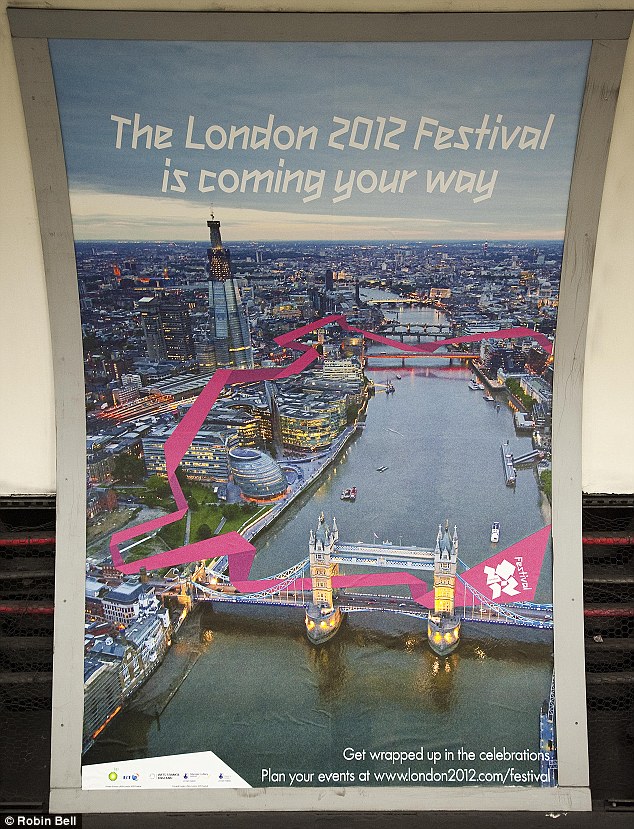
The image on the right is a new poster for the London 2012 Olympics featuring a section of the River Thames. The image on the left is a photo of the roughly the same section of the river. Notice a difference? (Click on the thumbnails for larger images.) The graphic artists who designed the poster have apparently airbrushed out the Royal Navy light cruiser, HMS Belfast. Not surprisingly, many are not happy about it.
Are Olympics chiefs ashamed of our proud military history? Just days before Remembrance Sunday, HMS Belfast is airbrushed from poster
Continue reading
A fascinating story from Wales. Sometime between 1743 and 1745, a smuggler from Llanfairynghornwy on the isle of Anglesey, rescued two boys, in stormy seas in the middle of the night – the only survivors of an apparent shipwreck. Both boys had a swarthy complexion and neither spoke Welsh or English. One boy died shorty after being taken to a local doctor. The other was given the name Evan Thomas by the doctor, who subsequently adopted him. The boy proved to have a distinct ability to set bones. As he grew, he also developed the use of splits and traction to align and immobilize broken bones to speed healing. He taught his skills to his children and grandchildren. Remarkably, eight generations of his family dominated the discipline of bone-setting for two and a half centuries. His great-grandson, Hugh Owen Thomas, the first of the family to be formally trained as a physician, would be hailed as the “father of modern orthopaedics.” Hugh’s nephew, (Evan Thomas’ great-great-grandson,) Sir Robert Jones, was the first physician to use X rays to align broken bones and is credited with reducing fracture deaths on the western front in World War I from 80% in 1916, to just 8% by the end of the war through the use of splints developed by his uncle.
Continue reading
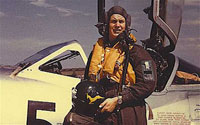
The American movie, Top Gun, starring Tom Cruise, won 8 Academy Awards and earned over $300 million at the box office. The movie was inaccurate in several ways, not the least of which was the addition of a sexy female flight instructor to provide a love interest for the male pilots. It also left out any mention of the British instructors from Fleet Air Arm who were instrumental in establishing the US Navy Fighter Weapons School, better known as Top Gun. Brigadier General Richard Stanley Lord, who died in late October at the age of 75, was the foremost British instructor sent to train American pilots in 1968, who at the height of the Vietnam War were being shot down at an unacceptable rate by by North Vietnamese pilots.

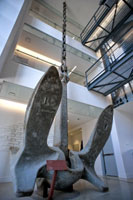
2200-pound anchor in main entranceway of the Navy Yard Museum. Photo: Corey Sipkin/New York Daily News
The two events are unrelated, but they are both highly welcome. The South Street Seaport Museum is on its way toward reopening, while a new museum celebrating over 200 years of shipbuilding and maritime history at the Brooklyn Navy Yard is openings its doors on Veteran’s Day, this Friday.
The South Street Seaport Museum, which has been shut down due to financial problems, has been taken over by the Museum of the City of New York. See our previous post – Museum of the City of New York to Take Over Seaport Museum with $2M Grant. Notwithstanding many details to be worked out and much work left to be done, it appears that the South Street Seaport Museum is firmly on its way back.
The Return Of The South Street Seaport Museum… A Meeting Recap
Across the East River, the Brooklyn Navy Yard Museum is opening this Friday, Veterans Day.
Continue reading
Here is a wonderful video shot on Halloween a quarter-mile offshore from Seabright Beach in Santa Cruz, CA. A bikini clad surfer paddles over to a group of kayakers who are out watching the large number of humpbacks who are feeding close to shore. The photographer, Barb Roettger, is in another kayak with a friend, shooting the video. The surfer mentions, off camera, that she’s never been out this far and suggests to the kayakers that there is strength in numbers. On the video you can hear Roettger murmur, “Not necessarily.” Seconds later two humpback whales leap skyward, lunge feeding on krill, exactly between the two sets of kayakers.
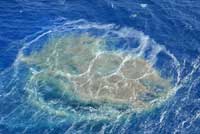
Last month we posted about Kick’em Jenny, an active underwater volcano off Grenada in the Caribbean, which was last active in 2001. Now the eruption of an active underwater volcano off El Hierro Island, in the Canary Islands off the northwest coast of Africa, has caused Spanish officials to shut the port of La Restinga. Ships have been ordered away from waters around La Restinga and aircraft have been banned from flying over the island’s southern tip. The 600 residents of the port were evacuated Tuesday. The water temperature around the up-welling associated with the eruption has risen sharply and there have been reports of pyroclasts, airborne volcanic fragments, erupting from the area. For more photos click here. Thanks to Dirk Bal for pointing out the story on Facebook.
El Hierro Volcano (Canary Islands) : Red alert – Impressive Jacuzzi sea temperature graphic
The six boats competing in the Volvo Ocean Race departed from Alicante, Spain yesterday and were immediately battered by rough seas and high winds while still in the Mediterranean. The Abu Dhabi Ocean Racing‘s Azzam lost her mast only six hours and 85 nautical miles from the start of the race. Team Sanya withdrew from the race after reporting hull damage in over 40 knot winds and over 30 foot waves. The Volvo Ocean Race (formerly the Whitbread Round the World Race) is a yacht race around the world, held every three years. The first leg is from Alicante, Spain to Capetown, South Africa. Thanks to Ulrich Rudofsky for passing the story along.
Fleet battered by elements in brutal first 24 hours
Brutal wave smashes Abu Dhabi – Volvo Ocean Race 2011-12
[iframe: width=”560″ height=”315″ src=”http://www.youtube.com/embed/tuWGtdCRs4o” frameborder=”0″ allowfullscreen]

John Masefield 1913
I can’t decide whether I love or hate John Masefield‘s poem Sea Fever. I lean strongly towards love, though the poem has been repeated so many times and in so many places, that it is hard not to groan every time it is recited anew. Clichés often become clichés because they represent a fundamental truth. So it is with Sea Fever. You know the poem. The first lines are:
I must down to the seas again,
to the lonely sea and the sky,
And all I ask is a tall ship
and a star to steer her by…
I wonder what Masefield must have felt about Sea Fever. Did he have a love/hate relationship with it as well?
Continue reading

Matthew Fontaine Maury
The New York Times recently featured an article, Catching a Wave, and Measuring It, about a project to send a “fleet of robots that move out in the ocean to measure everything from weather to oil slicks, sharply reducing many of the costs of ocean-related businesses.” The Wave Glider robots, developed by James Gosling’s Liquid Robotics, are a marvel of technology. “Using a wave-based propulsion system and two solar panels to fuel its computers, the robots travel slowly over the ocean, recording data. The sensor data is crunched onboard by low-power cellphone chips, and then shipped by satellite or cellphone to big onshore computers that do complex analysis.”
The first sentence of the New York Times article reads, “James Gosling wants to network the world’s oceans.” The truth is that Matthew Fontaine Maury beat him to it and he did so in the 1850s.
Continue reading
Two workers in Vietnam and one in Brazil have died recently in explosions of refrigerated containers. Faulty coolant is believed to have caused the explosions. The containers were among an estimated 8,000 reefer boxes serviced in 2011 in Vietnam. The explosions have caused worldwide concern and have disrupted cargo operations on the US West coast. Longshoremen at Seattle, WA’s Harbor Island terminal are refusing to handle reefer containers. Likewise, longshoremen at the port of Oakland, CA have refused to work on vessels calling at the TraPac and SSA Marine terminals after concerns that refrigerated containers could explode. So far no explosions or injuries have been reported at US ports. The concern with the reefer containers serviced in Vietnam is that local workers used adulterated coolant in recharging the containers. Thanks to Irwin Bryan for passing the story along.
Explosive container danger halts Port of Oakland
The fear of exploding containers may be the least of the Port of Oakland’s problems. Yesterday Occupy Wall Street protesters shut down the port, the fifth-busiest port in the nation.
In late September, the Alexander von Humboldt II was christened in Bremerhaven. She is the first German tall ship newbuilding since 1958. She recently made her first shakedown day cruise. Thanks to Phil Leon for passing along the story.
Alexander von Humboldt II’ Christened in Bremerhaven, First Voyage in October
The Alexander von Humboldt II Tall Ship
[iframe: width=”560″ height=”315″ src=”http://www.youtube.com/embed/k9RGNd7mxaQ” frameborder=”0″ allowfullscreen]
The Porthkerry Leisure Park, a caravan park in the Vale of Glamorgan in Wales, (what would be called a trailer park in the United States), must have had lovely ocean views even before 40 feet of cliff fell into the ocean near the mouth of the Severin River, leaving 13 caravans hanging over the edge of the cliff. Fortunately none of the caravans fell off the cliff and no one was reported injured. Thanks to Alaric Bond for passing the story along.
Caravans left hanging over sheer drop after large chunk of cliff falls to beach below

Point Lookout Lighthouse
In honor of Halloween, it seems appropriate to post about the Point Lookout Lighthouse of St. Mary’s County, Md., at the junction of the Potomac River and the Chesapeake Bay, which is said to be the most haunted lighthouse in the United States. The lighthouse was built in 1830 and the area surrounding it was initially a summer resort.
All that changed with the Civil War, when the largest camp for Confederate prisoners was built just North of the lighthouse. Between 1863 and 1865, 52,000 prisoners were held in the camp and 4,000 reportedly died. The lighthouse was closest to the camp hospital building and parts of the lighthouse may have been commandeered by the Union troops. In addition to ghosts of lighthouse keepers and of Civil War soldiers, there have been reports of ghosts from several shipwrecks just offshore. For photographs and recording of ghostly appearances and voices check out Paranormal Happenings at Point Lookout Lighthouse. The lighthouse has made its way into popular culture, appearing in the action, rollplay video game, Fallout 3.
Ghosts of Point Lookout Maryland and the Most Haunted Lighthouse in the USA
Continue reading

USS Reuben James
The first American Naval ship lost in World War II was not sunk in the attack on Pearl Harbor on December 7th, 1941. Over a month before, on October 31, 1941, the destroyer USS Reuben James, escorting a convoy bound for Britain, was sunk by a torpedo from a German submarine, U552 near Iceland. Of the 159-man crew, only 44 survived. This was the third attack by German submarines on US destroyers. On September 1941, the destroyer USS Greer exchanged fire with a German submarine, but was not hit. Then, on October 17th, the destroyer USS Kearny was hit by a German torpedo but survived. Eleven crew members were killed and 22 injured in the attack.
The sinking of the Reuben James was memorialized by the American folk singer Woody Guthrie: Continue reading