I can imagine a couple of bird watchers who become excited when they sight puffins on Pembrokeshire’s Ramsey Island. There haven’t been puffins on the island since the 1890s when they were killed off by rats. The rats are gone now, but the only puffins on the island are plastic decoys, installed on the cliffs in hopes of luring real puffins back to their former home. Apparently the use of plastic decoys has been successful on other islands, so the folks on Ramsey are hoping that their plastic puffins will do as well.

In March of last year we posted about the attempts to scuttle HMAS Adelaide as an artificial reef off New South Wales. (See HMAS Adelaide – A Hard Ship to Sink ) “She was scheduled to be scuttled … but an environmental action group has managed to stop the scuttling over concerns regarding possible PCBs in her electrical wiring and lead paint on the ship. This is notwithstanding that there was never any reported lead paint used on the ship and that tests performed on behalf of the Australian government showed no evidence of PCBs.” After transiting the courts, HMAS Adelaide was finally sunk. It is hoped that the wreck will become an artificial reef that will generate millions of dollars in revenue for New South Wales. The scuttling was delayed for one final time by a pod of dolphins who were coaxed out of the area before the scuttling charges were set off.
HMAS Adelaide Scuttling / Sinking
[iframe: title=”YouTube video player” width=”480″ height=”300″ src=”http://www.youtube.com/embed/g4ddYnyhN2A” frameborder=”0″ allowfullscreen]
Thanks to Alaric Bond for passing the news along.
The US Navy keeps trying to find new and different ways to blow things up. Last December it demonstrated an electromagnetic railgun potentially capable of hitting a target 100 miles away. Recently, it has used a a solid-state laser, aboard the USS Paul Foster, to set a small board on fire over a mile away while both vessels were under way.
Video: Navy Laser Sets Ship on Fire
Thanks to Irwin Bryan and Phil Leon for passing the article along.

Photograph: Stephen Nessen
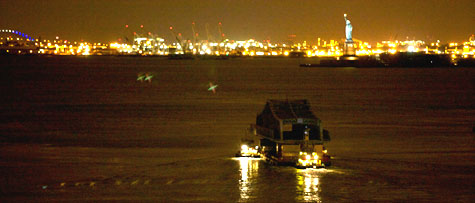
It is amazing what you can see passing through New York harbor. Those awake in the hours before dawn this morning may have seen a highway bridge under tow down the East River around the Battery and across the Hudson River to Jersey City. It was the Willis Avenue Bridge which has spanned the Harlem River for 110 years once carrying 70,000 vehicles daily between upper Manhattan and the South Bronx. The old bridge has been replaced by a new prefabricated bridge. Plans are for the old steel to be cut up and recycled and the concrete to be used for fill.
For those in the area this looks like fun. The Great Lakes Shipwreck Museum and MLive.com are sponsoring a two-night stay for two in the restored 1923 U.S. Coast Guard crews quarters at Whitefish Point in the Upper Peninsula of Michigan. Also included is a tour of the Great Lakes Shipwreck Museum, a video presentation on the history of the Edmund Fitzgerald and a one-year membership into the shipwreck society. The deadline to enter is 5 p.m. Friday, April 15. Winners will be chosen by random drawing.
Thanks to Phil Leon for passing the word along.
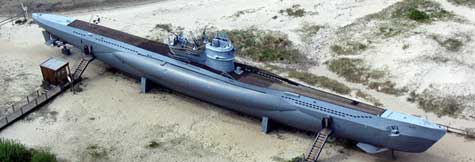
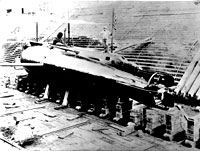
One hundred and eleven years ago today the US Navy accepted its first successful submarine, the USS Holland. The previous November, in New York harbor, the Holland passed the Navy’s tests. She ran for one mile underwater, surfaced, fired a torpedo then dove again and returned underwater to her starting point. Chief Engineer John Lowe, U. S. N. who observed the trials, wrote: “I report my belief, after full examination, that the Holland is a successful and veritable submarine torpedo-boat, capable of making a veritable attack upon the enemy unseen and undetectable, and that, therefore, she is an engine of warfare of terrible potency which the government must necessarily adopt into its service.”
Great footage of the Lynx from TheSailingChannel.TV
Hundreds of dead dolphins and sea turtles are washing ashore on the beaches of the Gulf of Mexico. No one knows exactly what is killing them though many point to the BP Deepwater Horizon oil spill of a year ago. In the mean time, BP is spending roughly $100 million in advertising to “clean up” its image.
Dolphin Deaths Designated An ‘Unusual Mortality Event’
Continue reading
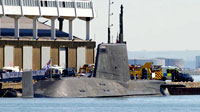
Reports now indicate that Ryan Donovan, 22, a sailor on HMS Astute, burst into the submarine control room and opened fire with an SA80 assault rifle yesterday, killing the ship’s weapons engineering officer, Lt. Cmdr. Ian Molyneux, 36, and wounding a second officer, Lieutenant Commander Chris Hodge. The shooting took place during a tour of the submarine by the Southhampton City Council. The leader of the Southampton Council, Royston Smith, reportedly wrestled the rifle away from the shooter. Southhampton Mayor, Carol Cunio, said she helped stanch blood flowing from Lieutenant Commander Hodge, who had been shot below the ribs on his right side. Lieutenant Commander Hodge is reported to be stable condition.
Senior officer killed in UK nuclear sub shooting
Continue reading
After dabbling with space ships, Richard Branson has turned to the deep oceans. The Virgin Oceanic team will be diving to the deepest ocean depths in a one man submarine designed by Graham Hawkes. The submarine has an operating depth of 37,000ft (7 miles) and is capable of operating for 24hrs unaided. Its top speed is around 3 knots.
The Life Aquatic with Richard Branson
[iframe: title=”YouTube video player” width=”480″ height=”300″ src=”http://www.youtube.com/embed/_Sk_XEHfqwk” frameborder=”0″ allowfullscreen]
Thanks to Alaric Bond for passing the article along.

Photo: Kyoto News
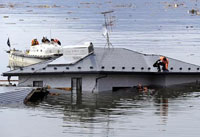
For all the damage that the Japanese tsunami of March 11th left behind on shore, it also carried considerable wreckage out to sea. this week the Japanese Coast Guard warned ships to look out for and avoid the floating debris and wreckage.
Japan warns ships to avoid floating houses, debris
Continue reading

HMS Astute
The BBC is reporting that one sailor has been killed and another seriously injured on the Royal Navy nuclear submarine HMS Astute. A member of the crew is reported to have shot two of his fellow sailors before being overpowered. HMS Astute, the Navy’s newest and most advanced submarine, is docked at Southampton’s Eastern Docks on a five-day official visit to the city. The UK Press Association is also reporting that Southampton City Council’s mayor, leader and chief executive were aboard the submarine at the time of the shooting but were uninjured.
Last October we posted about HMS Astute running aground off Skye during a training mission.
Thanks to Alaric Bond for passing the news along.

Photo: Will van Dorp
Fire Island is a thirty mile long barrier island on the south shore of Long Island, east of the entrance of New York harbor. Last week, Le Papillon, a 50′ steel pinky schooner, went ashore on the beach on Fire Island near the village of SaltAire. The 19 year old captain and the two 20 year old passengers were rescued without injury. Will van Dorp of the Tugster blog captured dramatic photos of the grounded schooner in the Fire Island surf. What will become of Le Papillon? That is difficult to say, but by Tuesday of this week, an ad appeared in Craigslist offering the schooner for sale for $15,000, with the important requirement: “Needs immediate removal.” Le Papillon is neither the first nor likely to be the last vessel to run aground on the Fire Island shoals.
Continue reading
After 66 days at sea, Anthony Smith and a crew of three friends arrived in St. Maarten on a voyage from the Canary Islands on the raft “An-Tiki“. Smith celebrated his 85th birthday during the voyage. The crew of the An-Tiki included John Russell, David Hildred, and Andrew Bainbridge.
Sailor, 85, crosses Atlantic on raft with friends
Continue reading
My wife and I are celebrating our 25th wedding anniversary in a week by having dinner at Le Bernardin. I had proposed in the Le Bernardin, when the restaurant was still in Paris, so it has always seemed a great place to celebrate anniversaries. What does this have to do with radiation? The New York Times recently reported:
“Eric Ripert, the chef of Le Bernardin, the high temple of seafood in Manhattan, bought a new kitchen gadget a few days ago: a radiation detector.
Continue reading