 There is no bad time to read Melville. For the past 15 years in early January, the New Bedford Whaling Museum has a held a Moby Dick Marathon, an event which includes a non-stop reading of the great American novel. This year’s festivities will be spread over three days starting Friday night, January 7th, running through Sunday, January 9th. From their website, it appears that there will be a live feed for anyone wishing to watch remotely.
Continue reading
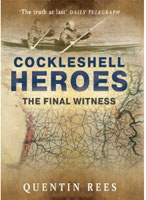 On the night of December 7,1942 ten British commandos set off in five wood and canvas canoes from a British submarine in the Bay of Biscay off the coast of occupied France. Their intent was to paddle 75 miles up the Gironde estuary and attack and sink German ships with limpet mines in the harbor of Bordeaux. Only two of the ten commandos survived but they succeeded in sinking one ship and severely damaging four others, as well as disrupting port operations for months. The British Prime Minister Winston Churchill believed the mission shortened the Second World War by six months.
Much has been written about the commandos who would become known as the “Cockleshell Heroes,” but apparently there are gaps inthe information about those who died in the raid. Quentin Rees has recently written Cockleshell Heroes – The Final Witness to answer the remaining questions about their fate. The book is available from Amazon UK. It has not yet been released in the US but can be pre-ordered from Amazon in the US. Thanks to Alaric Bond for passing the article along.
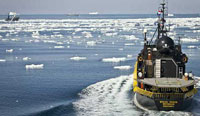 Rather than pressuring the Japanese to stop whaling, the vigilante violence of the Sea Shepherds made it more difficult for Japanese diplomats to compromise in negotiations to reduce whaling according to documents released by WikiLeaks.
WikiLeaks releases documents about anti-whaling group Sea Shepherd
Continue reading
This video, which was tweeted about by Sailing Magazine, stunned me. I had never seen an International Moth class boat and had frankly never imagined a hydrofoil boat of this size zipping about like some sort of otherworldly water creature. But enough verbiage. Just watch the video.
The “Support Captain Owen Honors – USS Enterprise” Facebook page has over 11,000 supporters. Admiral John C. Harvey is not one of them. This afternoon, Admiral Harvey relieved Captain Honors of his command.
 As Shakespeare noted, “the course of true love never did run smooth.” That was literally the case when, in early October, Tokelaun teenager Filo Filo, with two of his friends, set off to visit a young lady on the neighboring Fakaofo atoll, some sixty miles away. The skiff ran out of fuel and the boys drifted for fifty days across nearly 1,000 miles of the Pacific ocean in the small aluminum dinghy before being rescued by a passing fishing vessel. Now the young lady whose face launched the stolen skiff has been revealed. She has been communicating with her young suitor by Facebook. Thanks to Joan Druett for passing along the article.
 An interesting if odd news item today:
Cretan Tools Point To 130,000-Year-Old Sea Travel
Archaeologists on the island of Crete have discovered what may be evidence of one of the world’s first sea voyages by human ancestors, the Greek Culture Ministry said Monday. A ministry statement said experts from Greece and the U.S. have found rough axes and other tools thought to be between 130,000 and 700,000 years old close to shelters on the island’s south coast.
What made this announcement a touch odd was that a virtually identical announcement was made last February. See our previous post from almost a year ago.
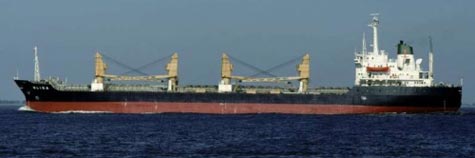
MV Blida hijacked on New Years Day in the Gulf of Aden
Today is the first day back to work for many after a bit of time off for the holidays. And how has the New Year begun? More or less the same as the last year which just ended. On the New Years Eve, the North Korean freighter, the Kang Bong sank. Three crew were rescued, two were confirmed dead and fifteen remain missing. (Thanks to Phil for passing along the article.) On a very different note, New Years Eve also saw the start of the Barcelona World Race, the “first only double-handed (two-crew) regatta around the world.” Fifteen boats are competing in the non-stop race. Piracy remains with us. On New Year’s Day, the 20,586 tonne Algerian bulker, MV Blida , with a crew, of 27 was hijacked by pirates in the Gulf of Aden. Also on New Year’s Day, the US Navy ended all smoking on US submarines. Nicotine gum and patches will be available for the estimated 40% of submariners who smoke. We wish them all the very best during the no-doubt difficult transition. See our post from last April.
So, we have had a mixed start to the new year. Let us all hope that it is better than the last.
It is difficult to imagine how anyone thought that this was a good idea. The XO (Executive Officer) on the nuclear powered aircraft carrier USS Enterprise made a series of videos to “entertain the crew.” They were a bit on the raunchy side, involving masturbation, “chicks in the shower” sailors in drag, gay slurs, rectal exams – that sort of thing. Some people on board were offended. Complaints were ignored. The XO, Owen Honors, who is now the captain of the ship, suggested that if people did not like the videos, they shouldn’t watch them. He also states at the beginning of each video that “the captain and the admiral – they don’t know anything at all about the content of this video or the movie this evening, and they should absolutely not be held accountable in any judicial setting.” OK, fine. How the XO, now the captain, thought that the videos would not find their way to the world outside the ship, to say, I don’t know, the internet, is frankly a bit beyond me. Captain Honors is now in hot water for his lack of judgement and his video directing and editing skills are on display all over the web. Here is a sample as provided in reporting by the Virginia Pilot:
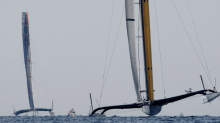 The 34th America’s Cup races will be sailed in San Francisco bay in 2013. San Francisco beat out Newport and an unnamed Italian port city. This will be the first time that America’s Cup races will be hosted by the city by the bay and and the first time in 15 years that the races have been held in the US.
San Francisco picked as venue for 34th edition of America’s Cup
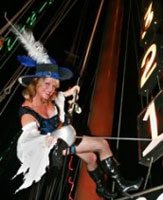
Dropping a Pirate Wench in Key West
In New York City tonight, just on the other side of the Hudson River from where I am now typing, roughly one million people gather in Times Square to watch a crystal ball being dropped on exactly midnight to celebrate the new year. (To be precise, it is actually carefully lowered to coincide with the stroke of midnight.) Another hundred million or so folks will be watching the ball drop on television in the US and an estimated billion people will see the event on video around the world.
In Key West, Florida, the southernmost city in the United States, they do things just a bit differently. They will celebrate the New Year with three different “drops” – a giant conch shell at Sloppy Joe’s Bar on Duval Street, a pirate’s wench from the masthead of a tall ship at Key West’s Historic Seaport, and if conchs and wenches are too tame for you, Sushi, a drag queen, will be dropped at the Bourbon St. Pub also on Duval Street.
New Year’s Eve in Key West: A Wench, A Shell and A Drag Queen
Wherever you may be, we here at at the Old Salt Blog wish you all a most Happy New Year!
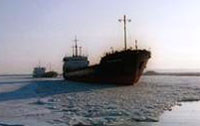 Several news agencies are reporting that more than 600 crewmembers are aboard ten vessels trapped in the ice in the Sea of Okhotsk.
More than 600 people aboard ice-trapped vessels in Sea of Okhotsk
Continue reading
While I don’t normally associate show tunes from “Guys and Dolls” with foul weather and tug boats, Captain Brucato‘s video does a great job of capturing a tug’s-eye view of the recent blizzard that hit the US East coast the day after Christmas.
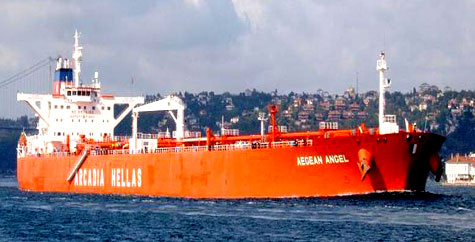
The 160,000 dwt tanker Aegean Angel was en route from Tallinn, Estonia, to Houston, Texas when it encountered heavy weather northeast of Bermuda on Thursday. A large wave is reported to have struck the ship, killing the captain and the chief engineer, who had gone forward to inspect for damage. Several others, including the first officer, were reported to have been injured.
Wave hits tanker in mid-Atlantic, two killed
Continue reading
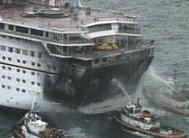 A weird dissonance between two cruise stories struck me recently. On one hand, Carnival Cruise Lines is “the official confetti sponsor of the Times Square New Year’s Eve 2011 celebration.” As reported by the the Maritime Executive “the sponsorship includes multiple opportunities to associate the “Fun Ship” brand with the annual excitement.” A You-tube video of Carnival’s Senior Cruise Director is also featured. On the other hand several media sources have been quoting from an excellent and timely post from last March on Jim Walker’s Cruise Law News blog, Ten Years of Cruise Ship Fires – Has the Cruise Industry Learned Anything?
Continue reading