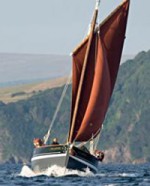
 A year ago we posted about the “Voyage of theSpirit of Mystery,” the recreation of an epic voyage by seven Cornishmen, several of whom had never been out of sight of land, who set sail in 1854 bound for the gold fields of Australia in Mystery, a 37′ Mounts Bay Lugger. Adventurer Pete Goss and his crew built and sailed the Spirit of Mystery, a Mounts Bay Lugger modeled after the original Mystery, to Australia to commemorate the original voyage, arriving in Melbourne almost exactly a year ago. Now the Spirit of Mystery will be returning home to Cornwall, though on this leg of the trip she will be traveling as cargo on a larger ship, at least as far as Holland. Thanks to Tom Russel on the Linked in Tall Ship & Traditional Sail Professionals group for the reference.
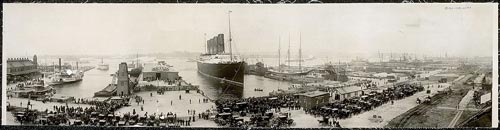
Lusitania arriving New York on her maiden voyage
A new study in the Proceedings of the National Academy of Sciencesconsiders the sinking of two well known ships, the Titanic and theLusitania, and looks at who made it to the lifeboats and who was left behind. Both had a similar number of passengers and a similar loss of life. The big difference between the two ships appears to be the time they took to sink. The Lusitania took 18 minutes while the Titanic took almost three hours. On the Lusitania a higher percentage of men made it to the lifeboats whereas women and children fared much better on the Titanic. The implication is that where time was short, as on the the Lusitania, basic survival instincts took over in the scramble to the boats. On the Titanic, where there was time to organize boarding, the old rule – women and children first, seems to have asserted itself.

USS Constitution
The first exhibit in the $500 expansion of the Boston Museum of Fine Arts new Art of the Americas Wing in currently being installed. The first new exhibit – ship models. An excellent choice. The new wing opens in November. For those in the Boston area who would rather not wait, the USS Constitution Model Shipwright Guild’s Annual Model Ship Show – Models in the Spotlight runs through March 2oth at the USS Constitution Museum.
As a follow up to our previous post, (Cruelty on the Cowpens? Cruiser CO Relieved of Duty), a newly released report by the Navy Office of the Inspector General details the charges of “cruelty and maltreatment” and their findings which resulted in Captain Holly Graf being relieved from duty as captain of the USS Cowpens. As reported by Time Magazine:
 In addition to the investigation underway by the Barbados Maritime Ship Registry on behalf of the government of Barbados, where the Concordia was registered, the Transportation Safety Board of Canada has decided to conduct its own independent investigation into the capsizing and sinking of the sail training ship.
Transportation board to probe sinking of Concordia
Class Afloat, owners of the Concordia say the 18-year-old brigantine was designed and tested to survive the sort of knockdown that apparently sank her.
Tall ship passed stability testing, owners say
Continue reading
11th Annual Ghost Ships Festival 2010
The Ghost Ships Festival is Wisconsin’s largest trade show devoted to Scuba Diving and Great Lakes Maritime History. Exhibits, workshops, and presentations cover just about every aspect of Great Lakes maritime history and scuba diving.
Milwaukee’s Ghost Ships Festival
Thanks to Alaric Bond for the heads-up.
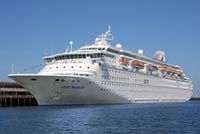
Louis Majesty
Huge wave kills 2 on cruise ship in Mediterranean
A 26-foot wave smashed into a cruise ship carrying nearly 2,000 people in the Mediterranean on Wednesday, smashing glass windshields and killing two passengers, according to officials and news reports.
Continue reading
 Yesterday we posted that the Independence Seaport Museum doesn’t have the money to support the upkeep of the USS Olympia nor does it have the money to dredge the channel to tow her away. On the other side of the river the USS New Jersey Battleship Museum is also having financial troubles. Given the current troubles centered around the Delaware River it almost seems a shame to report that the SS United States, which has been sitting of at Pier 84 in South Philadelphia for the last fourteen years, is now being inspected by scrap dealers. Then again, she is a rusting, gutted shell. Perhaps it is time to let the old lady go. As reported in Maritime Matters:
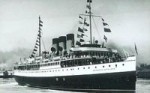 Sunken Canadian ship spewing oil off Alaskan coast: U.S. Coast Guard
A storied Canadian steamship that offered luxury cruises for decades along the British Columbia coast, then served a crucial role during the Second World War transporting troops, supplies and Jewish refugees is now adding an unfortunate chapter to its rich history: the polluting of a major Pacific Ocean inlet.
Continue reading
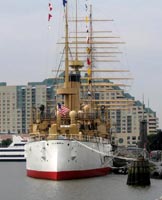 Recently we posted that the Independence Seaport Museum is seeking a new owner for the USS Olympia which it cannot afford to support. See Philly Museum Sends SOS to Care for Historic Ship. Sadly it appears that not only can’t the museum afford to keep the Olympia at dockside, but that it can’t afford to move it either.
Historic ships steel-hulled ships should be drydocked for maintenance at least every twenty years. The Olympia has been in the water continuously for 56 years, since 1945.
Olympia needs $30m in repairs, new caretaker
Continue reading
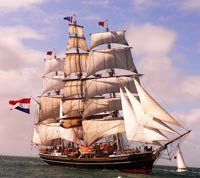 Stad Amsterdam arriving in Melbourne
Back in September we posted about a group of historians and naturalists, as well as a film crew for Dutch VPRO Television sailing on the Stad Amsterdam. The ship is retracing the voyage of HMS Beagle on the 150th anniversary of the publication of Darwin’s On the Origin of the Species. See Retracing Darwin’s Journey – 150 Years Later. The ship arrived in Sydney, Australia earlier this month and last week called at Melbourne. Visit the project website here (in Dutch and English.)
In the ongoing somewhat surreal operation against piracy off Somalia, the HDMS Absalon, a Danish destroyer, sank a pirate “mother ship” but allowed the pirates to return to shore. The official goal appears to be to “disrupt” rather than stop pirate activities. Thus far the naval flotilla has proven itself a significant inconvenience to the Somali pirates but little more. It appears that the nation states involved continue to lack the will to arrest and charge the pirates under international law. A policy of ”catch and release” works well for stocking trout streams but does little in stopping piracy in one of the most important shipping lanes in the world.
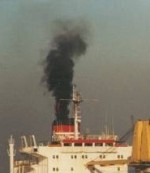 Is a ship the “greenest”, most efficient means of transportation or is the dirtiest? It is easy to be confused about hoe clean or dirty ocean transportation may be from reading the newspapers.
Transportation by water has always been the most efficient means of moving goods over distance. At the turn of the 19th century the cost of transporting an item across the Atlantic by ship was roughly the same cost as moving it 30 miles inland. With canals, railroads and highways, overland efficiency has improved, but, nevertheless, things haven’t changed so much.
A study by National Geographic on the transport of wines reflects this, as expressed by the carbon footprint of the shipment. If you live in New York, a French wine, transported by ship, can have a carbon footprint of only an equivalent to only 0.3 pounds of CO2, whereas a California wine, transported overland by truck, has a carbon footprint of 4.4 pounds.
Ship or Truck Transport Makes All the Difference in Wine’s Carbon Footprint
Continue reading
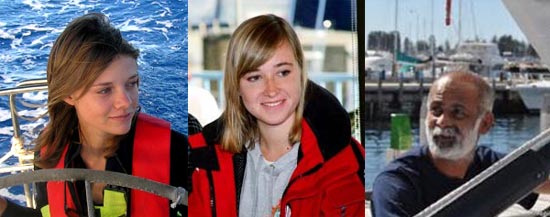
Jessica, Abby, & Dilip
Here is an update on the circumnavigation attempts under way by Jessica Watson, Abby Sunderland and Commander Dilip Donde. The last name may not be as familiar as those of the blonde teenagers. The 42 year old Indian Navy Commander is on the last leg of his quest to be the first Indian to circumnavigate the globe singlehanded. He recently stopped at Cape Town on his way to Mumbai, literally one ocean away from his destination.
Continue reading
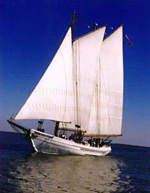 The Port Norris Rotary presents the 13th annual “Run for the Schooner” a 5K run, walkathon & 1 mile fun run/walk on Saturday, April 10, 2010, to benefit the A.J. Meerwald, the official Tall Ship of the State of New Jersey.
To learn more call 856-785-2060, or visit the Bayshore Discovery Project .
The A.J. Meerwald is an authentically restored 1928 oyster schooner operated as a hands-on sailing classroom throughout the region as well as offering shore-based programs and events in her home port of Bivalve on the scenic Maurice River in Cumberland County.
Continue reading