 “Super yachts” rarely impress me. Russian billionaire, Roman Abramovich’s megayacht, “Eclipse,” may be the largest private yacht now sailing but it is, to my eye at least, a bit boring. It may be over 550 feet long and cost a bazillion rubles, but so what?
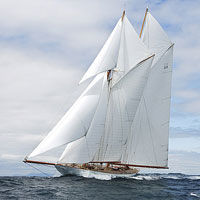
The new Schooner Elena on the other hand is both breathtaking and a resurrected bit of history. The first Elena was built for New York’s Morton Plant in 1911 by Nathaniel Herreshoff. She was beautiful and the fastest yacht of her day, winning races for years including the 1928 Trans Atlantic King’s Cup from New York to Santander.
Continue reading
 From
From 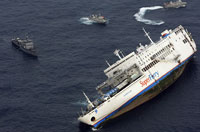 I’ve always been struck by the tragedy that those most in need of ferry service are often also most at risk. We have seen recent ferry accidents in the Philippines with the sinking of the
 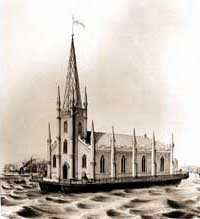 If you can’t get sailors to church, bring the church to the sailors. That was the strategy used in 1844 by the Protestant Church Missionary Society for Seamen, which was renamed the
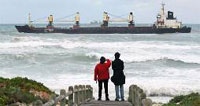
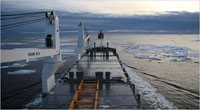
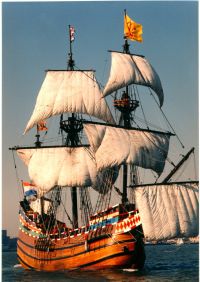 Today there are 1.6 million or so residents on the island of Manhattan. How things have changed. Four hundred years ago on September 12th, 1609, when Henry Hudson first stepped onto the island, there were roughly 600 Lenape Indians living there. The natives called the island Manna-hata, as recorded in the 1609 logbook of Robert Juet, an officer on Hudson’s ship, Half Moon. Manna-hata is translated from the Lenape to mean the “island of many hills.”
 Last February, we posted about
 We recently posted about how
  In the aftermath of the fire in 1934 on the passenger liner Morro Castle, in which 135 passengers and crew died, there was considerable blame to be shared. The ship’s safety equipment was poorly maintained, the crew poorly trained and the ship’s officers made several questionable decisions which may have contributed to the rapid spread of the fire. How the fire started has never been determined. One man, George White Rogers, a radio officer, would be held up as hero. He stayed at his station transmitting “SOS” despite intense heat and smoke in the radio room.