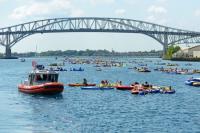
 On July 12, 1812, General William Hull led a force of roughly 1,800 US militia across the Detroit River to invade Canada. It did not go well. Within days Hull and his forces were driven out by British, Canadian and Native American forces. By August 16th, Hull surrendered Fort Detroit to the British without a fight. This weekend, there was a sort of accidental re-enactment of Hull’s invasion, by an estimated 1,500 Americans on the nearby St. Clair River. Instead of being dressed as militia, however, most of the invaders were wearing bathing suits, were floating in tubes and rafts, and many were reported to be intoxicated.
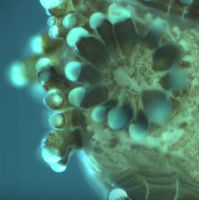 Coral are individual invertebrate polyps living in communities, which can grow to become vast reefs. Until recently, there was no way to examine the living coral polyps in their own habitat. Now, researchers at the Scripps Institution of Oceanography at UC–San Diego have developed an underwater microscope that that makes that possible for the first time. As reported by Slate:
The first-of-its-kind microscope has two parts: a computer with a diver-friendly interface, and a microscopic imaging unit. It sports an electronically tunable high-magnification lens, a ring of LED lights for fast shutter speeds, and fluorescence imaging. “The system is capable of seeing features as small as single cells underwater,” according to one of its designers, Ph.D. student Andrew Mullen.
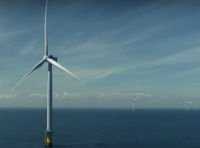 Recently, we posted about the first offshore wind farm in the US — the Deepwater Wind Project which is installing five turbines with an installed capacity of 30 MW off Block Island, RI. While this is definitely progress, it is also a reminder of how far behind the US is in developing offshore wind power as compared to the rest of the world.
Last week, the UK approved Hornsea Two, the second phase of the world’s largest wind farm. The 300 turbine project by Denmark’s Dong Energy is fifty-five miles off the coast of Grimsby and is expected to deliver 1.8 gigawatts of clean electricity to 1.8m UK homes. With the 1.2 gigawatts developed by phase one of the project, Hornsby One, the combined project will supply 3 gigawatts, enough to power 2.5 million average (U.S.) households. If the third phase of the project is completed, Hornsea will have a total capacity of 4 gigawatts.
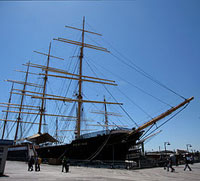 German media is reporting that sometime next spring, the historic Laeisz Flying P-Liner Peking is expected to leave New York harbor, where she has been a museum ship at the South Street Seaport Museum for over 40 years. She will be returning to her home port of Hamburg, where she was built, 105 years ago. In no condition to travel on her own bottom, the grand old windjammer will be carried across the Atlantic on the deck of a heavy lift ship. Prior to her trans-Atlantic passage, she will move from the South Street Seaport to a local shipyard to be made ready for the voyage.
The Peking‘s new owner is the Hamburg Maritime Foundation. The ship will be part of the a new Hamburg maritime museum, which is under construction.
On August 26th, as part of their “Free Fridays” program, the South Street Seaport Museum will be honoring the Peking with participatory sail-raising aboard the barque, printing demonstrations at Bowne Printers with Peking themed take-aways, and a special screening of Around Cape Horn. Click here to register for the screening.
 One day, I would love to sail to the Faroe Islands. The Faroes are an archipelago of eighteen strikingly beautiful islands between the Norwegian Sea and the North Atlantic Ocean, approximately halfway between Norway and Iceland, and 200 miles north-northwest of mainland Scotland. Given how remote the islands are, it may not be surprising that Google has not yet sent their 360 degree cameras to map the islands for Google Street View on Google Maps. The Faroese, however, are a creative lot.
The islands are an autonomous country within the Kingdom of Denmark with a population of around 50,000 people and around 80,000 sheep. Indeed, the Danish name, Færøerne, translates as “the islands of sheep”. What does this have to do with Google Street View?
If the Faroese did not get Street View, they could set up their own mapping with SheepView 360. As reported by the Guardian, with the help of a local shepherd and a specially built harness built by a fellow islander, Durita Dahl Andreassen of Visit Faroe Islands has fitted five of the island’s sheep with a 360-degree camera.
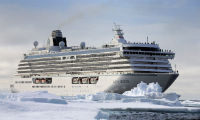 The 1,070 passenger 68,870 GT cruise ship Crystal Serenity is arriving in Nome, Alaska on Sunday, August 21st, before continuing on in a 1,500 km voyage to transit the Northwest Passage via Canadian and Greenland. The 32 day voyage, which began in Seward Alaska, is expected to arrive in New York on Saturday, September 17, 2016. Accompanying the Crystal Cruises ship will be the RRS Ernest Shackleton, a vessel built for and operated by the British Antarctic Survey (BAS). During the Antarctic winter/Arctic summer, the ship is available for commercial charter.
The Crystal Serenity is not the first cruise ship to transit the Northwest Passage but is, by far, the largest. Continue reading
 Tall Ships Duluth 2016, billed as the “Greatest Spectacle on Lake Superior,” kicks off this morning at 11AM and runs through Sunday, August 21th. The festival features eight tall ships including El Galeon Andalucía, the US Brig Niagara, and the schooners Pride of Baltimore II, Mist of Avalon, When and If, Denis Sullivan, Appledore V, and Zeeto. The “World’s Largest Rubber Duck” will also make an appearance. The festival offers ship tours, day sails, educational programming, food and beverage, entertainment and fun for all ages.
This year, the festival has partnered with Art in Bayfront Park to create an event within an event including 150+ high quality art vendors.
 A fire broke out on the passenger/roro ferry Caribbean Fantasy as she was approaching San Juan, Puerto Rico on Wednesday morning. A reported 512 passengers were evacuated from the burning ship, roughly a mile off Puerto Rico’s north coast. The fire was said to have started in the engine room and to have spread. Thus far only four injuries to passengers and crew have been reported and no one has been reported to have died or to be missing.
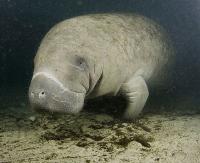 Recently, what is being described as a “manatee mating ball” stopped traffic on the Courtney Campbell Causeway between Tampa and Clearwater, Florida. Dozens of people abandoned their cars to line the shore to watch manatees having sex. Video after the page break. This wasn’t the first time that manatee sex stopped traffic on the causeway.
Manatee mating herds are infrequent but not that unusual, occurring every three to five years on the Courtney Campbell. In 2012, we posted Mating Manatees Stop Traffic on Tampa Bay Causeway about the last time when a manatee herd mated at just about the same spot. In 2004, another group of mating manatees drew a reported 500 onlookers to the Courtney Campbell.
So, what is happening? Save the Manatee Club has an Everything You Always Wanted to Know About Manatee Mating Herds (but were afraid to ask”) page to explain it all. Continue reading
 Last November, we posted Wind Power Returns to Block Island about a planned offshore wind farm. The installation of America’s first offshore wind farm has finally come to pass. America’s very first offshore wind turbine was erected recently off the coast of Block Island, Rhode Island. Perhaps paradoxically, while the new wind turbines are the first offshore wind farm in the United States, wind power is not by any means new to Block Island.
The new Block Island wind farm is a five turbine 30 megawatt project which developed by Deepwater Wind, which should provide most of the power required for Block Island, an island in the Atlantic thirteen miles south of the coast of Rhode Island. Compared to European wind farms with an installed capacity of over 6,600 MW, the Block Island installation is tiny. Nevertheless, it is a start.
Block Island, however, is no stranger to wind power. Continue reading
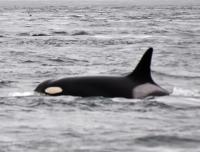
Photo: Leigh Calvez
Orcas live in complex multi-generational pods led by a matriarch. In the pod that scientists have labeled as the “J pod,” the matriarchal orca, designated as J2, also-known-as “Granny” was recently sighted swimming with her pod off the coast of Washington. Remarkably, Granny is believed to be oldest living orca at 105 years old. If so, Granny was swimming the Pacific when the Titanic was launched.
As reported by the SF Gate: The 105-year-old whale nicknamed “Granny” was seen on July 27 swimming with a few other whales, and seemed to be in “high spirits,” according to a whale-sighting report shared by Orca Network. Continue reading
 A new and fascinating video from Mystic Seaport Museum. From their website:
From the history and lore inspired by whaling in the 19th century, it can be hard to imagine the whalers being idle at sea. However, whaleships were often at sea for months or even years, leaving the crew with an excess of downtime. Much like hobbyists today, sailors tried to keep busy by making use of what they had available onboard their ship. Using crude tools, sailors etched designs into whale teeth, bones, and baleen to create intricate and often useful pieces of art.
Scrimshaw, as these pieces are known, is thought to come from the Dutch for “idle fellow.” The term has come to include anything made out of marine mammals. While the craft was certainly useful for occupying the ship’s crew on long voyages, it also serves as visual history of the whaling. Sailors often depicted nautical motifs inspired by things they experienced during their voyage, giving a glimpse into their daily life at sea. Continue reading
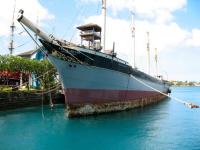 Sad, if not surprising news. The Hawaii Department of Transportation Harbors Division (HDOT Harbors) has ordered that the 138-year-old sailing ship Falls of Clyde be removed from Honolulu harbor. Previously, in a letter dated June 15th, the Harbor Division had given the Friends of the Falls of Clyde, the current owners of the ship, 30 days to remove it from Pier 7 in Honolulu harbor, where the ship has been berthed, free of charge, for the last seven years. In the letter, the Harbors Division cited safety concerns. “The condition of the Falls of Clyde poses an unacceptable risk to navigation in Honolulu Harbor and a safety and security risk to harbor users.”
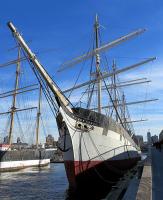
Photo : John Wisniewski
Forty six years ago yesterday, the full-rigged iron sailing ship Wavertree, arrived in South Street Seaport after being towed from Argentina. The 1889 built windjammer had languished as a sand barge in Argentina for decades, before being purchased and partially restored by the South Street Seaport Museum. In May of last year, the ship was moved to Caddell’s Drydock in Staten Island to undergoing a major $13 million restoration and refurbishment.
Next Tuesday, the Wavertree‘s third and final mast will be stepped. From the Seaport Press release: The event begins at Noon on Tuesday, August 16th, 2016 and culminates in a coin-placing ceremony at 1pm. Following maritime tradition, a coin is placed at the base of the mast for good luck. The mast is then “stepped” or installed. In attendance at the August 16th ceremony will be Seaport Museum co-founder Norma Stanford, Peter and Norma Stanford’s three grandchildren, and Joan Davidson, a former Seaport Museum trustee. Before the mast is stepped, an 1885 Maundy Fourpence coin will be placed at the base of the mizzenmast by Joan Davidson and Peter and Norma Stanford’s grandchildren.
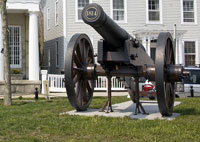 Two hundred and two years ago this week, in a three day battle, the militia at Stonington, CT drove off a four ship Royal Navy flotilla during the War of 1812. Here is lightly edited repost about the battle from July 11, 2012.
Stonington, Connecticut, is a small village on the extreme eastern coast of the state. In the center of the village, two 18 pound cannon are on display in the fittingly named Cannon Square. On their tampions, blocking the ends of the cannon’s muzzles, is the date 1814, when the two cannons, manned by local militia, almost miraculously drove off a British force of four Royal Navy ships under the command of Captain Sir Thomas Hardy, Nelson’s flag captain on HMS Victory at the Battle of Trafalgar. The battle may not have been of any great strategic importance, but was one of a series of American victories in the last days of the War of 1812.