Many of these “mind blowing facts” don’t seem that surprising, but they do get the bottom line right — “For an industry that basically runs the world economy most people know very little about the enormous complex that touches almost every single thing you use.”
Photos from the Sultana Downrigging Weekend in Chestertown, MD. A touch rainy, cold and windy but still a great time. Along with the schooner Sultana were the pinnance Kalmar Nyckel, and the schooners Lady Maryland, Pride of Baltimore II and A.J. Meerwald. A variety of classic smaller craft were also in attendance including the sharpy schooner E.E. Moore and the vintage catboat Silent Maid.
[tribulant_slideshow gallery_id=”1″]
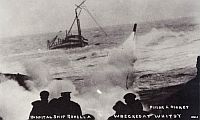 Just over 100 years ago, the World War I hospital ship, SS Rohilla, ran aground in a gale less than a mile off the North Yorkshire coast, near Whitby, with the loss of 85 crew and passengers. SS Rohilla had left Scotland on 30 October 1914 with 229 aboard and had been thrown off course by violent storms. The ship was carrying medical staff bound for Dunkirk, in Belgium, to treat the wounded from the Great War. The rescue, which would take three days, also marked the end of the rowed lifeboat for ship rescue.
For three days, brave lifeboat crews from Whitby and surrounding communities battled to reach the stranded ship, which was breaking up under in the storm. After initially rescuing over 90 of the survivors, the conditions worsened, so that the oar-powered lifeboats were unable to reach the remaining survivors aboard the ship. Finally one of the very few motor-driven lifeboats of the day, the Henry Vernon, was brought from Tynemouth, and successfully rescued the last 50 survivors. According the legend, the last off the ship was the captain carrying the ship’s black cat.
The RNLI produced a short documentary about the Rohilla Rescue: Continue reading
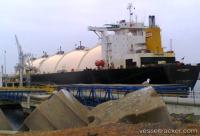
LNG Taurus Photo: Vesseltracker.com
In honor of Halloween, here is a troubling account of a modern-day haunted ship. The LNG Taurus was one of a series of ten Moss-Rosenberg type 125,000 cubic meter Liquefied Natural Gas ships (LNG) ships built by General Dynamics in Quincy Massachusetts in the late 1970s. The story takes a while to tell, so please bear with me.
As a liquid, natural gas is 600 times more dense than as a gas, which is why it is economical to carry by ship. The challenge is that natural gas can only be liquefied by refrigeration which means that LNG ship are essentially giant thermos bottles carrying gas liquefied at approximately −162 °C (−260 °F). Some claim that because of the potential volatility and energy contained in the cargo, that LNG ships could be floating bombs, capable of doing significant damage to port cities if the hulls were breached. So far, in a half century of LNG ship operations, these fears have proven unwarranted.
There have been close calls. When I heard that Robin Williams took his life in August, I was reminded of the suicide of the captain of an LNG ship which ran hard aground in a storm at the entrance of a Japanese port, many years ago. When it must have seemed that his ship would break up, spilling its dangerous cargo with unknown but dire consequences, the captain stepped into his cabin and committed suicide with the ship’s revolver.
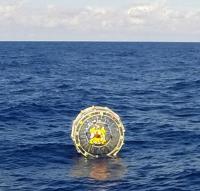
Baluchi in his bubble
As we posted earlier this month, Reza Baluchi, an extreme runner, attempted to run the almost 1,000 miles from Florida to Bermuda in a sort of bubble — an inflatable cylinder with a metal frame, that looked sort of like a clear hamster wheel. Not surprisingly, he made it about 70 miles before he needed rescue by the US Coast Guard. The rescue cost taxpayers roughly $144,000. Incredibly, it now appears that Baluchi is going to attempt the same lame stunt again. From his website:
Reza plans to save money, design a 4th generation bubble and return to Miami to bubble across the Bermuda triangle again in January. His 4th generation bubble will be his best design yet. He’s going to make it faster with 4″ deep fins that will propel through the water quicker, especially with the 28 soccer balls he will stick between the frames that wrap around the circumference of the bubble.
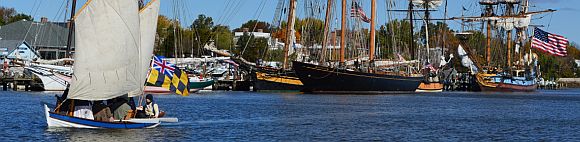 Downrigging is one of those necessary chores on a sailing vessel at the end of a season before the winter sets in. The good folks at the Sultana Education Foundation have turned the necessary and often bittersweet chore of downrigging the replica schooner Sultana into a festival celebrating tall ships and wooden boats. Starting Friday, October 31 and running through Sunday November, 2 in Chestertown, MD, the “Downrigging Weekend” will feature tall ships, art, music and food in one of America’s best preserved historic seaports. The tall ships Kalmar Nyckel, Lady Maryland, Pride of Baltimore II and A.J. Meerwald will be joining the schooner Sultana for dockside tours and, weather and space permitting, public sails.
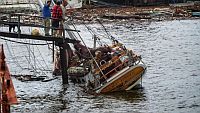 Captain Ron Strathman has cruised the Sea of Cortez for the last 6 years in his 1977 wooden schooner Gold Eagle. Last month, Hurricane Odile slammed into Mexico’s Baja peninsula with reported winds reaching 100 knots. At least five died in the storm and dozens of boats were sunk. One of them was Strathman’s Gold Eagle. He is now attempting to raise money to salvage and restore the schooner. Click here to learn more and to help a sailor who could use a hand.
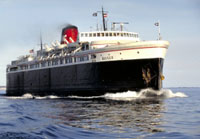 Next season, the SS Badger may no longer be the “the filthiest ship on the Great Lakes.” With the end of the current sailing season, SS Badger will no longer dump coal ash into Lake Michigan. For years, there has been a running argument over whether the ship is a national historic treasure or an environmental hazard. The SS Badger, a passenger and vehicle ferry operating on Lake Michigan, is the last large coal burning vessel in the United States. Until recently, the Badger has been dumping around 500 tons of coal ash each year into into Lake Michigan. The ash is toxic, containing containing mercury, arsenic, and lead. Two years ago, the owners of the ship entered into a consent decree with the EPA to reduce the amount of ash being dumped and to end the dumping entirely by the beginning of the 2015 sailing season.
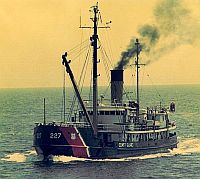 If you are in the neighborhood, this is a most worthwhile event. There is also exiting news. At the fundraiser, the Lilac Preservation Project will announce the launching of a campaign to restore steam to the Lilac, a 1933 lighthouse tender that once carried supplies to lighthouses and maintained buoys for the U.S. Lighthouse Service and the U.S. Coast Guard. Decommissioned in 1972, USCGC LILAC is now a museum ship owned by the non-profit Lilac Preservation Project. The project will restore her boilers and overhaul the original machinery to put her back in operation. From their press release:
On Wednesday, November 12, Lilac Preservation Project will host its first fundraiser at Cercle Rouge Restaurant in Tribeca. Continue reading
And now for something completely different — what happens when you crack an egg underwater? I will admit this hasn’t been a question that has been keeping me awake at nights, but it is interesting, nevertheless. Here is what happens when you crack open an egg when 60′ below the surface. The video was produced by the Bermuda Institute of Ocean Sciences (BIOS) to demonstrate the effects of pressure under water.
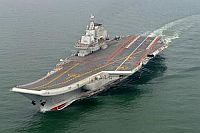
CNS Liaoning
The Russians and the Chinese each have only one aircraft carrier in service. They happen to be sister ships and both have major problems in staying afloat and keeping the propellers turning. Both ships were built in the Black Sea Shipyard in Mykolaiv, Ukraine.
Russia’s only operational aircraft carrier, Admiral Kuznetsov, dating back to the Soviet Union, was ordered in 1981 and went into full service in 1995. The ship has had significant operating problems. There were reports that in 2011 that the U.S. Navy’s Sixth Fleet kept close by in case the Admiral Kuznetsov happened to sink. The carrier made it back to her home port and has recently undergone a refit.
China also has one aircraft carrier, Liaoning, which is also beset with problems. The Chinese purchased the unfinished ex-Soviet carrier, Varyag, in 1989. The Liaoning happens to be a sister vessel to Admiral Kuznetsov, though was never delivered due to the collapse of the Soviet union. The Liaoning was commissioned two years ago but is still undergoing sea trials and reportedly has suffered significant mechanical failures. Even the China daily is admitting that “more time is needed to hone [Liaoning’s] combat readiness.”
Admiral Kuznetsov and Liaoning are each roughly half the size of a US Navy Nimitz class aircraft carrier, of which the US has ten. According to globalsecurity.org, the US Navy has over twice as many aircraft carriers as the rest of the world combined, measured both by the number of ships and aircraft deck space.
 Easter Island, called Rapa Nui by its inhabitants, famous for its massive stone statues, is one of the most remote inhabited islands in the world. It is almost 2,000 nautical miles from the coast of South America and over 1,000 nautical miles to Pitcairn, the closest inhabited island.
Despite the distance, recent DNA analysis suggests that sailors were traveling back and forth between Rapa Nui and South America several hundred years before the the island was first visited by Europeans. In this week’s issue of Current Biology, researchers argue that the DNA points to contact between Native Americans and Easter Islanders between 1300 C.E. and 1500 C.E, three centuries after Polynesians settled the island and at least two centuries before Europeans first landed on the island in 1722. “We found evidence of gene flow between this population and Native American populations, suggesting an ancient ocean migration route between Polynesia and the Americas,” said geneticist Anna-Sapfo Malaspinas of the Center for GeoGenetics at the University of Copenhagen, who led the study.
But did the South Americans sail to Rapai Nui or did the Polynesians sail to South America? Opinions vary. As reported in Science:

Ceres as seen by Hubble Space Telescope
In September, we posted about a recent study that concluded that up to half the water on our planet is older than the sun. Scientists now speculate that the existence of water may be far more common in the universe than previously thought. Some of that water may be fairly close to home, at least in astronomical terms. The dwarf planet Ceres, the largest object in the asteroid belt, which lies between the orbits of Mars and Jupiter, may contain more water than our planet Earth.
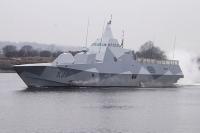
Swedish Corvette Visby, one of the ships searching for the mystery sub
Last Friday, there were reports of unexplained underwater movements near the Stockholm archipelago. There were also reports of an encrypted distress call of the sort used by the Russian Navy, leading to speculation that a Russian submarine was stranded underwater. Russian officials have emphatically denied that, if there is a submarine, that it is theirs, and instead suggested that it could be a Dutch submarine, which participated in an exercise with the Swedish navy last week. The Dutch responded by saying that their sub left the area well prior to the sightings. Yesterday, Sverker Göransson, Sweden’s top military commander, told reporters. “This is very serious, I would even go so far as to say, that it’s fucked up.” (The Swedish phrase used was “Det är för jävligt.” If anyone has a better translation than “that’s fucked up,” we be happy to hear it.)
On Trafalgar Day, the anniversary of Admiral Horatio Nelson‘s victory and death at the Battle of Trafalgar, a ballad describing the battle, “On board a Man o’ War,” sung by Ian Page. Feel free to grab a mug of porter, or coffee or tea, and to sing along.
Song: “On board a Man o’ War” – Nelson’s Victory & Death at the Battle of Trafalgar, 1805