Last month we posted that tanker charter rates were at the lowest they have been in 14 years and that the number of large tankers in lay up was approaching levels similar to those during the slump in the 1980′s. This week, the tough times in the tanker markets claimed a high profile victim as General Maritime Corporation filed for Chapter 11 bankruptcy protection. General Maritime operates a fleet of 7 VLCC, 11 Suezmax , 10 Aframax, 2 Panamax, and 4 Handysize tankers and once had a $5.3bn market capitalization.
Continue reading
Recently, divers from Cleveland Underwater Explorers, Inc. discovered the wreck of the brigantine Sultan, which sank in September 1864 in Lake Erie in 45 feet of water. The ship is in quite good shape.
Beyond the discovery itself being interesting, I can’t help but be amused by the reporting. The brigantine is described by the writer as a “double-masted, solid wood structure, … a favorite among both pirates and other hearty seafaring folk.” If the ship had been a “solid wood structure,” the loading of cargo would have been very difficult but it would have been much harder to sink. Most “seafaring folk” are reasonably “hearty,” I suppose, even if the Great Lakes is not well known for pirates. Roaring Dan Seavey is the only Great Lakes pirate that I am familiar with, but he came along after the Sultan sank. Nevertheless, the reporter does deserve points for effort. Thanks to Phil Leon for passing the article along.
The Thames sailing barge was a remarkably efficient cargo carrier that lasted well into the 20th century before being replaced by diesel trucks. We have followed the rebuilding and the relaunching of the Thames sailing barge Cambria, which was the last British registered vessel to carry a commercial cargo under sail alone, retiring only in 1970. Thanks to Søren Nielsen and Doug Mills on Facebook for pointing out a new documentary about Thames sailing barges – Red Sails by Countrywide Productions. Additional clips from the documentary are available on their website.
Red Sails – The Trailer (Thames Sailing barges)
[iframe: width=”560″ height=”315″ src=”http://www.youtube.com/embed/UBT_zOC0V0c” frameborder=”0″ allowfullscreen]
The USS George HW Bush, the tenth of the Nimitz class, is the US Navy’s newest aircraft carrier. It cost $6.2 billion to build and is powered by two nuclear reactors which can develop 260,000 shaft horsepower. The carrier can carry 90 fixed winged aircracft and helicopters. The ship’s crew numbers 3,200 with an additional 2,400 serving in the air wing. The one thing that the ship does not have, apparently, is working toilets.
Since it deployed in May, the new carrier has suffered from widespread plumbing failures, which, at times, rendered the entire ship without a single working head. With remarkable understatement, the crew has complained that the lack of toilets has “affected their morale, health and job performance.” The problem has been ongoing for six months. The Navy is blaming the sailors, who are blaming the design of the vacuum toilet system.
Carrier Bush suffers widespread toilet outages
Continue reading
The Maritime Museum of San Diego brags that the Star of India is the oldest active sailing ship in the world. This weekend they demonstrated how they can make that claim. The Star of India, built at Ramsey Shipyard in the Isle of Man in 1863, went sailing this weekend, along with HMS Surprise and the Californian. At 148, the old lady is looking mighty fine.
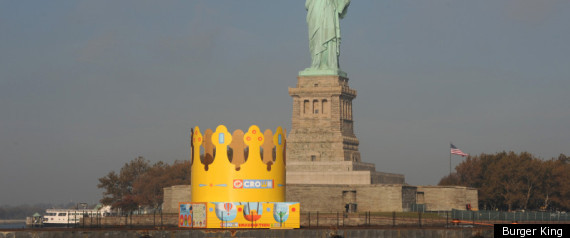
There have been several interesting art projects on and/or soon to be under the water around New York harbor. Late last month a Harvest Dome built of discarded umbrellas was unexpectedly shipwrecked on Riker’s Island in New York’s East River. A day or two later, the folks at the fast food restaurant, Burger King, unveiled the world’s largest aluminum sculpture on a barge in honor of the 125th birthday of the Statue of Liberty. Whether a crown celebrating fast food is an appropriate symbol to use to honor the anniversary of the Statue of Liberty or whether it even qualifies as art, I will leave to the reader to decide. It did however set a Guinness World record. Finally, just a bit South of the harbor, a group known as Art as Reef is building a 50 by 23½-foot horseshoe crab sculpture to be sunk on the Axel Carlson Reef outside Manasquan Inlet. The sculpture will provide habitat for many marine species.
Continue reading
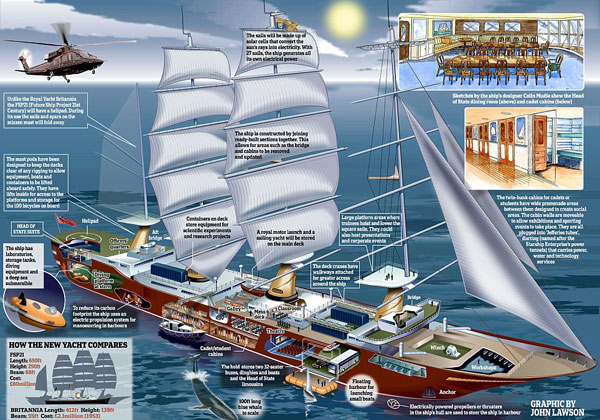
Since 1660, Great Britain has had 83 royal yachts. The last was the HMY Britannia, built at John Brown’s Clydebank Shipyard and delivered in 1954. She was retired in 1997 and thus far there are no plans to build another. Recently the British newspaper the Daily Mail announced a new campaign to build a 21st-century successor to the Britannia. This weekend they posted an interesting, if slightly fanciful, artist’s representation of a proposed replacement yacht. Interestingly enough, the proposed yacht is a four masted square-rigged barque, with solar cells incorporated into the sails, a heli-pad, a mini-sub and and an underwater laboratory. In these days of austerity, the plan is to build the ship from private donations and have her pay her way by using the vessel for trade shows and training cadets. The drawing of the proposed ship is a bit of a cartoon but is fun to consider, neevrtheless. Thanks to Alaric Bond for passing the article along.
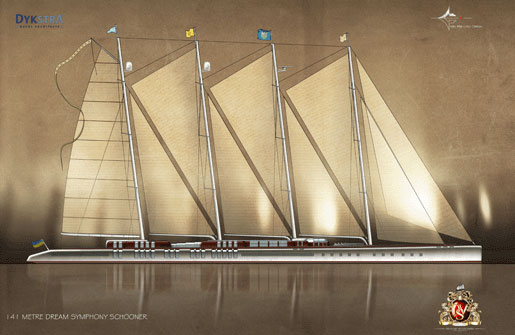
Yesterday, we looked at the Bugis phisini, a modern sailing ship built using traditional wood ship building methods that date back a thousand years or so. Today, a look at the other end of spectrum – wood sailing ships that use the most modern building technology.
Dream Symphony, with four masts and 462 feet (141M) long, will be the largest wooden sailing yacht ever built. It will also be among the longest wooden vessels ever built. In the early 20th century, wooden shipbuilders discovered that there was a limit how long one could build a wooden ship. Ships over 300 feet long tended to be too flexible to hold together in a seaway.
Continue reading
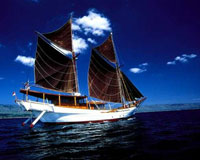
For centuries, the Bugis people have sailed from South Sulawesi across the shallow seas of the Indonesian archipelago. They would sail east and west on the monsoons, regularly trading as far as Northern Australia in their two masted ships, known as phinisi (often also spelled pinisi.) The great age of sail, which ended in the West in the early twentieth century, never quite ended in Indonesia. The Bugis have continued to build their phinisi on the beaches of Sulawesi and continue to sail the islands to this day. In addition to serving as transport and traders, the phinisi are also increasingly used as tour, cruise and dive boats. Some are fitted out as yachts.
What brought this to mind was an article posted by Tom Russell in the Traditional Sail Professionals Linked-in group, about a large phinisi recently launched from the beach at Tanjung Bira, in Bulukumba, South Sulawesi.
Bulukumba shipyard launches another impressive Phinisi Schooner
Continue reading
I am not one for cute pet videos. And I am not a huge fan of cats. Nevertheless, for this video I have to make an exception. The video was shot in at the Theater of the Sea, a marine animal park in Islamorada, Florida in 1997. The dolphins are Shiloh and Thunder and the cat is Arthur. Thanks to Ann and Hal Brown for passing the video along.
Cat and Dolphins playing together
[iframe: width=”480″ height=”360″ src=”http://www.youtube.com/embed/rynvewVe21Y” frameborder=”0″ allowfullscreen]
“HMS” Bounty, the replica of the ship of the mutiny fame, built for the Marlon Brando movie of 1965, is on her way home from her European Summer cruise. Doug Faunt, with whom I briefly sailed on the Rose, has been posting updates of their progress on their Facebook page. I particularly liked yesterday’s update, where he detailed their “definite plans.”
News from the Bounty….definite plans
Continue reading

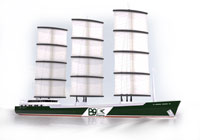
Proposed B9 3000dwt sailing cargo ship
I love the headline in the article in Sail-World – Britain set to introduce sailing ships to counter emissions. The first paragraph reads:
It’s official. The days of sail may be just about to recommence. The UK’s Committee on Climate Change has come out with a report that recommends ‘installing supplementary power systems to make use of solar or wind power’ on British ships.
Wouldn’t it be interesting, if it were true. It isn’t.
Continue reading

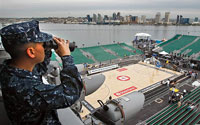
Photo: Don Bartletti / Los Angeles Times
Happy Veterans Day. Sadly the “war to end all wars” that ended on the eleventh hour of the eleventh day of the eleventh month of 1918 did not not live up to its billing. Nevertheless, we celebrate the sacrifices made by veterans on this day in the faint but fervent hope that one day all wars will end.
Last May we posted about an unusual way to celebrate the upcoming Veteran’s Day – a basketball game on an aircraft carrier. Today, in San Diego, the nuclear aircraft carrier USS Carl Vincent‘s flight deck is being transformed into a basketball court and arena for the Veteran’s Day Carrier Classic basketball game between North Carolina and Michigan State.
Continue reading
A fitting tribute to the 29 men who went down with the Great Lakes ore boat, the SS Edmund Fitgerald, which sank 36 years ago today in Lake Superior. I am having a hard time believing that she sank that many years ago.
The image on the right is a new poster for the London 2012 Olympics featuring a section of the River Thames. The image on the left is a photo of the roughly the same section of the river. Notice a difference? (Click on the thumbnails for larger images.) The graphic artists who designed the poster have apparently airbrushed out the Royal Navy light cruiser, HMS Belfast. Not surprisingly, many are not happy about it.
Are Olympics chiefs ashamed of our proud military history? Just days before Remembrance Sunday, HMS Belfast is airbrushed from poster
Continue reading