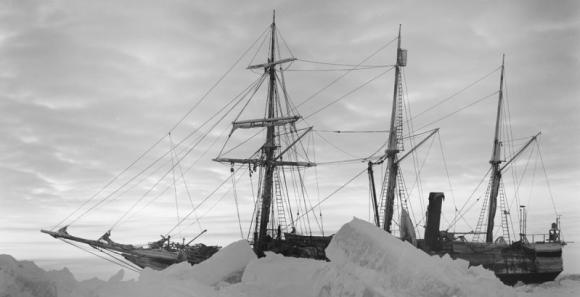
On Throw-Back Thursday and Valentine’s Day, here is a repost from a few years ago of a series of Valentine Islands, not all of which are tropical. Are they islands of love on the storm-tossed seas of life? Sadly, they are probably not, but they do look like Valentine’s Day hearts.
Originally posted in gCaptain. Reposted with permission.
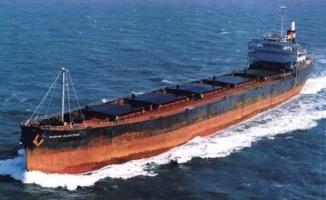
Thirty-six years ago this week, the SS Marine Electric sank off the coast of Virginia with the loss of 34 officers and crew. There were only three survivors. The tragedy resulted in major reforms in ship inspections and operations and ultimately saved many lives. Last month, a new documentary series premiered on the Smithsonian Channel, Disasters at Sea. The second episode of the series, Deadly Neglect, examines the sinking and subsequent investigation and aftermath of the loss of the SS Marine Electric. Here is a review.
The Oliver Hazard Perry, the largest civilian Sailing School Vessel in the United States, has offered programs in New England in the Summer and headed south in colder months. Recently, however, the operation ran a deficit approaching $1 million.
Rather than sail the ship south again this winter, the Oliver Hazard Perry Rhode Island organization board put the ship in drydock and has decided to take a “strategic pause” to rethinks its strategy for the ship’s financial sustainability. The goal is to refocus the organization’s activities to cut expenses, which would likely limit the ship’s operations to New England’s waters in the foreseeable future.
Walter H. Munk, world-renowned oceanographer and geophysicist, has died at 101 at his home in San Diego. Referred to by many as “Einstein of the sea“, Dr. Munk’s work ranged from predicting wave heights on beaches for an amphibious landing in World War II to pioneering research on oceanic sound transmission to measure changes in water temperatures, forecast waves and seek signs of global warming.
From the Scripps Institution obituary: As a geophysicist at Scripps Institution of Oceanography at the University of California San Diego, Munk made groundbreaking observations of waves, ocean temperature, tidal energy in the deep ocean, ocean acoustics and the rotation of the earth. As an advocate of science and broader scholarship, Munk served as an advisor to presidents and the Pentagon and conferred with public figures including the Dalai Lama and Pope Francis. His convictions led him to refuse to sign a loyalty oath required by the University of California during the peak of anti-communist fervor in the early 1950s and his passion helped create the architecture that would become the defining style of the Scripps Oceanography campus.

Credit: Princeton University
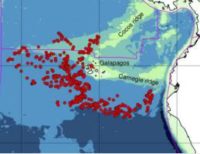
Scientists have identified a huge magma plume under the Galapagos archipelago using an array of floating robotic seismometers. In other news, the acronym writers have been working overtime. The robotic seismometers used in study have been named Mobile Earthquake Recording in Marine Areas by Independent Divers, or MERMAIDS.
The EuerkaAlert! reports: The researchers, from institutions in the United States, France, Ecuador and China, found that the volcanoes on Galápagos are fed by a source 1,200 miles (1,900 km) deep, via a narrow conduit that is bringing hot rock to the surface. Such “mantle plumes” were first proposed in 1971 by one of the fathers of plate tectonics, Princeton geophysicist W. Jason Morgan, but they have resisted attempts at detailed seismic imaging because they are found in the oceans, rarely near any seismic stations.
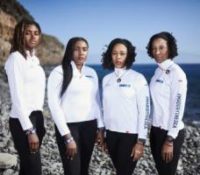
The Talisker Whisky Atlantic Challenge is billed as the world’s toughest row, 3,000 miles across the Atlantic from San Sebastian in La Gomera, Canary Islands, Spain to Nelson’s Dockyard, English Harbour, Antigua & Barbuda. This year an all-female Antiguan team made history by becoming the first all-women team to represent the island and as the first Black team to row across an ocean.
The Island Girls team; Elvira Bell, Christal Clashing, Kevinia Francis, and Samara Emmanuel; departed La Gomera on December 12 and arrived in English Harbour 47 days, eight hours and 25 minutes later, on January 28th. They placed 13th out of 28 teams competing. As of this morning, six boats are still at sea bound for Antigua.
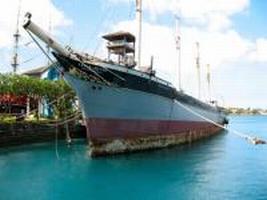
Even though it was expected, it still comes as a shock. Yesterday, the Hawaii Department of Transportation (HDOT) Harbors Division filed a public notification that the historic windjammer, Falls of Clyde, is being offered for sale by auction.
Those who wish to bid on the ship must post a performance bond in the amount of $1.5 million guaranteeing removal of the vessel from Honolulu Harbor within 60 calendar days from the bill of sale. The 280 foot long, iron-hulled, four-masted ship will be available for inspection to potential bidders on February 15. Sealed bids are due by 11 AM on February 28th. The winning bidder will be announced later that day. If no bids are received the State reserves the right to sell the ship by negotiation, to scrap it or to dispose of it by any other legal means.
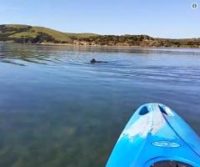
Did you, by any chance, lose a USB memory stick while kayaking sometime before November 2017, near Oreti Beach in Invercargill, a city on the southern tip of New Zealand’s southern island? If you did, the memory stick has been found and it is still functioning. There are some nice photos and video footage of sea lions and a kayak. The finders are willing to return the stick to you in exchange for some leopard seal poop. And no, I am not making this up.
Several weeks ago, researchers in New Zealand were analyzing a pile of leopard seal poop. (Note to self, be very grateful that I don’t have that job.) Buried in the poop was a USB memory stick.
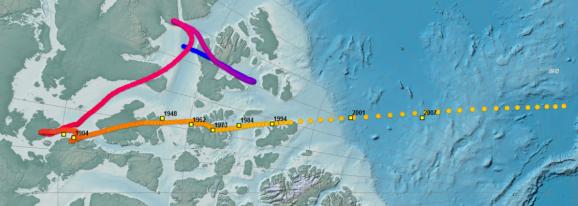
Recently, the media has somewhat breathlessly reported that the usually slow drift of the magnetic north pole has sped up dramatically. My favorite headline is from NPR which reads, “As Magnetic North Pole Zooms Toward Siberia, Scientists Update World Magnetic Model.” Is the magnetic pole really zooming?
Where magnetic north had been moving at an average speed of around 9 miles per year for some time, it has recently sped up to 34 miles per year. The increase was significant enough require a revision to the World Magnetic Model, (WMM) maintained jointly by the UK and the US. The model is typically updated every five years but was given a quick tweak recently to account for increased motion.
While the increased motion is notable, to say that it is zooming is more than a bit hyperbolic. Even at 34 miles per year, the rate of drift is still ten times slower than the speed of an average garden snail. So call it a very slow zoom.
According to a saying often attributed to Mark Twain, “History may not repeat itself. But it often rhymes.” This came to mind recently when posting about the sad state of the windjammer Falls of Clyde, which recently nearly sank at the dock in Hawaii. In addition being the last surviving iron-hulled, four-masted full-rigged ship, the Falls of Clyde is also the only remaining sail-driven oil tanker.
After an almost 30-year career carrying general and bulk cargos around the world, in 1907, the Falls of Clyde was converted into a tanker by Standard Oil, one of the firm’s 16 sail driven tankers. The Falls of Clyde would operate as a tanker carrying oil to Hawaii and molasses to California for another twenty years until 1927.
Why a sail-powered tanker? The economics made sense. Sailing ships cost less to operate than motor ships of the day.
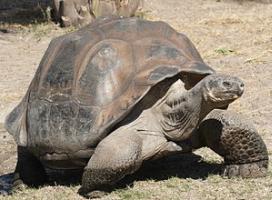
For the first time in 150 years, baby giant tortoises have been born on the Galapagos island of Pinzón. Biologists reported that they had observed ten tiny, newly hatched saddleback tortoises on the island early last month. They commented that there may be many more because their size and camouflage makes them hard to spot. The discovery indicates that the giant tortoise is once again able to reproduce on its own in the wild.
In the 1600s, there were an estimated 250,000 giant tortoises on the islands of the Galapagos archipelago. Indeed, around 1535, Bishop Tomás de Berlanga christened the islands, Galapagos, an archaic Spanish word for turtle or tortoise. By the 1970s, the number had dropped to only around 3,000, accompanied by predictions of the extinction of the tortoises which had given the islands their name.
We are a few days late in wishing the iconic cartoon character, Popeye the sailorman, a happy birthday. (Frankly, I am not sure how one sends birthday wishes to a cartoon character, in any case.)
Popeye first appeared on January 17, 1929, as a bit player in E.C. Segar’s comic strip “Thimble Theatre” in the New York Journal-American newspaper. He turned out to be highly popular and a few years later was given his own comic strip.
Exactly How Old is Popeye?
Popeye the sailor made his comic strip debut 1929, however, according to the artist, when he was created the character was 34 years old, born in a typhoon in Santa Monica, California. So, does that make him 90 or 124? Your choice.
Who Inspired Popeye and OliveOyl? Continue reading
We recently posted an incomplete list of some of the great things that the US Coast Guard was doing while not getting paid during the government shutdown. One of the missions was the resupply of the US McMurdo Station in Antartica by the US heavy icebreaker USCGC Polar Star. The Polar Star broke through ice as thick as 21 feet to clear a path to allow a resupply ship to get to the outpost. This is the sixth year that the Polar Star has successfully undertaken the mission, dubbed Operation Deep Freeze.
Unfortunately, after 43 years of demanding and often brutal service, the Polar Star is continually breaking down. Only the hard work, skill, and ingenuity of the 141 officers and crew keep the old ship going.
More bad news for the Falls of Clyde. The 1878 built windjammer, the last surviving iron-hulled, four-masted full-rigged ship, recently came close to sinking at the dock in Honolulu, Hawaii. On Thursday, the ship began taking on water by the bow, at Pier 7, where it has been docked for over a decade. The State Department of Transportation dispatched contractors with pumps and divers to attempt to stop the ship from sinking. Divers located and repaired four or five open seams through which the water was flooding.
HawaiiNewsNow.com reports: “I was here on Saturday and the vessel was laying flush like this here. When I got here this morning the whole bow was tilted forward,” said Ken Otebo, who was contracted to transfer water off of the ship onto his boat, the SOS Minnow. By 1 p.m. he said 60,000 gallons had been removed ― with plenty more to go.
For the “blue water” Navy veterans suffering from the effects of Agent Orange from their service in Vietnam, a federal appeals court in Washington has done what the politicians have refused to do.
As reported by the Washington Post: The U.S. Court of Appeals for the Federal Circuit ruled overwhelmingly for these sailors, finding they are eligible for the same disability benefits as those who put boots on the ground or patrolled Vietnam’s inland rivers.