The Manchester Ship Canal, from Liverpool to Manchester, was built in 1894 and was once large enough to serve any ocean-going ship. Now a new container barge service is operating on the canal, saving on costs and cutting carbon emissions.
 In 1914, the opening of the Panama Canal shortened the distance by sea between the Atlantic and Pacific Oceans by almost 7,000 miles, eliminating the need to round treacherous Cape Horn. One hundred years later, in 2014, a new third set of locks will be opened and the two other locks will be widened and deepened, allowing twice as much cargo to pass through the canal each year. The impact of this expansion is been widely discussed andyet no one will really know who will benefit the most until after 2014. The new canal locks will allow ships 25 percent longer, 50 percent wider and with drafts up to 50 feet to transit. Currently a “Panamax” containership can typically carry roughly 5,000 twenty foot containers. After the expansion, ships carrying up to 13,000 containers should be able to transit the locks.
In the mean time, yesterday, the New York Times featured panoramas of the current locks and of the construction. Definitely worth a look.
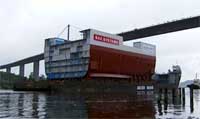 I am glad that I am of the age to have seen ships constructed the old fashioned way. Not all that long ago, shipyards still built ships from the bottom up. The shipyard first fabricated the double bottom sub-assemblies and then started adding framing blocks and so forth. When the hull was fabricated, assemblies welded and painted, they launched the ship down the ways into the water with a satisfying splash, using technology that had been first developed by the ancient Egyptians.
A recent article reminded me of how much things have changed. Ships are now built in large sub-assemblies, welded into blocks, and then the blocks are welded together in drydock. In the case of the new British aircraft carriers, HMS Queen Elizabeth and HMS Prince of Wales, the construction blocks will be fabricated at seven different shipyards. Recently the “lower block three” of HMS Queen Elizabeth, 8,000 tonnes of steel, piping, cable and other outfitting was towed from BAE Systems shipyard on the Clyde in Govan in Glasgow, on its way Rosyth on the Forth, 600 miles away, for final block integration and assembly.
The new British carriers will each cost a budget-busting £2.6bn (US$4.3 billion.) That is still less than half the cost of the USS Gerald R. Ford, the new US carrier under construction, which is estimated to cost US$ 9 billion or US$14 billion if research and development costs are included.
Assembly to Begin on Britain’s Biggest Warship
Continue reading
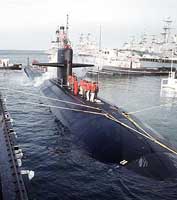 The most interesting question about the recently revealed cheating scandal on personnel training exams on the nuclear-powered fast attack submarine, USS Memphis, is whether the cheating was an isolated case or whether the practice is more widespread. The Navy says the former is the case while officers and sailors interviewed by the Associated Press disagree.
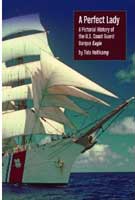 Having recently visited the USCG Cutter Barque Eagle, I can wholeheartedly agree with the title of Tido Holtkamp’s book, A Perfect Lady: A Pictorial History of the Coast Guard Barque Eagle, which has recently gone into its second printing. The ship is indeed a perfect lady. Holtkamp has far more experience with the ship than most. He sailed on her as a cadet when she was the Segelschulschiff Horst Wessel, a German school ship training German naval cadets, just as the Eagle is used to train US Coast Guard cadets today.
Tido Holtkamp tells tales of days when the Eagle, “America’s Tallship” was a Nazi naval ship named Horst Wessel.
Continue reading
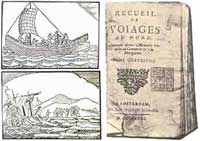 On August 15th, 1653, the Dutch East India Company ship, Sperwer (Sparrow Hawk), was shipwrecked on Jeju Island off the southern coast of Korea. Thirty six of the sixty four crew survived. One of the survivors was the ship’s book keeper, Hendrick Hamel. The surviving crew was brought to Seoul and presented to the court of the king, Hyojong of Joseon. The Joseon dynasty was often referred to as the “Hermit Kingdom” for its harsh isolationism and closed borders. The shipwrecked Dutchmen were given some freedom of movement, but were forbidden to leave the country. After thirteen years in Korea, Hamel and seven others escaped to Japan. They were finally able to reach the Netherlands in 1666. On his return, Hamel published an account of his time in Korea, the first European account of Korea and the Joseon dynasty.
Coincidentally, in addition to the wreck of the Sperwer, August 15th is an important date in Korean history. On August 15, 1945, Japan surrendered, ending World War II in the Pacific. Also on August 15th, 1948, the Republic of South Korea was established.
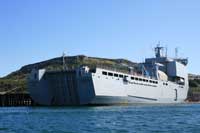 In May, we posted about the death of Claude Choules at 110. Choules was the last surviving veteran of World War I. Yesterday, Australian Prime Minister Julia Gillard announced that the ex-Royal Navy Largs Bay, a Bay class landing ship dock, would be commissioned as HMAS Choules. The Largs Bay served with the Royal Fleet Auxiliary (RFA) from 2006 to 2011 until she was sold to Australia earlier this year. Mr. Choules, like the ship named in his honor, served in both the Australian and the Royal navies.
Ex RN ship to be named after last WWI vet
One wonders how Mr. Choules might has responded to the honor. As reported by the BBC,” … despite his military record, Mr Choules became a pacifist. He was known to have disagreed with the celebration of Australia’s most important war memorial holiday, Anzac Day, and refused to march in the annual commemoration parades.”
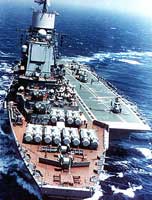
Admiral Gorshkov prior to conversion
We recently posted about the Chinese conversion of the Russian aircraft carrier Varyag. China is not the only country looking to surplus Russian aircraft carriers to expand their naval power. India purchased the surplus carrier, Admiral Gorshkov, from the Russians in 2004. The ship was notionally free and upgrades and refurbishment were expected to cost $947 million. The ship was supposed to be delivered to the Indian Navy in 2008. The ship, to be renamed INS Vikramaditya, still has not been delivered and the cost has risen by a factor of three to $2.9 billion. The ship is now expected to go into service in 2012.

This may be the tiniest sea monster, a hydrothermal worm, a deep sea creature, almost as small as bacterium found near hydrothermal vents in the ocean. Here is the “worm from hell” viewed close up with an electron-microscope. Click on the image to see a larger view.
Hydrothermal Worm Viewed Under An Electron Microscope

Neptune Photo:NASA/JPL
On Sept 23-24, 1846, the planet Neptune was discovered by by Johann Gottfried Galle. In celestial terms, that was 165 years ago. In terms of Neptune’s path around the Sun it was only about one year ago. (To be precise, on July 12th, Neptune completed one full circuit around the Sun since its discovery.) So Happy Birthday Neptune. We can celebrate Neptune’s second rotation since discovery in 2176. I can hardly wait.
 Last week, a bright orange jelly or “goo” floated up on the beaches of Kivalina, a remote Alaskan village of just over 400 residents. Now scientists at the National Oceanic and Atmospheric Administration have determined that the goo is not man-made but rather millions of microscopic invertebrate eggs, filled with fatty droplets. Experts are guessing that they are from some sort of crustacean, but so far have been unable to identify which species of invertebrate laid all the eggs or whether the mass of eggs will prove harmful to the village water supply or impact local fishing.

Edward Bulwer-Lytton
The Bulwer-Lytton Fiction Contest is an annual tongue-in-cheek contest, sponsored by the English Department of San Jose State University in San Jose, California. Entrants are invited “to compose the opening sentence to the worst of all possible novels.”
Edward Bulwer-Lytton was an English playwright and novelist who had a knack for coining memorable phrases. He wrote, for example, “the pen is mightier than the sword,” “the almighty dollar,” and “the great unwashed.” He may be best remembered however for the first sentence of his 1830 novel, Paul Clifford, which begins, “It was a dark and stormy night…” which inspired the contest which bears his name.
There is no category for nautical fiction in the contest, but several winning entries this year have a nautical theme:
Continue reading
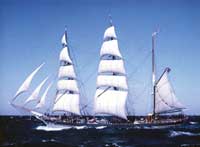 The barque Elissa is one of the true ship restoration success stories. The ship was rescued from near oblivion and restored at considerable cost by a dedicated group of volunteers. She has been well maintained in Galveston and has been taken on yearly sails, a remarkable achievement in its own right for a ship built in 1877. Nevertheless, earlier this month, the US Coast Guard determined that due to corrosion in the hull plates, the ship was no longer seaworthy. What happened?
Continue reading
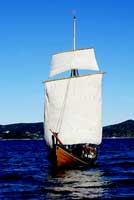 The Viking longboat replica, Dragens Vinge, is reported to have broken up in a gale while on a voyage from Norway to Lerwick. The crew was rescued by helicopter fifty miles 50 miles east of Shetland after they activated the Emergency Position Indicating Radio Beacon (EPIRB.)
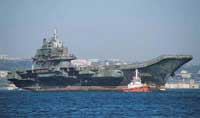 In May, we posted about what appears to be the deck of an aircraft carrier built onto the top of a government building in China (China takes a Great Leap Forward in the Concrete Carrier Arms Race.) Some speculated that it was for pilot training for a then unannounced Chinese aircraft carrier, the first in their fleet. Then in June, Gen Chen Bingde, head of China’s General Staff of the People’s Liberation Army confirmed that China’s first aircraft carrier is under construction. Today the carrier to be named, Shi Lang, sailed on sea trials. The Shi Lang is not, however, a new ship.
Continue reading